
Experienced Attorneys Protecting the Rights of the Neglected and Abused
The Nursing Home Law Center is committed to providing the legal resources necessary to hold negligent facilities accountable.

Nursing home wrongful death settlements provide financial relief when a resident dies due to the nursing home’s negligence, abuse, or neglect.
Wrongful death in nursing homes and assisted living facilities is often preventable, since staff is responsible for daily monitoring, proper care, medication management, and responding quickly when a resident’s health declines.
A nursing home wrongful death claim may involve pressure wounds, sepsis, choking accidents, broken hips, medication errors, dehydration, malnutrition, falls, or untreated infections that ultimately lead to a resident’s death. These cases are especially serious when they involve vulnerable residents suffering from dementia, mobility limitations, or chronic conditions that require closer supervision and care.
Settlement value depends on how the nursing home failed the resident, whether nursing home staff ignored known risks, and how the loss affected surviving family members emotionally and financially.
Our nursing home wrongful death lawyers review medical records, incident reports, staffing logs, and facility history to determine whether nursing home abuse or negligence caused the resident’s death. If our investigation shows that the facility provided substandard care, we can help you file a nursing home wrongful death lawsuit and pursue the financial relief your family deserves.
Contact us for a free case evaluation.
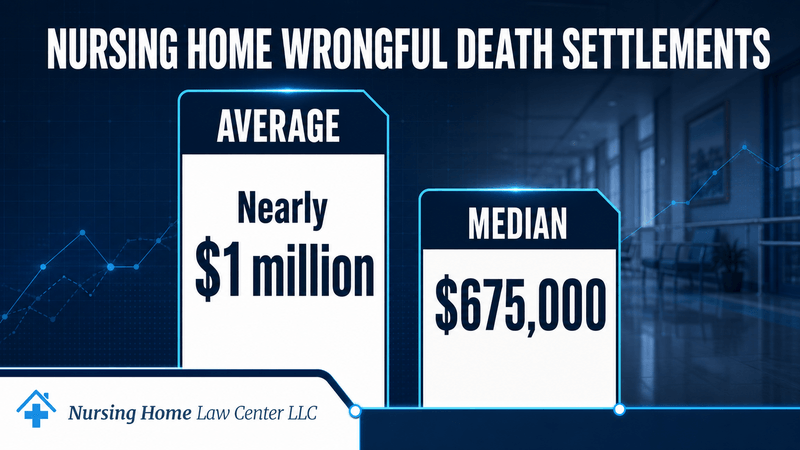
The national average for nursing home lawsuit settlements for cases involving wrongful death are around $900,000, though settlement amounts vary widely based on the facts of each case. The median settlement is much lower, at $675,000, since a smaller number of very high-value settlements pull the average settlement upward. In rare cases, punitive damages may be awarded, driving the settlement amounts higher.
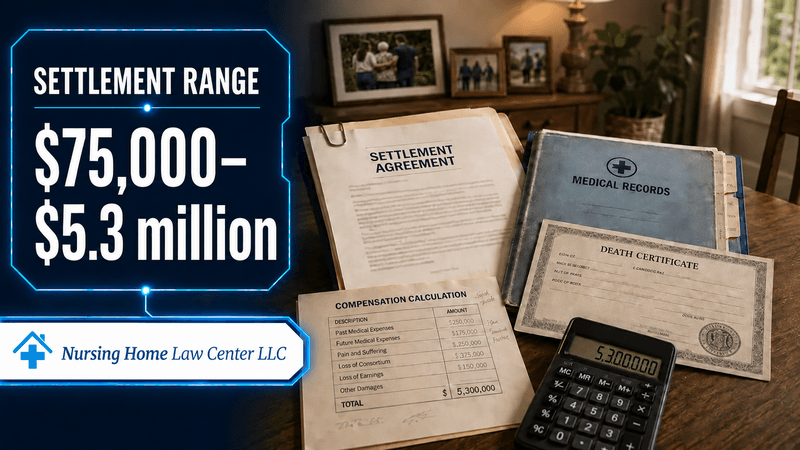
In general, nursing home negligence cases involving fatality settle anywhere from $75,000 to $5,300,000.
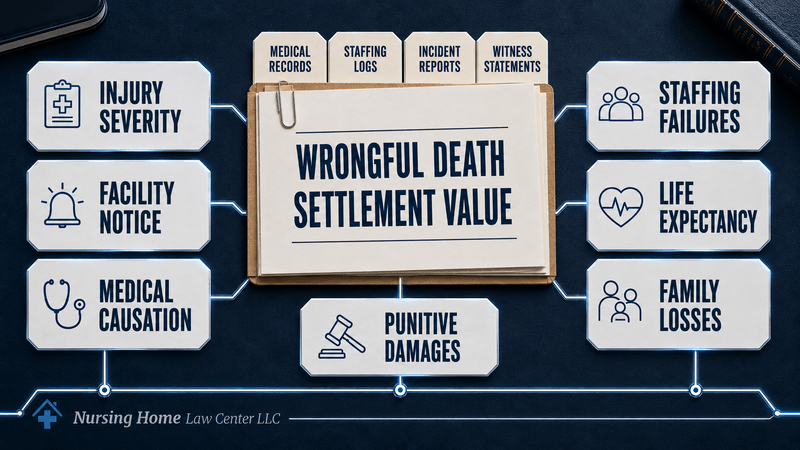
The value of a nursing home lawsuit depends on the specific circumstances that led to the resident’s death. Lower-value cases may involve a shorter life expectancy or fewer damages tied to the resident’s passing. In contrast, higher-value nursing home negligence settlements often involve preventable death from sepsis, pressure wounds, or choking accidents.
Settlement value also depends on whether the facility had prior notice of the risk. Incident reports, staffing records, medical treatment history, and witness statements showing that the staff ignored warning signs can strengthen a wrongful death claim and support higher financial compensation. In cases involving gross negligence or intentional misconduct, punitive damages may drastically increase the total settlement value.
The nursing home neglect cases below show how a facility’s understaffing, delayed care, or lack of supervision contributed to the resident’s death, as well as how outcomes and nursing home lawsuit settlement values can vary from case to case.
An 82-year-old woman was placed in a Texas nursing home while recovering from a hip implant. Her physician ordered her to be repositioned every two hours. Staff failed to follow this order, and she developed severe bed sores and suffered from malnutrition and dehydration. She was removed from the facility, but died shortly after.
Her family pursued a Texas nursing home lawsuit settlement alleging understaffing and failure to meet her needs promptly. The Texas nursing home abuse lawyers who pursued this claim also cited the disregard of care orders.
An 88-year-old resident of a California nursing home with dementia fractured her hip after she was stalked and knocked down by another resident with early-onset dementia and a known history of aggression. Staff failed to separate the two, and she suffered abuse once again before paramedics arrived.
After hip surgery, she returned to the facility still unsteady, but staff left her unattended, leading to a second fall that refractured the same hip. She became immobile, stopped eating, and died two months later.
The Oakland, CA, nursing home abuse attorneys who represented the estate of the woman and negotiated this California nursing home abuse settlement pointed to ignored staff complaints about the assailant as a key factor.
A 73-year-old resident in a Florida nursing home recovering from surgery and partially paralyzed was found covered in ant bites after a longstanding fire ant infestation went unaddressed at his facility. He died about 40 hours later from shock caused by the ant venom.
The Florida nursing home negligence settlement argued the facility failed to protect residents from a known issue.
An 86-year-old patient with dementia developed severe bed sores, sepsis, dehydration, and malnutrition over 14 months in care of a Mississippi nursing home.
Her estate representative alleged the facility falsified care records and was understaffed below state minimums, and that it had previously been cited for failing to treat bed sores in other residents. Lawyers obtained this nursing home pressure injury settlement after arguing this pattern of neglect caused her suffering and death.
A man was found unresponsive at his Tennessee nursing home after paramedics suctioned large pieces of food from his airway. He was pronounced dead a few hours later due to asphyxiation. To obtain this Tennessee nursing home neglect settlement, his family’s lawyer argued he was left unsupervised despite dietary orders and that the facility was understaffed.
A 96-year-old woman with dementia was admitted for rehabilitative care in a Los Angeles nursing home, while bedbound with an existing deep tissue injury on her tailbone. Staff failed to reposition her as her care plan required, and the wound progressed to a Stage 4 pressure sore requiring a catheter, which led to repeated urinary tract infections.
The nursing home bedsore attorneys who reviewed this case noted that missing repositioning records and expert testimony calling the injury preventable increased its settlement value.
An 84-year-old resident of a Pennsylvania nursing home was being transported by van after a medical appointment when she fell out of her wheelchair, suffering spinal injuries. She died several weeks later after her condition progressed to a stroke.
Her estate filed a nursing home wrongful death lawsuit alleging staff failed to secure her wheelchair and did not call for emergency help immediately. The team’s delayed response was a key factor in this Pennsylvania nursing home negligence settlement.
A 57-year-old resident of an Illinois nursing home choked to death while eating dinner in a nursing home, unsupervised despite requiring a mechanical-soft diet. A nursing assistant attempted the Heimlich maneuver, but no other staff members responded to the call light before he died.
His Chicago nursing home choking lawyer argued that understaffing and poor training caused the death.
A 71-year-old Illinois facility resident with a history of stroke and partial paralysis required ongoing catheter care after being admitted for urinary tract infections. Staff failed to monitor or change his catheter for the duration of his stay, and he also lost significant weight after going unmonitored at mealtimes. He developed sepsis and died.
Staff falsified records to make it appear he had been examined daily, which was key in this nursing home sepsis settlement.
An 88-year-old patient with Alzheimer’s and dementia was a known high fall risk in a Grand Rapids nursing home. Yet, she was left unattended, suffering two falls within four days. The first caused facial fractures when he struck a toilet. The second, during a transfer, caused a subdural hematoma, more facial fractures, and lacerations. He died days later.
The Michigan nursing home abuse lawyers noted a state investigation into care violations and based this Michigan nursing home neglect settlement on understaffing.
A 79-year-old resident recovering from heart surgery was mistakenly given an insulin injection that caused her to become hypoglycemic in a New Jersey nursing home. She went into cardiac arrest, was placed on life support, and died a week later.
Her estate filed a nursing home wrongful death lawsuit alleging the medication caused her death, though the facility denied any injection was administered. Expert testimony ruled out other causes for her arrest and helped secure this New Jersey nursing home negligence settlement.
An 83-year-old woman was admitted to a nursing home in Montgomery, AL, following hip surgery with an early-stage bedsore on her tailbone already being treated. The wound progressed to yellow slough, foul odor, and necrotic tissue before a physician was consulted, and she died of sepsis shortly after transfer to the hospital.
Her estate filed a wrongful death lawsuit with an Alabama nursing home neglect lawyer. The Alabama nursing home neglect settlement was obtained after the director’s admission that the wound shouldn’t have progressed so severely.
An 81-year-old man with dementia and diabetes developed severe pressure ulcers on his heels and sacrum while residing in a New York City nursing home. The wounds became infected and gangrenous. His leg required amputation, and he died shortly after.
The New York nursing home bedsore attorneys appointed to this case alleged staff failed to monitor and treat the wounds, manage his diabetes, and provide adequate nutrition and hydration.
An 81-year-old resident with Alzheimer’s was admitted after hip surgery and lost nearly 25 pounds over several months in a Missouri nursing home. Staff also failed to ensure she received prescribed antibiotics for a respiratory infection. She was transferred to a hospital with sepsis, dehydration, pneumonia, and a urinary tract infection, and died two days later.
Her estate filed a nursing home wrongful death lawsuit alleging failure to feed her and administer medication. The Missouri nursing home neglect settlement was obtained once it was established that her decline was preventable.
A resident developed a sacral pressure ulcer that progressed to Stage IV while under the care of a Virginia nursing home. She was transferred between multiple hospitals for treatment before dying of renal failure related to the untreated wound.
An 85-year-old resident with end-stage cancer suffered an unwitnessed fall that caused superficial injuries in a Massachusetts nursing home. Despite his ongoing mobility problems, no additional safety measures were put in place, and he suffered a second fall days later, fracturing his neck. He died three days afterward.
The Massachusetts nursing home neglect settlement was obtained after the facility should have anticipated the second fall.
A 40-year-old resident with severe intellectual disability and pica ingested a metal nut and a piece of rolled shoe leather while under residential care in an Ohio nursing home, causing a bowel obstruction, bowel perforation, and sepsis that led to his death.
His estate filed a nursing home wrongful death lawsuit alleging staff failed to adequately supervise him and prevent access to hazardous objects despite his known condition. The Ohio nursing home neglect settlement was obtained once it was established the facility didn’t follow precautions to reduce his known risk of harm.
A 75-year-old resident of a South Carolina nursing home developed bedsores that progressed to sepsis, and ultimately led to his death.
His family alleged the facility failed to turn and reposition him, monitor for skin breakdown, and treat his wounds properly. The South Carolina nursing home neglect settlement was limited by the facility’s self-insured status and its denial of any breach in care as reasons the case settled for a modest amount.
Nursing home wrongful death often results when a facility fails to match a resident’s care needs with the level of supervision and treatment required to keep them safe.
Some residents cannot reposition themselves and develop bed sores. Some have swallowing difficulties and require supervision at meals to prevent choking. Others have dementia, mobility limitations, or chronic conditions that raise their risk of falls or infection. In each situation, the facility is responsible for identifying the risk and providing adequate care before it turns fatal.
Common causes of nursing home wrongful death include inadequate staffing, poor training, missed care-plan updates, ignored warning signs in medical records, delayed physician involvement, and failure to respond quickly when a resident’s condition changes.
A nursing home’s negligence can also take the form of falsified incident reports, unaddressed hazards within the facility, or a pattern of citations for the same violations without any corrective action. These failures often compound over time, allowing a preventable injury to progress into a wrongful death case.
Wrongful death can also occur in an assisted living facility or a group home, where residents may need less hands-on care but still require monitoring for signs of decline. When an assisted living resident is admitted with known health risks, the facility must have systems in place to catch early warning signs and arrange medical treatment before the situation becomes life-threatening.

The warning signs that a nursing home resident is heading toward a fatal decline can be subtle, especially in residents with dementia or other cognitive impairment who cannot communicate their symptoms. Family members should watch for early signs and any sudden change in condition during visits.
Warning signs that may point to a decline leading to wrongful death include:
Many nursing home injuries can turn fatal when a facility fails to catch or treat them in time. Below are some serious injuries our firm most often sees across nursing home wrongful death cases.
A strong nursing home wrongful death lawsuit depends on medical records and facility documentation that show what the nursing home knew about the resident’s condition and how staff responded. The following records and evidence are often central to building a case for legal action.
The financial compensation available in a nursing home lawsuit depends on the facts of the case and applicable state law. Surviving family members may be able to recover:
A nursing home wrongful death lawsuit can only be filed by the personal representative of the resident’s estate, though the compensation recovered is meant to benefit surviving family members. State law dictates who qualifies to serve in this role and who is entitled to a share of the settlement.
In most cases, the estate’s executor, or an administrator appointed by the court if no will exists, must file the lawsuit on behalf of the family. Surviving spouses typically have the strongest legal standing, followed by adult or minor children who depended on the resident financially or emotionally. If the resident had no spouse or children, the right to file may pass to surviving parents, and in some states, to siblings or other dependents.
A wrongful death claim also follows different rules than a standard nursing home injury case, including strict deadlines and court approval requirements for how any settlement is distributed. Our nursing home wrongful death lawyers can help identify who has legal authority to file the claim and guide your family through the legal process from start to finish.
Every state sets its own statute of limitations for filing a nursing home wrongful death lawsuit, and these deadlines generally range from one to three years from the date of death, depending on the state. Some states also allow limited exceptions that can shorten or extend this window. Because evidence and witness memories fade quickly, families should contact a nursing home wrongful death lawyer as soon as possible to protect their right to seek justice and pursue financial compensation.
Before accepting any settlement offer, families should take steps to protect their legal rights and strengthen their nursing home lawsuit. This includes:
Most nursing home wrongful death lawsuits settle before trial, but reaching a fair settlement usually requires a thorough legal process that includes investigation, record review, and preparation for litigation if a resolution can’t be reached. Our nursing home neglect lawyers guide families through each stage of this legal process to hold the facility accountable, including:
Our nursing home wrongful death lawyers have recovered significant settlements for families across the country. Below are examples of past results in cases resulting in the resident’s death.
Our client’s father was a longtime nursing home resident whose sores went untreated for weeks despite visible signs of infection. The wounds progressed until sepsis set in, and he died shortly after.
The case centered on the facility’s failure to follow basic wound care protocols and notify the family as his condition worsened.
Denise’s husband was admitted to a skilled nursing facility for rehabilitation following hip replacement surgery. During his stay, he developed serious pressure sores that were not properly prevented, monitored, or treated.
The nursing home wrongful death claim focused on whether staff failed to reposition him and provide timely wound care before his condition became life-threatening, and the emotional toll on his family.
A Minnesota woman developed bed sores after being admitted to a nursing home for short-term care. The wounds were not caught early, and by the time staff sought treatment, infection had already spread. She died from sepsis related to the untreated wounds.
The case highlighted gaps in the facility’s monitoring and treatment records, along with delayed physician involvement, both of which increased the settlement value.
A nursing home resident with swallowing difficulties choked during a meal after staff failed to follow his prescribed dietary restrictions. No one intervened quickly enough to clear his airway, and he died as a result.
Our lawyers tracked internal records that highlighted the facility’s failure to accommodate his known risk of choking.
Robert was recovering from a stroke and could not safely chew or swallow solid food, yet nursing home staff gave him a hot dog in violation of his prescribed soft-diet orders. He struggled to clear his airway for over 30 minutes before staff responded, and paramedics were not called until three hours after the incident began.
He was pronounced dead at the hospital, and two staff members were terminated following the incident.
Harry was a resident at a national nursing home chain where staff failed to prevent a pressure sore from developing and did not notify the family of the wound. His condition deteriorated quickly, and he died from sepsis within 30 days of the sore’s formation.
The facility’s delayed communication and lack of preventive wound care were key factors in this settlement.
If your loved one suffered abuse, neglect, or fatal harm while in the care of a nursing home or assisted living facility, our legal team is here to help you seek justice and hold the facility accountable. Our nursing home neglect lawyers can review medical records, incident reports, and other evidence to determine whether the facility failed to provide the necessary care and whether your family may be entitled to financial compensation.
We understand the emotional toll when a resident dies from a preventable death, and we’re committed to holding negligent facilities accountable. Our nursing home abuse attorneys have experience handling wrongful death settlements nationwide.
Your family deserves justice and support regardless of your financial situation. We work on a contingency-fee basis, so you pay no attorney fees unless we recover compensation for your family. To speak with an experienced attorney about potential legal action, call (800) 926-7565 or complete our online contact form to schedule your free legal consultation today.