
Experienced Attorneys Protecting the Rights of the Neglected and Abused
The Nursing Home Law Center is committed to providing the legal resources necessary to hold negligent facilities accountable.

A group home is meant to provide supervision, assistance, and a stable living environment for vulnerable residents in a smaller community-based setting. When a resident is harmed in a place that was supposed to provide structure and safety, a group home abuse lawyer from the Nursing Home Law Center can look at what the home promised, what the resident needed, and where the system broke down. Contact us for a free consultation.
A group home is similar to a nursing home, but typically much smaller. It is ideal for those with disabilities, mental health conditions, or higher care needs. While nursing homes are designed for individuals who require constant care, group homes are often tailored to more independent individuals. They may still require daily living assistance, but their needs are not as great.
Group homes typically have a higher staff-to-client ratio than assisted living facilities. Individuals with disabilities or mental health conditions and elderly residents can find adequate care and independence in group homes.
Abuse in a group home can come in many forms, including:
Family members should know the signs and symptoms of abuse and neglect in a group home, which include:
Here are some common causes of abuse and neglect in group homes.
The healthcare industry at large struggles with understaffing. When there are not enough staff members in a particular group home, one resident could slip through the cracks and not receive proper care or supervision.
Even if a group home has enough staff, professionals must have proper training to provide services and medical treatment to residents. This is particularly true when working with adults or children with disabilities, such as autism.
Poor training could place residents in danger if they deal with serious injuries or have high care needs. For example, if staff are not trained in how to move a resident from the bed to the chair, they could drop the resident and cause significant bodily harm.
More vulnerable adults are more likely to be victims of abusive behavior. Those with physical or intellectual disabilities may not be able to defend or advocate for themselves, making them easy targets. These residents are less likely to report incidents to administrators. As a result, group homes with higher numbers of impaired residents face additional risks.
Just as patients must be supervised by staff to ensure their needs are met, staff members must be overseen by supervisors to ensure they follow safe practices. The lack of oversight can result in staff cutting corners when providing services. If there is no accountability when incidents do occur, the abusive individuals can continue to behave poorly.
Group home cases are usually built on state law. Licensing rules, resident-protection statutes, contract duties, and ordinary negligence law tend to carry most of the weight.
While there is no single federal law that regulates every group home nationwide the way federal law regulates certified nursing homes, when a group home operates in a Medicaid-funded home- and community-based setting, federal HCBS rules (CMS-2249-F/CMS-2296-F) require more than basic shelter.
The setting must support privacy, dignity, respect, and freedom from coercion and restraint. In provider-owned residential settings, those protections can extend to everyday conditions that should not be treated as optional, such as visitors, control over schedules, access to food, and living space with real privacy protections.
Some group home cases turn to the ADA or Olmstead, based on which public systems cannot push people with physical or developmental disabilities into unnecessary segregation when community-based services are appropriate.
Our group home abuse attorneys will thoroughly investigate the facts of your case to determine the best course of action.
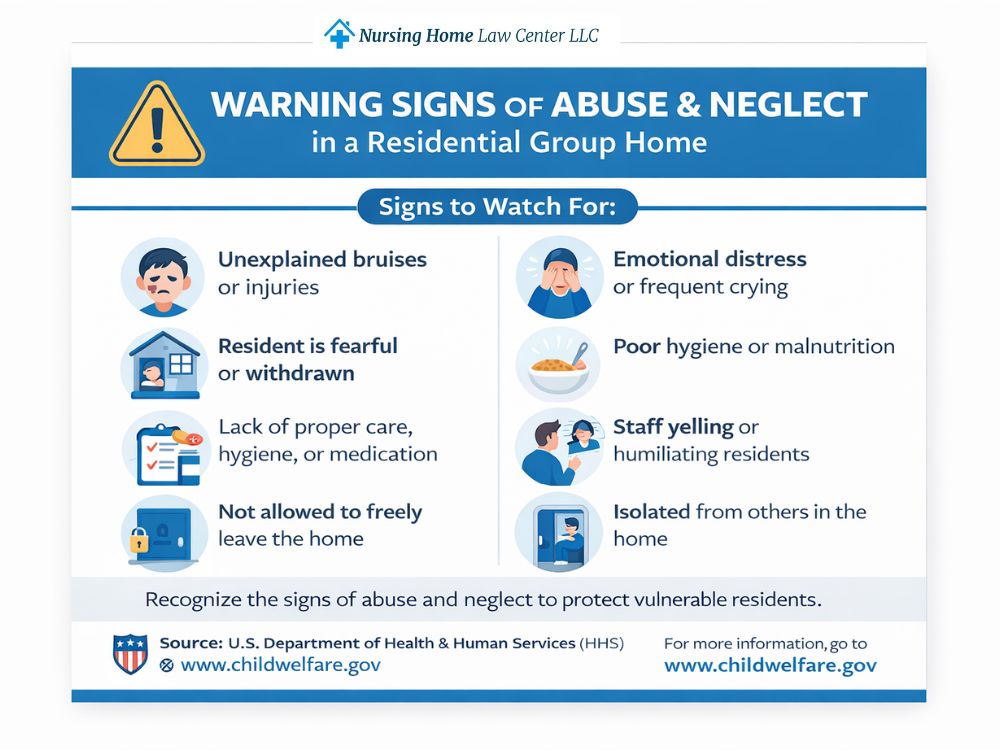
Here are the steps to take if you suspect abuse in a group living facility:
A group home neglect attorney from our team can help you build a claim based on one or more legal theories, including:
Responsibility for abuse or neglect in a group home does not always stop with the person who caused the immediate harm. Our group home negligence lawyers look at the following potentially liable parties:

A group home abuse attorney from our team will look at the full impact of what the abuse or neglect costs the resident and the family. This includes:
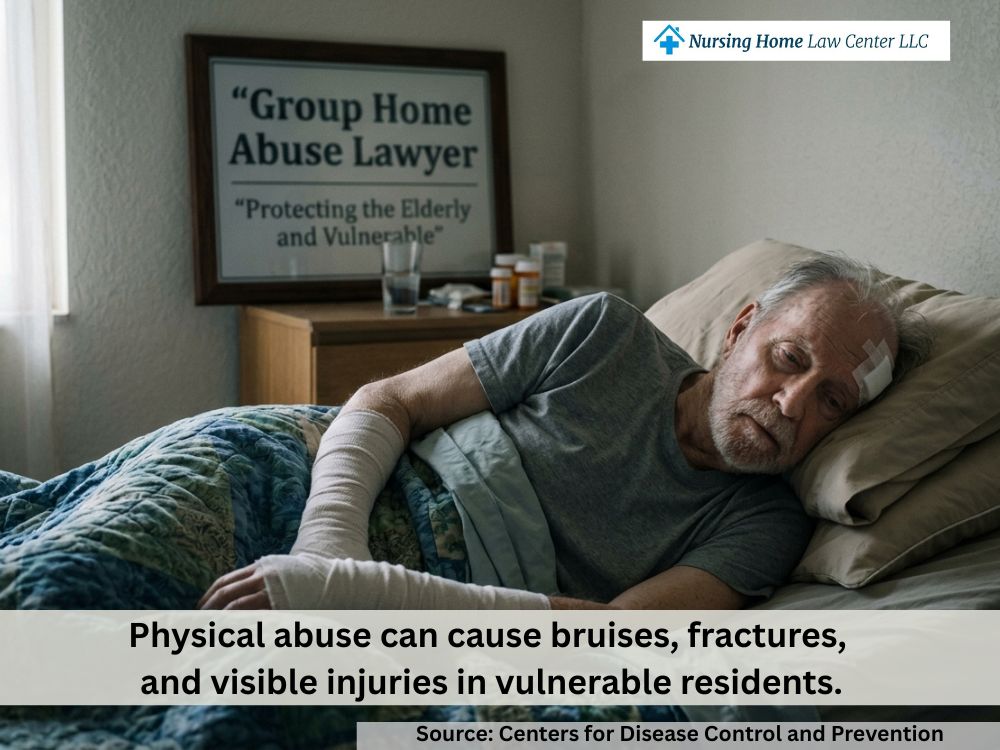
Nursing home and group home abuse can result in significant harm. They may suffer serious injuries, infections, worsening conditions, or even death if a staff member behaves negligently. Here are a few strategies for preventing abuse and neglect in a nursing home or group home setting.
For a healthcare professional to provide adequate care to a resident, they must be thoroughly vetted by the group home. This typically includes background checks and in-depth screening to weed out unqualified or dangerous applicants. If you are helping a loved one move into a group home, research the facility to ensure your family member is placed in a safe environment.
Care standards are not static. They often change to adapt to new research. As a result, the most effective group homes prioritize ongoing training and education for their staff.
These caregivers should consistently learn about the latest healthcare methods and standards to ensure they provide residents with the highest level of care. Additionally, all staff should be trained to prevent, recognize, and report abuse.
Since many group homes are owned and operated locally, oversight and monitoring could be an issue. They may not have inspections scheduled by state agencies as often as larger organizations that run multiple nursing homes.
For a group home to be safe, it must be regularly inspected to ensure all facilities and staff protocols are up to standard. Monitoring practices must be enforced to supervise residents and staff throughout the day. Resident advocates should be on-site frequently.
Moving a loved one or yourself into a group home is a big decision. Many of the residents in these environments are particularly vulnerable to abuse or neglect, especially those with physical disabilities or cognitive impairments. An abusive situation can cause injury, illness, or death.
If you or a loved one has suffered abuse in a group home setting, you may have grounds for a lawsuit to recover compensation for legal damages. If you win your group home abuse case, you could receive a settlement to pay for losses like medical bills, emotional distress, physical pain and suffering, or loss of enjoyment of life.
The Nursing Home Law Center team is ready to support you through this legal process. Our team knows what it takes to win a group home abuse case. Our process involves a thorough investigation to uncover evidence of your suffering and proof of wrongdoing by the group home staff.
Our law firm will assess all damages to ensure the settlement adequately covers your losses. An experienced attorney will then negotiate with the insurance company or group home for fair compensation. If your case goes to trial, we will represent your interests throughout the proceeding.
Call the Nursing Home Law Center today at 800-926-7565 or complete the online form to find out how we can help you protect your loved one’s civil rights.
The statute of limitations depends on state law, the type of claim, and the resident’s condition. Wrongful death claims may follow a different timeline as well. Because these limits can cut othe way federal law regulates certified nursing homesff otherwise valid legal options, we encourage families to consult a group home injury lawyer as soon as possible.
While victims and families can often file complaints on their own, an experienced lawyer can help identify the right claims, preserve records, and push to have the responsible parties held accountable.
Our law firm handles these cases on a contingency basis, which means the client does not pay anything up front. We collect fees that we will agree on up front only if we help you recover compensation.
According to OIG, 49 states had media reports of health and safety problems in group homes. As many as 99% of critical incidents were not reported to the appropriate law enforcement or state agencies.
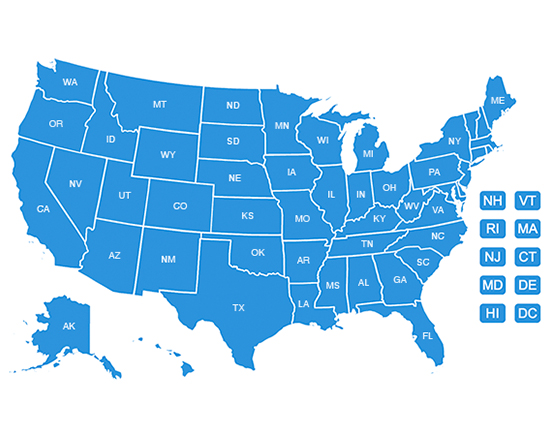
Nursing home abuse lawsuits must be pursued according to the laws set forth by the state where the facility is located. In this section, our attorneys have compiled the relevant laws, regulations and local organizations for each state so you can get an idea of how the law impacts your situation. Should you decide to move forward with a case, you will also find information about locating an experienced attorney who can assist your family.