
Experienced Attorneys Protecting the Rights of the Neglected and Abused
The Nursing Home Law Center is committed to providing the legal resources necessary to hold negligent facilities accountable.

Massachusetts nursing home lawsuit settlements provide financial compensation when a facility fails to give a resident proper care, prevent abuse, monitor changes in health, or respond to signs of neglect.
Cases of nursing home neglect and abuse often involve falls, pressure ulcers, medication errors, dehydration, malnutrition, physical or sexual abuse, financial exploitation, poor hygiene, broken bones, or wrongful death.
Massachusetts nursing home settlement value depends on the severity of the facility’s failures, whether staff members ignored known warning signs, and how the harm affected the resident and their family.
Our Massachusetts nursing home abuse attorneys review medical records, staffing logs, inspection reports, and state regulations to determine whether a facility can be held liable for the harm caused to your loved one. Contact us today for a free consultation.
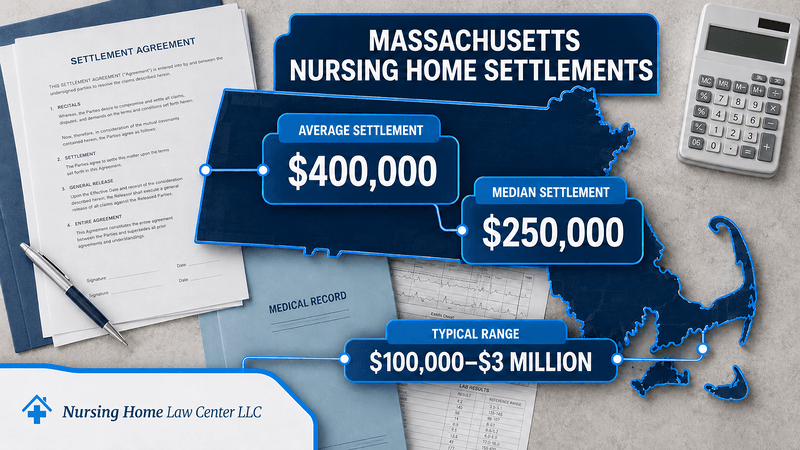
The average nursing home abuse settlement in Massachusetts is $400,000. However, the median settlement is $250,000, meaning half of all cases settle below this figure. Massachusetts nursing home settlements range from $100,000 to $3,000,000, with the average pulled higher by rare cases involving extreme abuse or severe, life-altering neglect.
Below are examples of past Massachusetts nursing home abuse settlements. They demonstrate the extent to which negligent facilities may be held financially liable for resident injuries and abuse.
An elderly nursing home resident was left unattended with food despite requiring supervised feeding and began choking. Staff failed to perform the Heimlich maneuver, the suction machine was broken, and no one knew where the defibrillator was stored. She was pronounced dead at the hospital. Her estate representative alleged understaffing, inadequately trained staff, poor equipment, and profit-driven neglect.
Billie, an 81-year-old resident with mobility problems, fell down a flight of stairs at her assisted living facility, fracturing her neck and suffering a brain hemorrhage. She fell into a coma and died 23 days later. Before the fall, her daughter had repeatedly asked staff to closely supervise her mother and move her to a first-floor room. Those written requests became important evidence of the nursing home’s failure to take reasonable steps to protect her despite the known risk.
An 88-year-old resident left her assisted living facility during a false fire alarm and was later found dead outside from hypothermia. Staff failed to verify that all residents returned indoors after the alarm. When pursuing the nursing home wrongful death settlement, plaintiff also alleged the nursing facility was negligent in not having an adequate plan for safety during a fire alarm.
A 95-year-old resident with Alzheimer’s disease and a documented history of more than 20 falls over six years fell from her wheelchair and fractured her femur after staff failed to provide a prescribed restraint cushion. She underwent hospitalization and open reduction with internal fixation but became bedridden and died three months later. The lawsuit also alleged the resident experienced neglect throughout her residency, with her repeated falls cited as evidence of inadequate supervision and poorly managed fall risk.
A 72-year-old dementia unit resident with 16 prior escape attempts left the facility through an unchanged keypad code and fell down an embankment. According to the nursing home elopement settlement case files, she suffered a fractured hip and hypothermia before being found by a security guard from a neighboring building.
An 82-year-old resident with dementia developed unexplained injuries and medical complications while residing at a nursing facility, including severe tongue swelling and swallowing difficulties requiring hospitalization, pneumonia, blisters and second-degree burns on her hand and foot, a fractured wrist, and a sexually transmitted infection. After evaluating her condition, physicians concluded she was abused. When negotiating the nursing home sexual abuse settlement, the family alleged the facility failed to properly supervise a known sexual predator who was temporarily housed at the same facility.
An 80-year-old resident fell from her wheelchair in front of an aide early in her stay at a care facility. She later developed severe dehydration and a urinary tract infection requiring nearly five weeks of hospitalization, then suffered repeated catheter failures. After returning to the facility, she fell again, striking her head, and died of a heart attack days later.
A 54-year-old Boston patient with severe multiple sclerosis, dementia, and depression was sexually assaulted by another resident with a mental illness at a nursing facility. Her mental deficits left her unable to describe the incident, and the accused resident died before he could be questioned.
An 87-year-old resident with mild Alzheimer’s and no wandering history left his facility and was found 36 hours later. Staff waited four hours before contacting authorities. He suffered a stroke and died days after being hospitalized. His family argued that the delayed search, inclement weather, and missed medications contributed to his death.
An 86-year-old resident at high risk for skin breakdown developed severe pressure ulcers after staff failed to follow his care plan. The bedsores progressed to stage 4, causing anemia and sepsis, and ultimately required a below-the-knee leg amputation.
An 87-year-old nonverbal resident with Alzheimer’s disease was allegedly shoved into a chair and later squeezed and shaken by a certified nursing assistant. Witnesses reported the physical elder abuse, which left her with visible injuries and emotional distress. The facility denied the allegations.

A Massachusetts nursing home abuse case value depends on the specific circumstances of the case. Below are the key factors that influence how much a claim may be worth.
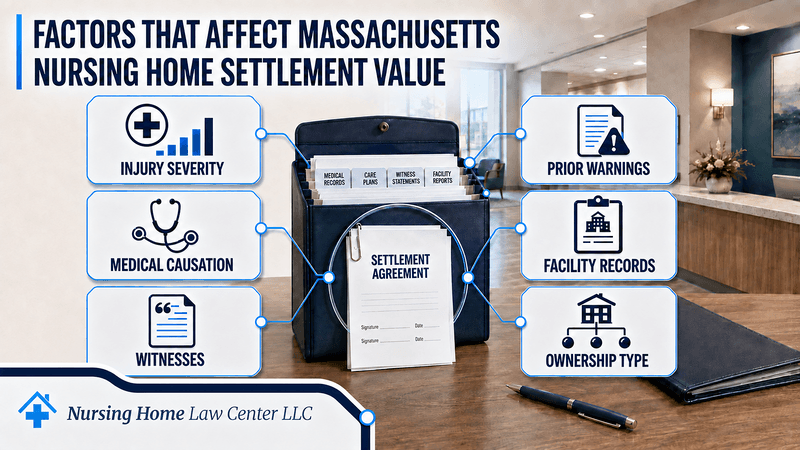
Compensation in a nursing home abuse case in Massachusetts depends on the injuries involved and whether the resident survived. Depending on the facts, recoverable damages may include:
Under Massachusetts General Laws Chapter 229, Section 2, punitive damages are available in nursing home wrongful death claims, but only when the death resulted from malicious, willful, wanton, or reckless conduct, or from gross negligence. Punitive damages are not available under Massachusetts personal injury law for claims where the resident survives. When punitive damages apply, the statute sets a minimum award of $5,000, with no fixed upper limit. Most nursing home cases still settle for compensatory damages, since proving intentional misconduct sufficient to justify punitive damages requires strong evidence.
A Massachusetts nursing home settlement can take anywhere from several months to a few years, depending on the case’s complexity. Straightforward claims with clear liability and cooperative insurers may resolve within six months to a year, while cases involving disputed facts, severe injuries, or wrongful death often take much longer.
The filing deadline depends on the type of Massachusetts nursing home claim being brought.
For most personal injury claims, Massachusetts law generally provides a three-year deadline for actions involving injury to the person under Massachusetts General Laws Chapter 260, Section 2A. Massachusetts courts have held that this period begins when the injury is discovered or reasonably should have been discovered, rather than strictly from the date it occurred.
For a Massachusetts nursing home neglect lawsuit involving a fatality, Chapter 229, Section 2 defines the deadline. It’s generally three years from the date of the resident’s death, or three years from when the estate’s personal representative discovered, or reasonably should have discovered, the factual basis for the claim.
Some nursing home abuse claims may instead fall under the medical malpractice statute of limitations, depending on whether the claim involves professional medical judgment or ordinary custodial care. If it involves professional medical judgment, such as a medication error or a missed diagnosis, Chapter 260, Section 4 generally applies, requiring the claim to be filed within three years, with an outer limit of seven years after the act or omission, except in cases involving a retained foreign object.
Claims based on ordinary negligence, such as understaffing or failure to supervise, may instead fall under the general personal injury deadline.
Because different deadlines apply to nursing home abuse and neglect cases, families should seek legal action as soon as possible. Waiting can make it harder to gather evidence, locate former staff members, obtain witness statements, and hold the facility accountable for the harm caused.
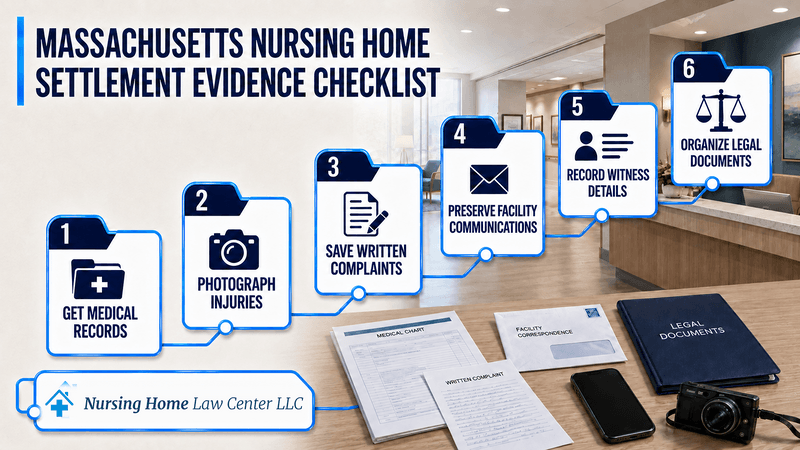
Before accepting any settlement offer, families should take steps to protect residents’ rights and strengthen their case. The following actions can help maximize the value of a Massachusetts nursing home settlement.
Most Massachusetts nursing home abuse lawsuits settle before trial, but reaching a fair settlement typically requires thorough investigation and negotiation with the facility’s insurer or defense counsel. Our process may involve the following steps.
Our nursing home abuse attorneys have fought for Massachusetts residents’ rights and recovered significant settlements in cases involving injury, neglect, and abuse.
Sharon entered a skilled nursing facility for rehabilitation after hip replacement surgery. Staff failed to reposition her regularly, and she developed severe, untreated pressure sores that led to her death. Our nursing home bedsore settlementnegotiations were based on the long-term care facility’s failure to follow her treatment plan and the preventable nature of her decline.
A certified nursing assistant, hired without proper background screening, sexually assaulted two female nursing home residents. Both women had cognitive impairments that left them unable to report the abuse, allowing it to continue undetected for months. Our nursing home sexual assault lawyers uncovered the facility’s hiring failures and its failure to protect vulnerable residents from a staff member it should never have employed.
Nancy’s father developed severe pressure sores during a short-term nursing home stay. Staff failed to follow his care plan, and the untreated wounds led to a fatal infection. To negotiate this nursing home sepsis settlement, we used her loved one’s medical records to document the rapid deterioration of his wounds and the gaps in his nursing care.
Barbara fell while unsupervised at her nursing facility, suffering a subdural hematoma and a hip fracture that required surgery. To negotiate this nursing home fall settlement, our legal team proved that she was a known fall risk who had been left unmonitored despite prior incidents.
Helen, a dementia resident, gained access to an unlocked storage closet containing cleaning chemicals and ingested them, resulting in her death. Our nursing home wandering lawyers established that the facility failed to secure hazardous materials in an area accessible to residents with cognitive impairment.
Edward, a group home resident, suffered repeated physical abuse from another resident after staff failed to intervene despite known conflicts between the two men. Our group home abuse lawyers collected statements from other residents who witnessed the incidents, proving that the facility failed to separate and supervise residents with a documented history of aggression.
Susan, a disabled nursing home resident, was injured during transport when facility staff failed to properly secure her wheelchair inside the transport vehicle. We showed that the van’s wheelchair restraints were never engaged and that staff had skipped the facility’s own pre-transport safety checklist before the vehicle left the parking lot.
If your loved one suffered harm in one of the worst-rated long-term care facilities in Massachusetts, contact us for a free case review. Our legal team can review the circumstances of your case, outline your legal options, and help you pursue compensation.
We work on a contingency-fee basis, meaning you pay no attorney fees unless we recover compensation for you. To speak with an experienced attorney, call (800) 926-7565 or complete our online contact form.
We represent clients and families throughout Massachusetts, including Cambridge, Lowell, Springfield, Worcester, and other communities. Whether your loved one was harmed through neglect, understaffing, or abuse, our attorneys are ready to review the facts of your case and guide you through every step of the legal process.