
Experienced Attorneys Protecting the Rights of the Neglected and Abused
The Nursing Home Law Center is committed to providing the legal resources necessary to hold negligent facilities accountable.

Before learning how to report nursing home abuse in Massachusetts, determine whether the resident is in immediate danger.
Call 911 when a loved one needs emergency medical care, may have been assaulted, or faces an urgent threat.
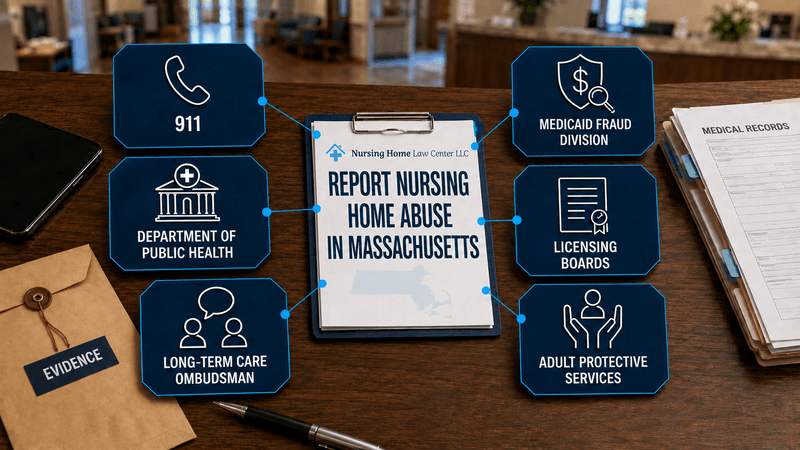
Serious nursing home abuse should be reported outside the facility. Families may need to contact the DPH, the police, the Long-Term Care Ombudsman, the Medicaid Fraud Division, or a licensing board. Reporting nursing home abuse can protect the resident and future residents.
A civil claim may help the resident and family recover compensation for the harm caused. Our Massachusetts nursing home abuse lawyers can investigate the facility, preserve evidence, identify responsible parties, and pursue damages for medical costs, pain, emotional distress, relocation, and other losses. We offer a free, confidential consultation, with no attorney fees unless we recover compensation.
Families may report nursing home abuse or neglect to several Massachusetts agencies. The contact depends on whether the concern involves facility care, an assisted living residence, Medicaid fraud, criminal conduct, or professional misconduct.
To report or avoid physical harm, call 911 when a resident faces immediate danger, serious injury, sexual assault, unsafe restraint, medical distress, elopement risk, or immediate jeopardy. Emergency help comes first.
Contact the police when suspected abuse may be criminal, including physical assault, sexual abuse, theft, intimidation, or deliberate withholding of medication. A police report preserves evidence if the facility changes its explanation.
The Massachusetts Department of Public Health is the primary agency for complaints about licensed nursing homes and rest homes. Its Division of Health Care Facility Licensure and Certification investigates complaints involving nursing home neglect, staffing, medication errors, falls, pressure injuries, infections, sanitation, delayed medical care, mistreatment, and nursing home regulations.
Report nursing home neglect through the DPH 24-hour Consumer Complaint Line at (800) 462-5540. The business-hours intake number is (617) 753-8150, and the fax number is (617) 753-8165. A Consumer, Resident, or Patient Complaint Form may be mailed to:
Division of Health Care Facility Licensure and Certification
Complaint Intake Unit
67 Forest Street
Marlborough, MA 01752
DPH advises against emailing protected health information. It also accepts complaints involving hospitals, home health agencies, or other health care facilities under its authority. Massachusetts law requires long-term care homes to meet care standards and respect the Patients’ Bill of Rights.
The state patient abuse law requires specified health care workers and facility personnel to report suspected abuse, mistreatment, neglect, or misappropriation of resident property immediately. An oral report must be followed by a written report within 48 hours.
The Massachusetts Long-Term Care Ombudsman Program helps nursing home residents, rest home residents, and assisted living residents with understanding their rights, care planning, discharge threats, visitation, retaliation, and unresolved care concerns.
Call (617) 222-7495 to speak with a Long-Term Care Ombudsman. An ombudsman can meet with the resident, review authorized records, and seek a resolution. The program is part of the AGE, formerly the Executive Office of Elder Affairs. Identifying information is generally protected.
The Massachusetts Attorney General’s Medicaid Fraud Division investigates MassHealth fraud and abuse or neglect in Medicaid-funded facilities. Contact it when a nursing home may have billed for services never provided, falsified records, diverted resident funds, or profited from inadequate care.
Call (617) 963-2360 or submit a Medicaid fraud complaint. Call 911 separately for immediate danger or criminal conduct.
Filing complaints with DPH addresses the nursing facility. Licensing complaints focus on individual nurses, physicians, or administrators.
Use the Board of Registration in Nursing complaint process for unsafe medication administration, falsified charting, failure to assess visible injuries, abandonment, impairment, or ignored changes in condition.
Call (617) 973-0800. The Board may investigate an anonymous written complaint at its discretion.
File physician complaints through the Board of Registration in Medicine’s online complaint system or call (781) 876-8200. Report ignored infection symptoms, failure to evaluate unexplained injuries, improper restraints, delayed hospital transfers, or other substandard medical care. The Board may investigate anonymous complaints at its discretion.
The Board of Registration of Nursing Home Administrators accepts complaints against administrators who conceal serious deficiencies, ignore reports of abuse or neglect, tolerate dangerous understaffing, or fail to protect residents.
Call (800) 414-0168 or (617) 973-0806. Complaints may also be filed through the state health professional complaint portal.
Massachusetts Adult Protective Services investigates abuse, neglect, financial exploitation, and self-neglect involving adults age 60 or older who live in the community. The Department of Public Health is generally the primary agency for incidents inside nursing homes and rest homes.
To report elder abuse, call the Elder Abuse Hotline at (800) 922-2275 or use the elder abuse reporting portal. Phone reports may be anonymous, while online reports require the reporter’s name. APS can help direct uncertain callers.
Assisted living residences are certified by the Executive Office of Aging & Independence rather than licensed as nursing homes by DPH. Report abuse or neglect, financial exploitation, medication problems, unsafe staffing, or missing services.
Submit the Assisted Living Residence complaint form, email ALRHelp@mass.gov, or mail it to:
AGE, Assisted Living Certification Unit
1 Ashburton Place, 10th Floor
Boston, MA 02108
Call (617) 727-7750. The form allows anonymous reporting by leaving reporter information blank. Residents may also contact the Ombudsman at (617) 222-7495, APS at (800) 922-2275, or 911 for immediate concerns. Civil legal action against these facilities also requires a specialized assisted living abuse and neglect lawyer.
Families do not need complete proof before reporting suspected abuse. Injuries, resident statements, unsafe conditions, poor care, or unexplained decline may justify a report.
Families can follow these steps:
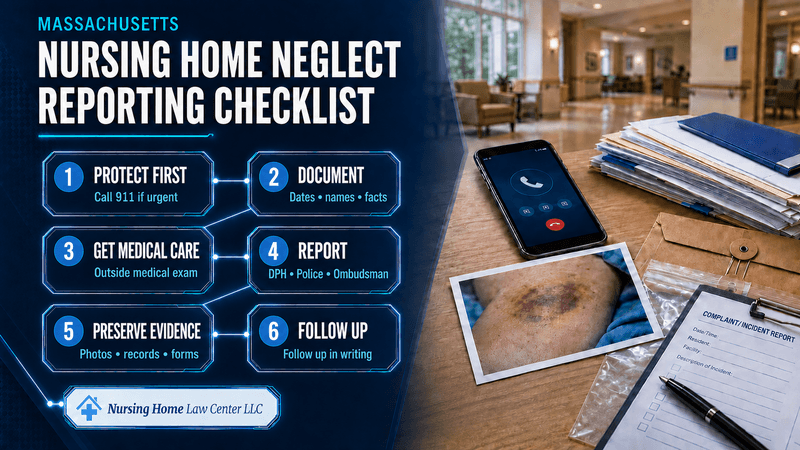
Give investigators enough detail to identify the resident, understand the danger, and begin reviewing the complaint.
Include:
Separate personal observations from information supplied by a resident or family member. Note patterns such as unanswered call lights, recurring falls, missed medication, or changing explanations.
The signs of nursing home abuse may be physical, behavioral, medical, or financial. Concerning signs include:
The Patient Abuse Statute, Mass. Gen. Laws ch. 111, § 72F defines abuse to include willful injury, unreasonable confinement, intimidation, punishment causing physical harm, pain, or mental anguish, and assault and battery. It also defines neglect, mistreatment, and misappropriation of patient or resident property.
DPH screens the complaint. Massachusetts law requires an investigation within 24 hours when the department reasonably believes a resident faces immediate danger from further abuse or neglect. Other covered reports must be investigated within seven days.
Investigators may inspect the facility, interview residents and staff, and review medical, staffing, and incident records. DPH may require correction, cite deficiencies, refer licensed professionals to a board, or notify law enforcement.
The Ombudsman may advocate for the resident, while the Medicaid Fraud Division and licensing boards can examine conduct within their authority.
A state finding can document nursing home negligence, but it does not automatically compensate the resident. Report discharge threats, isolation, reduced care, restricted visits, or intimidation immediately.
Some Massachusetts channels accept anonymous reports. The DPH form permits a reporter to withhold identifying information, although that person may not receive the outcome. APS accepts anonymous telephone reports, but its online portal requires a name. The assisted living form also permits anonymity.
Nursing and medical boards may investigate anonymous complaints at their discretion. Ombudsman communications receive confidentiality protections. Anyone using anonymous reporting should still provide relevant dates, names, and facts to identify the incident.
Families may alert the administrator, director of nursing, charge nurse, or social worker. Internal reporting may secure treatment or a room change, but it should not stand alone after serious injury, sexual abuse, repeated neglect, financial exploitation, or retaliation.
Document delayed medical care, refused records, pressure against outside reporting, changing explanations, or blame placed on the resident. A facility may be liable for the original abuse or neglect and its failure to respond after receiving notice.
A report asks an agency to investigate safety, compliance, professional conduct, or possible crime. A nursing home abuse lawsuit is a separate civil case seeking to hold negligent facilities accountable.
A lawsuit may pursue compensation for medical expenses, pain, mental anguish, disability, relocation, financial loss, or wrongful death. A Massachusetts nursing home settlement may resolve the claim, but an agency complaint does not guarantee payment or preserve deadlines.
Families should consider contacting an attorney in situations such as:
A lawyer can preserve records, identify responsible parties, and assess a possible civil claim under Massachusetts law.

Protecting older adults may require our attorneys to investigate the facility’s conduct, preserve key evidence, consult medical and industry experts, identify responsible parties, calculate damages, negotiate for fair compensation, and prepare the case for trial when necessary.
Evidence may include:
This evidence may reveal understaffing, missed treatment, altered records, or inadequate supervision. Our firm can pursue a fair nursing home abuse settlement or seek justice at trial.
Reporting elder abuse can protect a loved one and alert regulators. A legal case may also be necessary after a Massachusetts nursing home causes serious harm. Our network of nursing home abuse attorneys can review records and assess the family’s options.
The consultation is free and confidential. There are no upfront attorney fees, and the family pays nothing unless compensation is recovered. Contact us to discuss what happened and how we may help protect your loved one’s rights.