
Experienced Attorneys Protecting the Rights of the Neglected and Abused
The Nursing Home Law Center is committed to providing the legal resources necessary to hold negligent facilities accountable.

Ohio nursing home lawsuit settlements provide financial compensation when a resident suffers harm because a facility failed to deliver adequate care, staff neglected warning signs, or management failed to prevent abuse.
These claims often stem from falls, pressure sores, medication mistakes, dehydration, malnutrition, physical or sexual abuse, unexplained injuries, infections, or a loved one’s death.
The value of a settlement depends on the severity of the harm, the extent to which the facility’s negligence contributed to it, and the impact on the resident and their family.
Our Ohio nursing home abuse lawyers investigate medical records, staffing patterns, and facility history to build a strong claim on your behalf. Contact us for a free consultation.
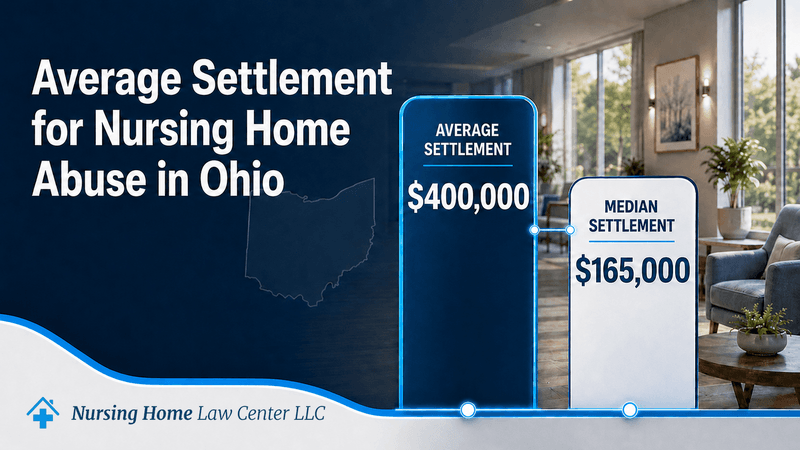
The average settlement for nursing home abuse and neglect in Ohio is around $400,000. This figure is pulled upward by a smaller number of cases involving severe abuse or neglect that result in large payouts. The median settlement, $165,000, is a more typical benchmark, since roughly half of Ohio nursing home cases settle for less than that amount.
A 30-year-old woman with spina bifida, paraplegia, and an intellectual disability resided in a Cleveland, Northeast Ohio, group home under the care of several physicians. She suffered shower burns, a stage 4 bed sore requiring flap surgery, and a cerebrospinal fluid shunt malfunction that raised her intracranial pressure, leaving her permanently blind. Her group home neglect claim alleged poor care by the facility and its physicians.
A 76-year-old man with a shunt for hydrocephalus was transferred to a Cincinnati, OH, nursing facility days after his surgery. A physician had ordered a lap belt restraint, but a nurse omitted it when transcribing his chart. Left unrestrained, he fell twice and developed a subdural hematoma that proved fatal.
A 60-year-old woman with multiple chronic conditions was transferred to a nursing facility after gastric bypass surgery. The facility claimed to have the experience and resources to care for a bariatric patient following such a procedure. Just days after her admission, she reported abdominal pain and breathing trouble, but staff allegedly failed to promptly inform her physician. She was later found to have an anastomotic leak and peritonitis, and died of sepsis.
A 93-year-old woman was injured while being transferred from her bed to a wheelchair at a nursing facility. Her care plan required a Hoyer lift due to osteoporosis, but staff did not use one. She was dropped, fracturing her leg. The facility admitted liability but described it as an accident. The case was ultimately resolved with a nursing home leg fracture settlement of $165,000.
A 78-year-old man with advanced dementia and documented swallowing difficulties was left unsupervised while eating at an Ohio veterans’ nursing home. He choked on a piece of chicken and went into cardiac and respiratory arrest, dying the same day. When negotiating the wrongful death settlement with the nursing home, his family alleged staff failed to follow his care plan, which required supervision during meals due to his dysphagia.
A 70-year-old man with Alzheimer’s disease and diabetes was burned on his foot by a heating pad left in his room at a nursing facility. The burn became infected, leading to an above-the-knee amputation and his death about a week later. His estate alleged staff failed to remove the heating pad and monitor him properly.
An 80-year-old man receiving rehabilitation at a Cleveland, OH, nursing facility fell and struck his head while attempting to reach the restroom without assistance. As a result of the fall, he underwent surgery for a subdural hematoma. His estate alleged he had called for help, and a nurse asked him to wait. The facility contended he never used his call light and got out of bed unassisted.
An 89-year-old woman with end-stage cancer developed serious bed sores during the final six weeks of her life while under the care of a Columbus, OH, nursing facility. To negotiate the bedsore settlement with the nursing home, her estate alleged physicians failed to treat the wounds promptly, causing painful decubitus ulcers.
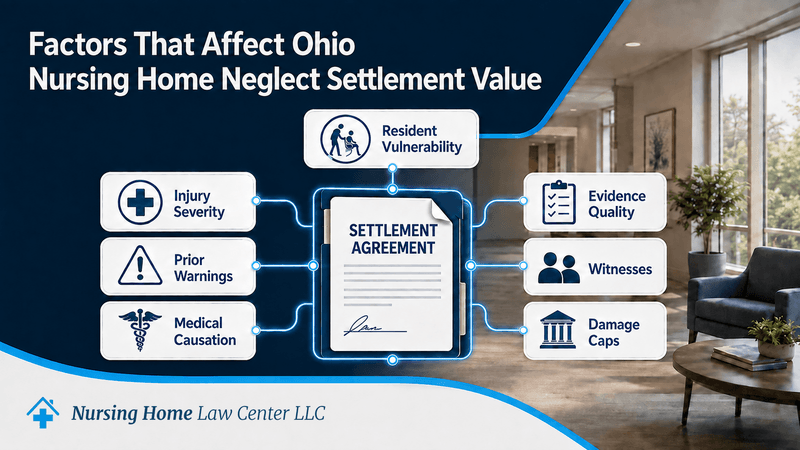
Every Ohio nursing home case is different, and settlement value shifts based on the specific facts involved. The following factors commonly influence how much a nursing home abuse case may be worth.
Below are some of the common injuries we see in Ohio nursing home lawsuits.
Depending on the facts, compensation awarded in a nursing home abuse lawsuit in Ohio may include:
Ohio also permits punitive damages in nursing home cases, but only if a plaintiff can prove by clear and convincing evidence that the facility acted with malice or aggravated or egregious fraud. Under Ohio Revised Code § 2315.21, such damages are generally capped at two times the compensatory award. If the defendant is a small employer or individual, the cap is instead the lesser of two times the compensatory award or 10% of their net worth at the time of the tort, up to a maximum of $350,000.
An Ohio nursing home settlement can take anywhere from several months to a few years, depending on the injury, the number of defendants, and whether liability is contested. Straightforward cases with clear records often resolve faster, while cases involving wrongful death, disputed causation, or multiple facilities tend to take longer to work through.
One Ohio-specific factor is the affidavit-of-merit requirement. Under Ohio Rule of Civil Procedure 10(D)(2), medical claims against a nursing home must include a qualified expert’s sworn opinion that the claim has merit before proceeding, which extends the timeline before litigation even begins.
The filing deadline depends on the type of Ohio nursing home claim.
For general personal injury claims, Ohio law provides a two-year deadline under Ohio Revised Code § 2305.10.
If the claim qualifies as a medical claim, it must be filed within one year of discovery, subject to a four-year statute of repose under Ohio Revised Code § 2305.113.
For wrongful death lawsuits, Ohio law allows two years from the date of death under Ohio Revised Code § 2125.02.
Because deadlines to file a nursing home abuse lawsuit vary by type, families should seek legal guidance as soon as possible. Acting early helps protect residents and preserve time-sensitive evidence, such as surveillance footage and witness memories.
Before accepting any settlement offer, families should take several steps to protect the resident’s rights and strengthen the value of their claim.
Most Ohio nursing home abuse lawsuits settle before trial, but reaching a fair settlement typically requires thorough investigation, record review, expert input, and negotiation with the facility’s insurer or legal counsel. Our nursing home abuse lawyers help families seek justice through:

Denise’s husband developed a severe pressure sore during a nursing home stay after hip surgery. Staff failed to reposition him regularly and treat the wound before it became life-threatening. Our nursing home bedsore attorneysensured that settlement value reflected the severity of the pressure injury, his rapid decline, and the evidence of neglect, along with funeral costs and the family’s loss.
Two cognitively impaired residents were sexually assaulted by a certified nursing assistant at the same facility. Both families alleged the facility failed to properly screen and supervise staff with direct resident access. Our nursing home sexual abuse attorneys shaped the settlement based on the severity of the abuse and the facility’s missed warning signs.
Christine developed pressure wounds that progressed into a fatal infection during an extended stay. Her family alleged staff ignored her care plan and delayed outside medical care. We determined who was liable for her wound care and secured a wrongful death settlement that reflected the severity of the infection and the facility’s delayed response.
Joan, an 87-year old nursing home resident, fell while unsupervised at his facility, suffering a hip fracture and a serious head injury requiring surgery. When negotiating the fall settlement with the nursing home, we relied on her family’s testimony that staff ignored her documented fall-risk precautions.
Theresa, a dementia nursing home resident, accessed an unlocked closet containing cleaning chemicals and ingested a toxic substance. The family alleged the nursing home failed to secure hazardous materials despite her known wandering behavior. Staffing and supervision failures, as well as the incident’s preventable nature, were contributing factors in determining the value of the nursing home elopement settlement.
Kevin, a resident of a group home for adults with developmental disabilities, suffered repeated harm from another resident with a known history of aggression. The family alleged staff failed to intervene. The pattern of similar incidents and a lack of separation shaped the final outcome.
Brenda’s father choked on food while eating unsupervised despite a documented swallowing impairment requiring assistance. He died shortly after. The case settled before litigation, based on the facility’s failure to follow his care plan and the clearly preventable nature of his death.
If your loved one suffered serious harm in one of Ohio’s worst nursing homes, contact us for a free case review. Your family deserves support, and our legal team can review the medical records, identify the responsible facility, and help you pursue justice.
Our nursing home abuse lawyers work on a contingency-fee basis, meaning you pay no attorney fees unless we recover compensation for you. Call (800) 926-7565 or complete our online contact form.
Our Ohio nursing home lawyers represent clients throughout the state, including Akron, Toledo, and beyond.