
Experienced Attorneys Protecting the Rights of the Neglected and Abused
The Nursing Home Law Center is committed to providing the legal resources necessary to hold negligent facilities accountable.

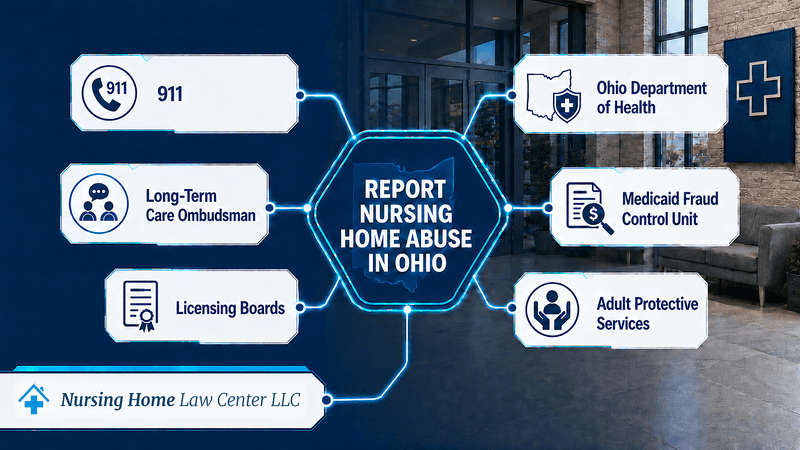
To understand how to report nursing home abuse in Ohio, first decide whether the resident faces immediate danger.
Call 911 for urgent medical risk, assault, sexual abuse, threats, or suspected criminal conduct.
Family members may contact several agencies, including ODH, police, the ombudsman, Medicaid authorities, or a licensing agency. Prompt reporting may protect nursing home residents. Our Ohio nursing home abuse lawyers can help preserve evidence and assess a civil claim.
Families may use several reporting channels to file a complaint. Choosing the appropriate agency when reporting nursing home abuse depends on the conduct, resident’s condition, Medicaid services, and whether the concern involves the nursing home or an employee.
Call 911 for immediate danger, emergency treatment, assault, sexual abuse, theft, intimidation, unlawful restraint, or another suspected crime. Contact local law enforcement for suspected crimes, even during an internal review.
For a nonemergency report, contact the police department or county sheriff where the incident occurred. Ask for the report number and investigating officer’s telephone number. A police report does not prevent an ODH complaint.
The Ohio Department of Health complaint program accepts reports about unsafe care, neglect, poor staffing, medication errors, pressure ulcers, falls, infections, unsanitary conditions, and regulatory violations. The Bureau oversees nursing homes, assisted living facilities, intermediate care facilities for individuals with intellectual disabilities, dialysis centers, ambulatory surgical centers, and clinical laboratories.
Families may submit the ODH complaint form online, email HCComplaints@odh.ohio.gov, or call 1-800-342-0553. Written complaints may be mailed to:
Ohio Department of Health
Bureau of Survey and Certification
246 North High Street
Columbus, OH 43215
ODH investigates complaints alleging non-compliance with licensing or certification standards for nursing homes. Complaints involving immediate danger receive the highest priority. Qualified surveyors may visit unannounced, observe care, speak directly with residents and staff, and review medical, staffing, incident, and billing records. Investigators may contact the complainant to obtain additional information.
Identified complainants generally receive acknowledgment and written findings. ODH cannot send updates to someone who chooses to remain anonymous. ODH protects every person’s identifiable information. Report retaliation concerns.
The Ohio Long-Term Care Ombudsman Program advocates for residents in nursing homes and other long-term care facilities. It can assist with resident rights, discharge threats, visitation, care planning, verbal abuse, retaliation, and dignity concerns.
Call 1-800-282-1206, email OhioOmbudsman@age.ohio.gov, or use the ombudsman contact form. Records are generally held in strict confidence.
An ombudsman may meet with the resident and help with resolving complaints. The program does not replace police, emergency services, or ODH when abuse and neglect may cause further harm.
Suspected provider fraud may be reported through the Ohio Department of Medicaid or the Ohio Attorney General’s Medicaid Fraud Control Unit. This route covers false billing, altered records, theft, financial exploitation, or neglect connected to Medicaid-funded skilled nursing care.
The Attorney General’s Health Care Fraud Section investigates provider fraud and patient abuse or neglect. File online, call 614-466-0722, or contact the Help Center at 1-800-282-0515. Include the provider, individuals involved, dates, charges, and supporting records.
You can send any additional documentation to:
Medicaid Intake Officer
Office of the Attorney General
30 E. Broad Street, 23rd Floor
Columbus, OH 43215
A nursing home complaint and professional complaint may proceed together. Licensing agencies focus on whether an individual violated occupational standards.
Use the Ohio Board of Nursing complaint process for unsafe practice, medication diversion, impairment, falsified documentation, improper delegation, abuse, or work outside a licensee’s scope. Call 614-466-3947. Complaint records are confidential under Ohio law.
The State Medical Board of Ohio accepts complaints involving improper prescribing, sexual misconduct, impairment, falsified records, or serious treatment failures. File online or call 1-833-333-SMBO (7626).
Report administrator misconduct to the Ohio Board of Executives of Long-Term Services and Supports at 614-466-5114. This may apply when an administrator concealed abuse, ignored warning signs, permitted unsafe staffing, retaliated against a resident, or tolerated a systemic problem.
Ohio Adult Protective Services investigates allegations involving vulnerable adults who generally live in community or independent-living settings. Reports may be made at 1-855-OHIO-APS (1-855-644-6277). A person seeking anonymity should report by telephone rather than online.
APS is not the primary regulator for employee abuse inside Ohio nursing facilities. County APS offices refer those allegations to the Ohio Department of Health. APS may remain relevant when an outside relative, guardian, caregiver, or other person is suspected of exploiting or harming the resident.
Families do not need complete proof before they report abuse. Resident statements, injuries, poor hygiene, or decline may provide sufficient information to justify action. Follow these steps:
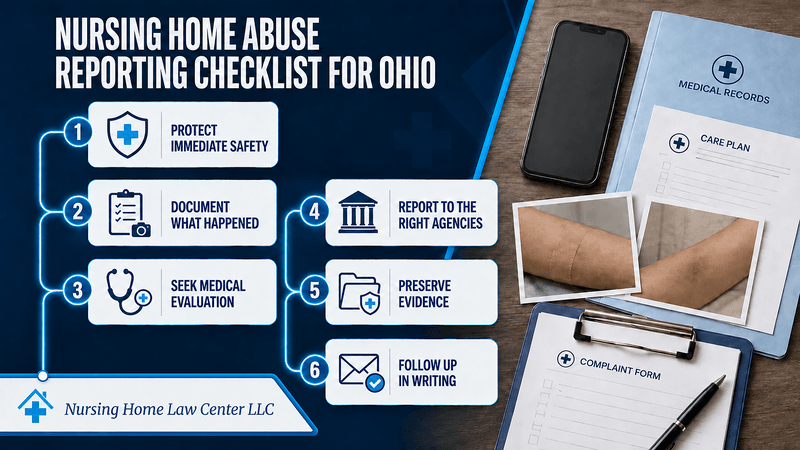
A useful complaint identifies the risk and helps investigators find records and witnesses. Include:
Separate what you personally observed from information supplied by others.
Abuse can take many forms, including physical, emotional, financial, verbal, and sexual harm. Families should take warning signs seriously when a facility fails to provide a safe environment or offers vague explanations for a resident’s condition.
Common signs of nursing home abuse include:
Ohio Revised Code § 2903.33 defines patient abuse, gross neglect, and neglect in covered care facilities, while Ohio Revised Code § 2903.34 criminalizes that conduct. Moreover, the Ohio Revised Code § 3721.22 addresses reporting duties and good-faith immunity. Ohio Revised Code § 3721.24 prohibits retaliation for reporting or participating in an investigation.
After screening the complaint, ODH may interview residents and employees, review records, observe treatment, inspect the building, and determine whether state law or federal regulations were violated. The department may cite deficiencies, require correction, refer findings to credentialing authorities, or coordinate with Medicaid officials, prosecutors, and other agencies. Serious violations may lead to civil penalties, admission restrictions, license consequences, or action affecting Medicare and Medicaid participation.
Federal rules require covered nursing homes to report alleged abuse, neglect, exploitation, and related violations immediately. Certain allegations involving serious bodily injury have a two-hour deadline, while other covered allegations generally have a 24-hour outer deadline. Ohio law also requires review and investigation of qualifying allegations involving long-term care residents.
An agency investigation may improve safety and establish that the facility failed to follow care requirements. It does not recover compensation. Our attorneys may need to secure records, identify responsible parties, consult experts, and prove how inadequate care caused injury or death.
Yes. The ODH online form allows a complainant to omit identifying details, and Ohio APS accepts anonymous telephone reports. The Ohio Department of Health protects confidential identifying information, but if you choose anonymous reporting, you cannot receive status letters or answer follow-up questions.
Ombudsman communications are confidential, while professional boards apply separate procedures. Providing contact details may help investigators verify facts. Families worried about retaliation should state that concern during intake.
Families may contact the administrator, director of nursing, charge nurse, or social worker. Serious elder abuse, elder sexual assault, urgent neglect, or suspected criminal activity should also be reported externally. Document changed explanations, delayed care, missing records, retaliation, or efforts to discourage reporting. Ohio nursing homes must investigate and report covered allegations. Internal discussion should not delay emergency help or an ODH complaint.
A report asks an agency to protect residents, assess compliance, and consider regulatory or criminal consequences. A nursing home abuse lawsuit is a separate civil action seeking accountability and compensation for medical expenses, relocation costs, pain, emotional harm, disability, financial losses, or death. An Ohio nursing home abuse settlementmay resolve a civil case, but an agency complaint does not automatically compensate the resident or family.
Legal help may be important when:
Our experienced attorneys can investigate how the harm occurred, identify responsible parties, and guide families through each stage of a civil claim. We can:
Evidence may include:
Our team of nursing home abuse attorneys can review what happened, explain Ohio reporting options, and assess a possible civil case. The consultation is free and confidential. We handle cases on a contingency fee, so families pay no upfront attorney fees and owe no legal fee unless compensation is recovered.
Contact us to discuss protecting your loved one, preserving evidence, and preventing further harm.