
Experienced Attorneys Protecting the Rights of the Neglected and Abused
The Nursing Home Law Center is committed to providing the legal resources necessary to hold negligent facilities accountable.

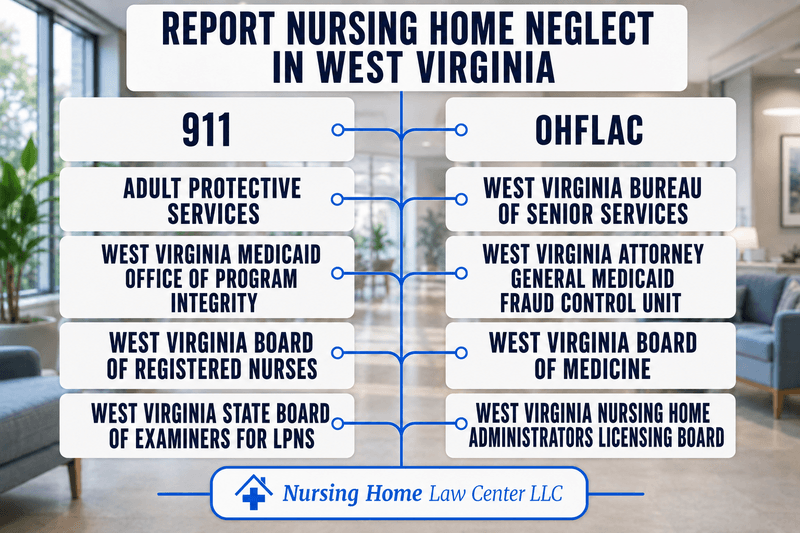
Knowing how to report nursing home abuse in West Virginia can help protect a loved one from continued harm. Call 911 for immediate danger, then contact the agency that handles the concern.
Our attorneys can help families report suspected abuse, preserve critical evidence, and pursue compensation when a resident has been harmed.
Families may file a report for nursing home abuse or neglect through various methods in West Virginia. The right contact depends on the resident’s condition, the type of health care facility, and whether the concern involves crime, Medicaid, professional conduct, or resident rights.
Emergency calls regarding immediate danger should be directed to 911. Call when a resident faces an assault, sexual abuse, threats, severe injury, abandonment, or an urgent medical risk. Families should also contact local police or the county sheriff when suspected conduct may be criminal.
The West Virginia State Police can be reached at 304-746-2100 for nonemergency assistance, but that phone number does not replace 911. Use this route when the victim may be unsafe now. Request emergency care, preserve physical evidence, and avoid a confrontation that could increase danger.
The Office of Health Facility Licensure and Certification, often called OHFLAC, licenses and oversees West Virginia assisted living facilities, nursing homes, and other long-term care facilities. Families sometimes look for the Department of Health, but facility complaints are directed to this health facility licensure office within the West Virginia Office of Inspector General.
Contact OHFLAC about unsafe care, poor staffing, medication errors, falls, bed sores, infections, inadequate hygiene, delayed treatment, improper restraints, or other certification violations. Its complaint intake office accepts reports through an online complaint form, by phone at 304-558-0050, or by mail at State Capitol Complex, Building 6, Suite 825, Charleston, WV 25305. The form allows a person to request confidentiality or remain anonymous, although anonymous reporters cannot receive case updates.
Identify the nursing home, resident, dates, injuries, staff involved, and prior action. Use a clear subject line such as “Nursing Facility Abuse Complaint” when you send documentation. The Office of Health Facility Licensure and Certification may review records or investigate possible care violations.
West Virginia Adult Protective Services, within the Department of Health and Human Services, investigates allegations involving vulnerable adults, including abuse and neglect, financial exploitation, abandonment, and emergency conditions. The Centralized Intake for Abuse and Neglect is the primary reporting point. Reports may be made by calling 1-800-352-6513 and selecting option 3, 24 hours a day.
Use APS when a resident may be physically harmed, neglected, exploited, or left without protective services. Anyone may report elder abuse. Mandated reporters include medical professionals, social service workers, law enforcement officers, and nursing home employees. Required reports must be made immediately and no later than 48 hours after suspicion arises.
Good-faith reporters generally receive civil and criminal immunity, and reporter identities are protected. Failure to report may bring misdemeanor penalties. Tell intake staff if the resident fears retaliation or needs relocation.
The West Virginia Long-Term Care Ombudsman Program advocates for nursing home residents and people living in other long-term care settings. A state or regional ombudsman can investigate complaints, explain resident rights, attend care-planning meetings, and seek solutions involving discharge threats, visitation, privacy, retaliation, missing property, poor communication, or quality of life. Services are free and confidential.
The direct statewide Ombudsman line is 1-800-834-0598, and the program office is 304-449-4755. The Bureau of Senior Services general line is 877-987-3646, but ombudsman requests should begin with the direct number.
Report suspected Medicaid billing fraud, false claims, payment abuse, or misuse of Medicaid resources to the West Virginia Medicaid Office of Program Integrity. Its official page provides a Medicaid Fraud Referral Form and lists its address as 350 Capitol Street, Room 251, Charleston, WV 25301.
The West Virginia Attorney General Medicaid Fraud Control Unit investigates provider fraud, criminal abuse or neglect in health care facilities, and misappropriation of patients’ funds. Reports may be made at 1-888-372-8398, 304-558-1858, or mfcu@wvago.gov. Contact this unit when the concern involves falsified services, diverted money, fraudulent records, or neglect tied to Medicaid-funded care.
Families may report nursing homes as well as individual nursing, medical, or administrative misconduct to the board that issued the professional’s license.
The West Virginia Board of Registered Nurses accepts complaints involving registered nurses and advanced practice registered nurses. Anyone may submit a concern. Call 304-744-0900 or use the board’s complaint resources.
Complaints involving an LPN may be filed with the West Virginia State Board of Examiners for Licensed Practical Nurses. The board’s phone number is 304-558-3572, and its email address is lpn.board@wv.gov.
The West Virginia Board of Medicine regulates medical doctors, podiatrists, and physician assistants under its authority. Families may call 304-558-2921 to start the board’s complaint process.
The West Virginia Board of Osteopathic Medicine investigates complaints against osteopathic physicians and related licensees. Its current state directory number is 304-723-4638.
The West Virginia Nursing Home Administrators Licensing Board accepts complaints concerning licensed administrators. Contact the board at 304-586-4070 or email veronica.s.cummings@wv.gov. General facility care concerns should still be reported to OHFLAC.
Families do not need complete proof before reporting. Resident statements, injuries, or unsafe conditions may support a complaint. Keep in mind the following steps:
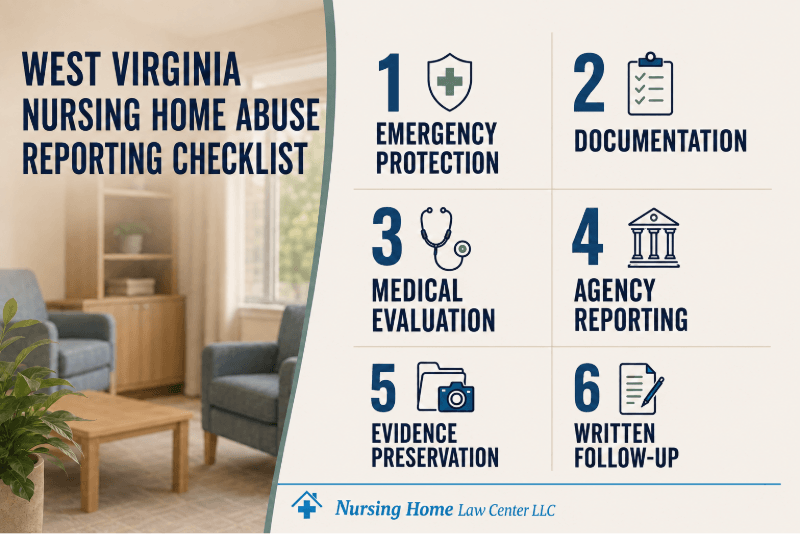
Include enough detail to identify the nursing home resident and assess urgency:
The signs of nursing home abuse vary. Common signs include:
West Virginia criminalizes certain abuse or neglect of incapacitated adults under W. Va. Code § 61-2-29. Mandatory-reporting duties appear in W. Va. Code § 9-6-9, while W. Va. Code § 9-6-11 requires covered reports to be made immediately and within 48 hours.
The receiving office may screen the complaint, interview residents and staff, inspect the nursing homes, review records, and decide whether violations occurred. A regulatory investigation may protect residents or produce corrective action, but it does not recover civil compensation.
Report retaliation immediately. W. Va. Code § 9-6-12 bars nursing homes from discriminating against residents, relatives, representatives, or employees because they filed or supported a complaint. Warning signs include discharge threats, reduced care, isolation, restricted visitation, intimidation, or refusal to speak with family members. Preserve every communication.
OHFLAC expressly accepts anonymous reporting. APS phone callers may decline to identify themselves, while state law generally protects reporter identity. Ombudsman complaints are confidential. Rules differ across licensing boards, and an anonymous report may limit follow-up or prevent status updates. Providing contact information can help investigators request clarification. Families worried about retaliation should state that concern.
Families may speak with the nursing home administrator, director of nursing, charge nurse, social worker, or human resources office. Serious abuse, urgent neglect, or suspected crime should also be reported externally. Make sure to document delayed care, changing explanations, missing records, and efforts to discourage outside contact.
An agency report focuses on safety, compliance, and possible enforcement. A nursing home abuse lawsuit is a separate civil case seeking accountability and compensation for medical costs, relocation, suffering, financial loss, or death. A West Virginia nursing home abuse settlement may resolve a claim without trial, but each case depends on its evidence and losses.

Legal assistance may be important when:
Our attorneys can help by:
Important evidence may include injury photographs, hospital records, care plans, incident reports, medication and wound-care records, staffing schedules, call-light logs, witness statements, family communications, inspection citations, billing documents, and an autopsy report when a resident died.
Our nursing home abuse attorneys help families seek justice for their loved ones after abuse or nursing home neglect. The consultation is free and confidential, and we handle accepted cases on a contingency fee basis. You pay no attorney fee unless we recover compensation.
Contact us to discuss your loved one’s injuries, the reporting process, and possible legal action.