
Experienced Attorneys Protecting the Rights of the Neglected and Abused
The Nursing Home Law Center is committed to providing the legal resources necessary to hold negligent facilities accountable.

Knowing how to report nursing home abuse in Texas can protect a resident and create an official record. If your loved one faces immediate danger, call 911 before contacting the facility. Suspected abuse should also be reported outside the nursing home.
Families in Texas may contact several agencies. The proper agency depends on the situation, possible criminal conduct, Medicaid funding, and whether the concern involves a facility or professional. Our Texas nursing home abuse attorneyscan help you assess whether you should file a separate civil claim.
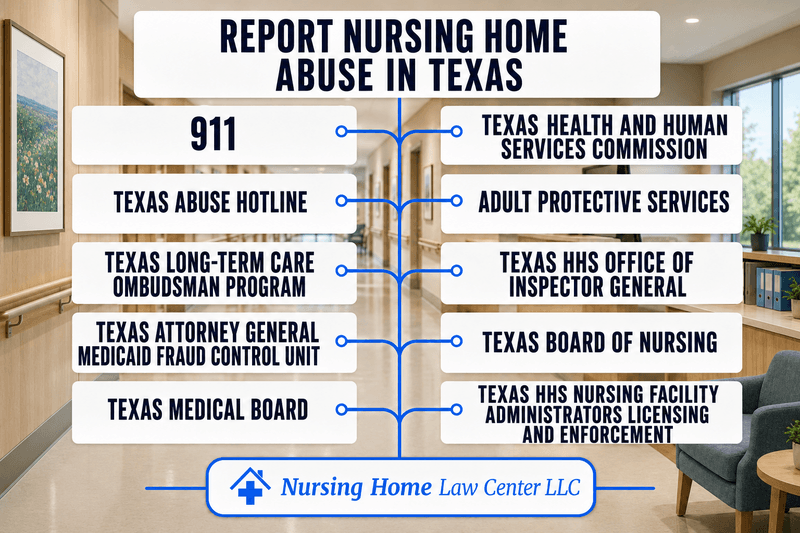
Depending on the circumstances, families may need to report nursing home abuse by contacting 911 or local police, Texas HHSC Complaint and Incident Intake, the Abuse Hotline, Adult Protective Services, the Long-Term Care Ombudsman, Medicaid fraud investigators, or the appropriate professional licensing authority.
Call 911 or local police when your loved one is being assaulted, sexually abused, threatened, unlawfully restrained, denied urgent treatment, or exposed to another immediate risk of serious harm.
Request emergency health services for serious injuries, breathing problems, uncontrolled bleeding, sudden confusion, or possible sepsis. Preserve the incident number and the names of responding officers.
For abuse or neglect in Texas assisted living facilities or nursing homes, contact the Texas Health and Human Services Commission Complaint and Incident Intake. Call 800-458-9858 or file online through the Texas Unified Licensure Information Portal. Nursing home complaints may also be sent to ciicomplaints@hhs.texas.gov.
This is the main intake channel for unsafe care, inadequate staffing, pressure sores, falls, medication errors, infections, poor hygiene, delayed treatment, exploitation, unexplained injuries, and regulatory violations. A family may complain without complete proof. Identify the resident, facility, staff, witnesses, and dates involved. HHSC accepts anonymous reports, although contact information can help an investigator request additional information.
The Texas Abuse Hotline accepts reports involving adults age 65 or older and adults with disabilities who may face abuse, neglect, self-neglect, or financial exploitation. Call 800-252-5400 when action may be needed within 24 hours or when you prefer to remain anonymous.
Texas Adult Protective Services generally investigates individuals living at home or elsewhere in the community. It does not typically investigate abuse inside licensed nursing facilities or group homes.
The Texas Long-Term Care Ombudsman Program advocates for residents of nursing homes and assisted living facilities. Call 800-252-2412 for help with resident rights, discharge threats, visitation, retaliation, care planning, communication, or unresolved complaints.
A long-term care ombudsman can listen, explain resources, contact the facility with permission, and advocate for the resident. This confidential service does not replace 911 when a loved one is in danger.
Medicaid fraud, theft, falsified records, or abuse may warrant a separate report.
The Texas HHS Office of Inspector General receives reports of fraud, waste, and abuse involving Texas Health and Human Services programs. Call 800-436-6184 or use its online reporting system. Examples include billing for care never provided, falsifying health records, duplicate billing, kickbacks, and misuse of state funds.
The Texas Attorney General Medicaid Fraud Control Unit investigates criminal Medicaid provider fraud and abuse or neglect of patients in Medicaid-funded facilities, including nursing homes. It also handles theft from resident trust accounts and assists prosecutors. Call 512-371-4700 or send a report to the unit at P.O. Box 12548, Austin, Texas 78711.
A facility abuse/neglect complaint may accompany a licensing report involving an individual professional.
File a complaint against a nurse through the Texas Board of Nursing. The toll-free complaint line is 800-821-3205, and written complaints may be emailed to complaints@bon.texas.gov. Report unsafe nursing practice, medication diversion, impairment, patient abandonment, or conduct outside the nurse’s licensed scope.
Use the Texas Medical Board complaint process for misconduct by a physician, physician assistant, or another professional under the board’s authority. Call 512-305-7030 for assistance. Complaints must be written or filed online and should explain the treatment, injuries, dates, and provider.
For misconduct by a licensed administrator, contact Texas HHS Nursing Facility Administrators Licensing and Enforcement. Public complaints are routed through Complaint and Incident Intake at 800-458-9858.
A report need not establish liability. Families may act when loved ones’ injuries, statements, unsafe conditions, or behavior changes raise concern. Follow these steps:
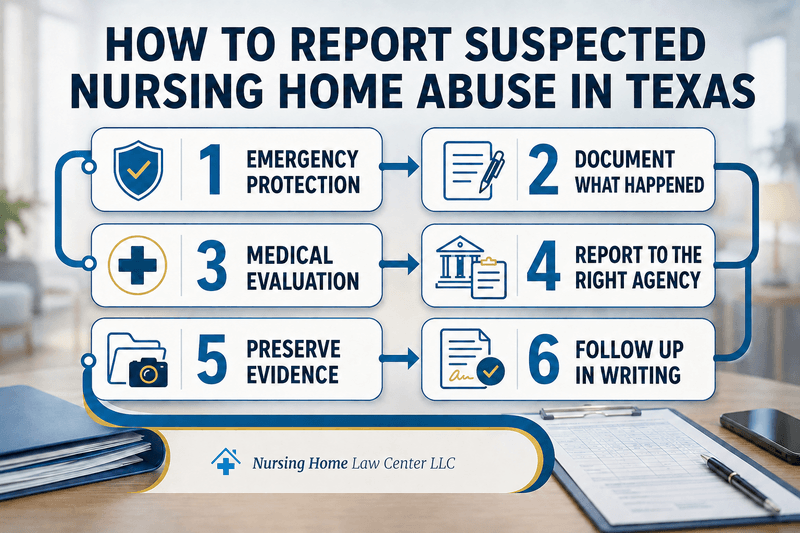
Specific information helps intake staff assess urgency and choose the next steps. Include:
Possible signs of nursing home abuse a loved one is sustaining include:
Texas Health and Safety Code Chapter 260A, particularly Texas Health and Safety Code § 260A.002, requires immediate reporting when a person has cause to believe a covered resident’s welfare has been or may be adversely affected by abuse, neglect, or exploitation.
Good-faith reporters receive statutory immunity, and employee retaliation is prohibited. Serious conduct may also violate Texas Penal Code § 22.04, which addresses injury to an elderly or disabled individual.
HHSC may screen the complaint, assign an investigator, inspect the facility, interview residents and staff, review records, and issue citations when violations are substantiated. Law enforcement or another agency may investigate criminal conduct. Keep providing relevant details and maintain access to copies of submissions.
An agency investigation addresses safety and compliance. It does not recover compensation for your loved ones. If the nursing home threatens discharge, reduces care, restricts visits, isolates the resident, or intimidates family members after a report, document and report that retaliation immediately.
Texas allows anonymous reporting to the HHSC under Chapter 260A, although the law does not encourage anonymity and an accusation against a specifically identified person may receive different treatment. Adult-abuse callers may also ask to remain anonymous when using the Texas Abuse Hotline.
Clear details improve the effectiveness of anonymous reporting. Contact information is useful when investigators need clarification, but families who fear retaliation should state that concern.
Families may notify the administrator, director of nursing, charge nurse, or social worker, but they should not rely solely on an internal complaint when serious abuse or neglect is suspected.
Report externally when safety, criminal conduct, serious injuries, or repeated failures are involved. Record any attempt to minimize the incident, discourage outside contact, withhold records, or change the explanation.

Reporting abuse may protect residents and lead to regulatory or criminal action. A nursing home abuse lawsuit is a separate civil case seeking accountability and compensation for medical costs, relocation, pain, emotional trauma, financial loss, or death.
The facts supporting a Texas nursing home abuse settlement may overlap with an agency report, but one process does not replace the other.
Contact a Texas nursing home abuse lawyer when:
Our experienced attorneys can:
Evidence may also include hospital records, emails, text messages, prior complaints, surveillance material, and an autopsy report when a resident’s death is involved. We work to hold responsible parties accountable.
Our nursing home abuse attorneys represent injured victims and families on a contingency fee basis. There are no upfront attorney fees, and we receive a fee only if compensation is recovered. The consultation is free and confidential.
Contact us to discuss what happened and learn how our firm may help protect your loved one.