
Experienced Attorneys Protecting the Rights of the Neglected and Abused
The Nursing Home Law Center is committed to providing the legal resources necessary to hold negligent facilities accountable.

Texas nursing home lawsuit settlements provide financial compensation when a resident suffers harm because a long-term care facility failed to deliver adequate care, prevent abuse, monitor at-risk residents, or act on visible warning signs.
These cases often involve falls, pressure ulcers, medication errors, dehydration, malnutrition, physical abuse, sexual assault, financial exploitation, medical malpractice, or wrongful death.
Settlement value depends on the severity of the facility’s failures, whether staff overlooked known risks, and the lasting impact on the resident and their family.
Our Texas nursing home abuse lawyers examine medical records, witness accounts, facility history, and state regulations to determine whether you have a valid claim. Your family deserves justice. Contact us for a free consultation.
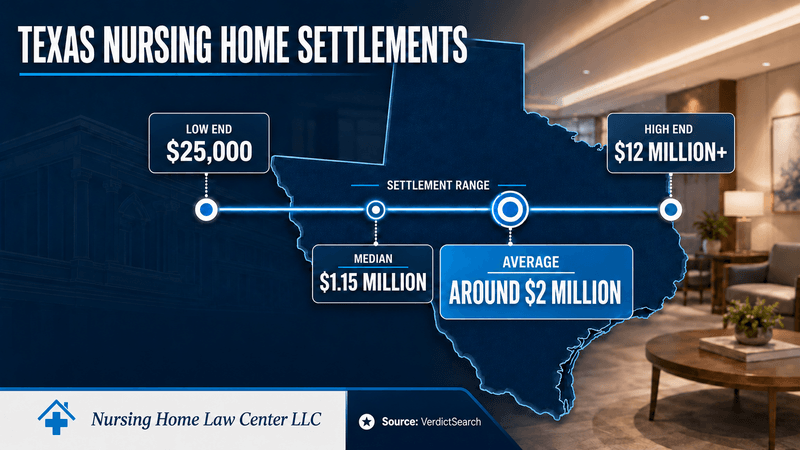
According to case data reported by VerdictSearch, the average settlement for nursing home abuse in Texas is around $2 million. This figure is pulled upward by a smaller number of cases involving extreme abuse or neglect, where nursing home settlement amounts reach into the millions. Nursing home neglect settlements in Texas range from as low as $25,000 to over $12 million.
The median settlement, $1.15 million, offers a more typical benchmark, since half of all nursing home cases settle below that amount.
The cases below reflect real Texas nursing home abuse lawsuits and their settlements.
A 90-year-old Texas nursing home resident with dementia and a history of strokes developed severe, infected pressure sores and suffered repeated dehydration, malnutrition, and falls during his long-term stay.
The victim’s estate brought a nursing home negligence and wrongful death claim, alleging chronic understaffing prevented staff from following care protocols and notifying a physician of his decline. The facility’s bankruptcy proceedings shaped the settlement outcome.
A 75-year-old nursing home patient was admitted with diabetes and several other chronic conditions. While in the facility’s care, he suffered two separate episodes of severe hypernatremic dehydration. His family filed a nursing home negligence and wrongful death claim, alleging staff failed to monitor his hydration, ignored physician orders, and altered his records after he transferred to another facility.
A 74-year-old nursing home resident with severe Alzheimer’s disease was placed in a shared room with another resident who also had advanced dementia and a history of aggression toward staff and residents. The nighttime noise from the resident’s condition agitated his roommate, who attacked and killed him.
His estate pursued survival damages covering roughly $15,000 in medical bills, while his daughter sought compensation under a wrongful death claim, alleging the facility ignored prior violent incidents.
An 82-year-old Texas nursing home resident fell at the facility at least 50 times over roughly two years. He sustained broken bones and lacerations, yet staff never assessed him for pain or provided pain medication.
His family alleged inadequate monitoring, insufficient staff training, and chronic understaffing that the facility’s corporate operators knew about but failed to correct.
A 79-year-old nursing home resident developed numerous pressure sores, including a stage 4 decubitus ulcer on her foot that required amputation. She later died from complications tied to sepsis, dehydration, and malnutrition.
Her son brought a nursing home negligence claim, alleging staff failed to properly monitor and assess her condition or notify her physician as her health declined.
A 91-year-old resident of a Texas facility wandered on her second night there. Staff restrained her without a doctor’s order and, according to testimony, used another patient’s sedating medication on her without authorization. She suffered repeated falls due to weakness from the prolonged restraint.
Her son brought a negligence claim, alleging the incident went unreported for weeks and was never properly documented.
A 65-year-old nursing home resident with a documented swallowing disorder and dementia choked to death on a large piece of meat served during an unsupervised meal.
Her family brought a wrongful death claim, alleging the facility failed to develop a diet plan that addressed her high risk of aspiration and choking, and that staff failed to respond appropriately once she began choking.

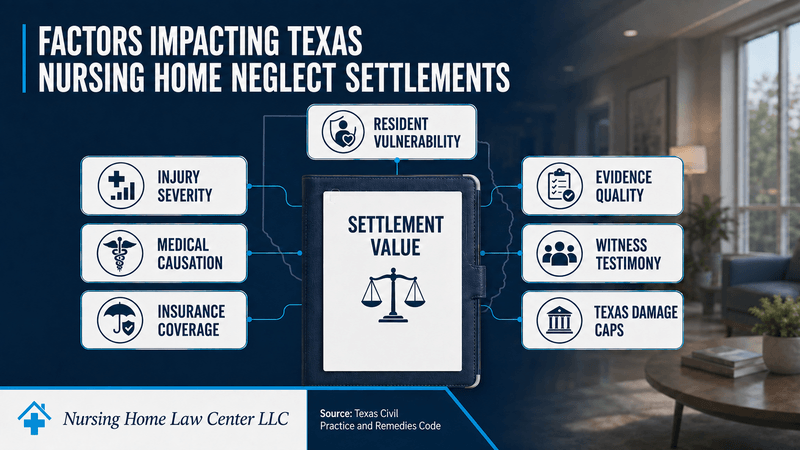
Many factors shape the value of the financial support you can receive through a Texas nursing home abuse lawsuit, from the case’s medical details to the state’s liability laws.
Pressure ulcers, infections, medication errors, malnutrition, dehydration, and physical or sexual assault each carry different damages. Incidents resulting in hospitalization, surgery, permanent disability, chronic pain, infection, or death typically increase a case’s overall value.
Dementia, limited mobility, swallowing difficulties, diabetes, or existing wounds can show the facility knew the resident required closer supervision or specialized care, but failed to provide it.
The nursing home insurance company’s available coverage often shapes what a case can realistically settle for, regardless of how strong the underlying claim is. Corporate ownership structures, umbrella policies, and whether multiple entities share liability can also affect how much a nursing home insurance company is willing to pay to resolve a claim.
Expert review is often necessary to connect the facility’s conduct, or lack of action, directly to the resident’s injury or death.
Missing records, delayed charting, inconsistent entries, or signs of alteration can significantly affect how a case is negotiated and valued.
Close family members, staff, roommates, visitors, and outside medical professionals can help establish what actually happened and when, driving the settlement value higher.
Texas law limits noneconomic damages in health care liability claims, which include most nursing home cases. Under Texas Civil Practice and Remedies Code §74.301, noneconomic damages against a single health care institution are capped at $250,000 per claimant, with a combined cap of $500,000 if multiple institutions are found liable. Separate, inflation-adjusted limits under §74.303 apply to wrongful death and survival actions.
Economic damages are generally uncapped, though government-run or charity-run facilities carry separate liability caps ranging from $100,000 to $500,000 per person.
Certain injuries appear repeatedly in Texas nursing home lawsuits against negligent facilities because they often stem from preventable lapses in care. Below are some of the most common injuries we see in nursing home cases.
Compensation in a nursing home abuse lawsuit depends on the specific harm suffered and the strength of the evidence. Depending on the facts of the case, financial relief may include:
To deter future abuse, Texas permits exemplary (punitive) damages in nursing home cases, but only where the claimant proves by clear and convincing evidence that the harm resulted from fraud, malice, or gross negligence, as defined under Civil Practice and Remedies Code §41.003. When awarded, exemplary damages are generally capped under §41.008 at the greater of $200,000 or two times the economic damages, plus up to $750,000 in noneconomic damages.
A Texas nursing home settlement agreement can take anywhere from several months to a few years, depending on the case’s complexity and the facility’s response to the claim.
Texas law adds a distinct early step to this timeline. Because most nursing home claims qualify as health care liability claims, Civil Practice and Remedies Code §74.351 requires the claimant to serve an expert report on each defendant within 120 days of filing suit.
The filing deadline depends on the type of lawsuit and the specific claims involved.
For most personal injury cases arising from nursing home neglect, including those resulting in death, Texas law generally provides a two-year deadline under Civil Practice and Remedies Code §16.003, requiring a claimant to file suit within two years of the date of injury or death.
Because nursing home claims are typically treated as health care liability claims, §74.251 may also apply, setting a two-year deadline that runs from the date of the breach or, in the case of an ongoing course of treatment, the last date of that treatment.
If the facility is government-owned, the Texas Tort Claims Act requires written notice of the claim within six months under §101.101, and some cities shorten that window further through local charters. Missing this notice can bar a claim even if filed within the standard two-year period.
Because the applicable deadline can depend on how a claim is classified and who owns the facility, families should seek legal guidance quickly. Acting sooner helps preserve medical records, secure witness statements, and hold the facility accountable before evidence becomes harder to obtain.
Before accepting any settlement offer, families should:
Most Texas nursing home lawsuits resolve through settlement negotiations rather than trial, but reaching that point requires thorough investigation, record review, expert input, and skilled negotiation with the facility’s insurer or legal team. If you or your loved one suffered abuse, our legal team can help with:
We have recovered significant compensation for nursing home patients and their families across a wide range of elder abuse and neglect claims. The nursing home abuse settlements below reflect the outcomes we’ve achieved, though each case turns on its own facts and no result is guaranteed.
Margaret’s husband developed severe pressure sores while recovering from hip surgery at a skilled nursing facility. The wounds went unaddressed until they became life-threatening, and he later died from related complications.
Documentation gaps in his care records, the advanced-stage wounds, and expert testimony we gathered on his preventable decline drove the settlement value.
Two women were assaulted by a certified nursing assistant at the same Texas facility. We alleged the nursing home failed to screen, train, or supervise staff with direct access to vulnerable residents.
The severity of the victim’s mistreatment, the facility’s failure to address warning signs, and the lasting emotional harm all influenced the value of the nursing home sexual abuse settlement.
Susan developed facility-acquired pressure wounds that progressed into sepsis and caused her death at a Texas nursing home.
The settlement value hinged on the documented wound progression, delayed physician involvement, and expert testimony linking the facility’s care failures to her death.
Gerald fell at his Texas nursing home after staff left him unsupervised despite a known fall risk, suffering a subdural hematoma and hip fracture that required surgery. Records we obtained showed prior falls the facility had failed to act on.
Beatrice, a care facility resident with advanced dementia, ingested cleaning chemicals left in an unlocked closet at her facility and died. The documented cognitive impairment, the facility’s supervision practices, and the preventable nature of the hazard drove this result.
If your loved one’s injuries stem from abuse or neglect in a nursing home or assisted living facility in Texas, don’t hesitate to reach out for a free case evaluation. Our experienced nursing home abuse attorneys can review medical records, investigate what happened, and help you hold the responsible parties accountable through a nursing home abuse, neglect, personal injury, or wrongful death lawsuit.
We handle cases on a contingency-fee basis, so you pay no attorney fees unless we recover compensation on your behalf. Call us today at (800) 926-7565 or complete our online contact form to speak with an experienced nursing home abuse attorney.
Our attorneys represent families in cases against the most poorly rated nursing homes throughout Texas, including Austin, Dallas, El Paso, Fort Worth, Houston, and surrounding communities, helping victims hold negligent nursing homes accountable.