
Experienced Attorneys Protecting the Rights of the Neglected and Abused
The Nursing Home Law Center is committed to providing the legal resources necessary to hold negligent facilities accountable.

Before you learn how to report nursing home abuse in Alabama, the first step is to determine whether the resident is in immediate danger and then contact the agency that handles the type of abuse, neglect, exploitation, or facility failure involved.
Serious nursing home abuse should not be handled only through an internal complaint to the facility.
In Alabama, families may need to report suspected abuse or neglect to the Alabama Department of Public Health, the Alabama Department of Human Resources, the Alabama Ombudsman Program, law enforcement, Alabama Medicaid, or a professional licensing board.
The proper authority depends on whether the concern involves immediate danger, poor care, insufficient staffing, unsafe conditions, adult abuse, financial exploitation, resident rights, or misconduct by a licensed professional.
An Alabama nursing home abuse lawyer from Nursing Home Law Center can help families preserve evidence, identify whether the facility failed to protect the resident, and determine whether a civil claim may be available after a report is filed. Contact us for a free consultation.
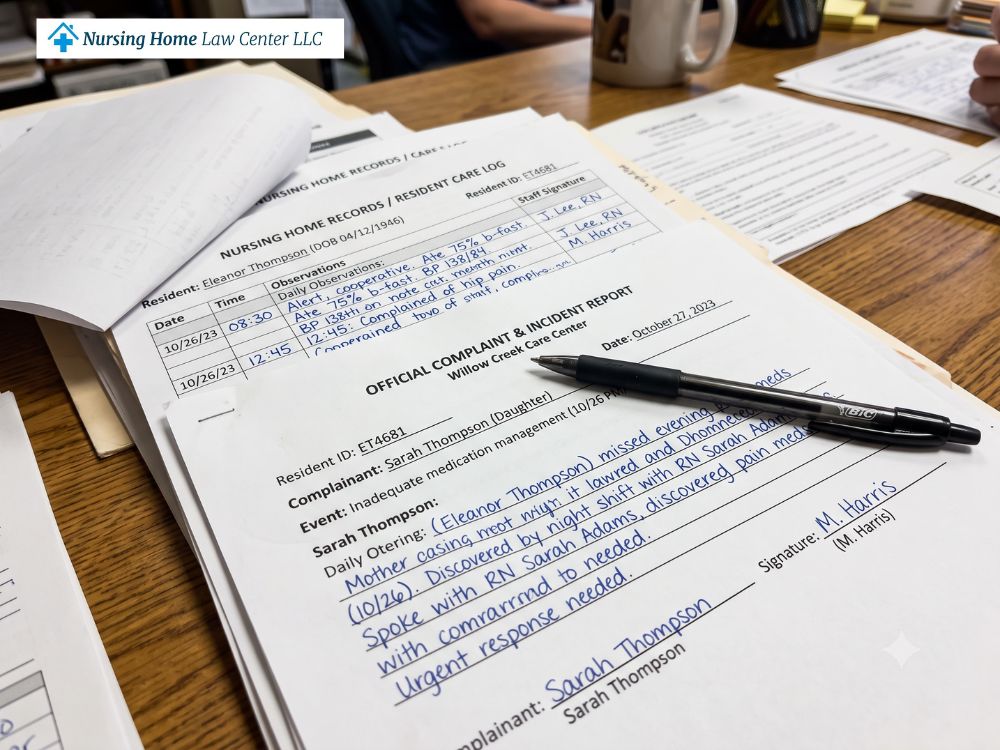
Families in Alabama may report nursing home abuse or neglect to several government agencies. The best contact depends on what happened, whether the nursing home resident remains at risk, and whether the issue involves facility conditions, criminal conduct, Medicaid-funded care, resident rights, or professional misconduct.
Call 911 first if the nursing home resident is in immediate danger. This includes suspected assault, sexual abuse, threats, severe neglect, untreated injury, unsafe restraint, wandering or elopement risk, or urgent medical distress.
Alabama law enforcement should also be contacted when the abuse may involve criminal conduct, such as physical injuries, sexual assault, theft, intimidation, or intentional harm. A police report can help document the incident and may become important if the facility later disputes what happened.
The Alabama Department of Public Health’s Bureau of Health Provider Standards is the state agency responsible for nursing home facility complaints in Alabama. ADPH states that the Alabama State Survey Agency has regulatory responsibility for all nursing homes in the state and lists abuse, neglect, poor care, insufficient staff, unsafe or unsanitary conditions, dietary problems, and mistreatment as examples of nursing home complaint reasons.
ADPH allows nursing home complaints through its Nursing Home Complaint Form, the ElderCare Hotline at 1-800-356-9596, email, or mail to:
The Complaint Unit at the Alabama Department of Public Health
Bureau of Health Provider Standards
201 Monroe Street
Suite 700
Montgomery, AL 36130-3017
If the abuse occurred in an assisted living facility, reach out to the ALF complaint unit via email, by calling the Assisted Living Facilities complaint hotline at 1-866-873-0366, or write a letter of complaint to the above address.
The Alabama Department of Human Resources Adult Protective Services Division handles reports involving abuse, neglect, or exploitation of elderly and disabled adults. DHR states that APS investigates reports involving older adults who cannot protect their own interests.
Families should contact Alabama APS when the concern involves:
Reports can be made to the Adult Abuse Hotline at 1-800-458-7214. DHR states that the hotline is staffed during regular workdays and hours but is accessible 24 hours a day, seven days a week. The adult abuse, neglect, or exploitation reporting form can also be mailed to:
Alabama Department of Human Resources
Adult Protective Services Division
50 N. Ripley St.
P.O. Box 304000
Montgomery, AL 36130-4000
Alabama DHR also states that reports may be made to the sheriff, chief of police, or any County Department of Human Resources office. Anonymous reports are accepted.
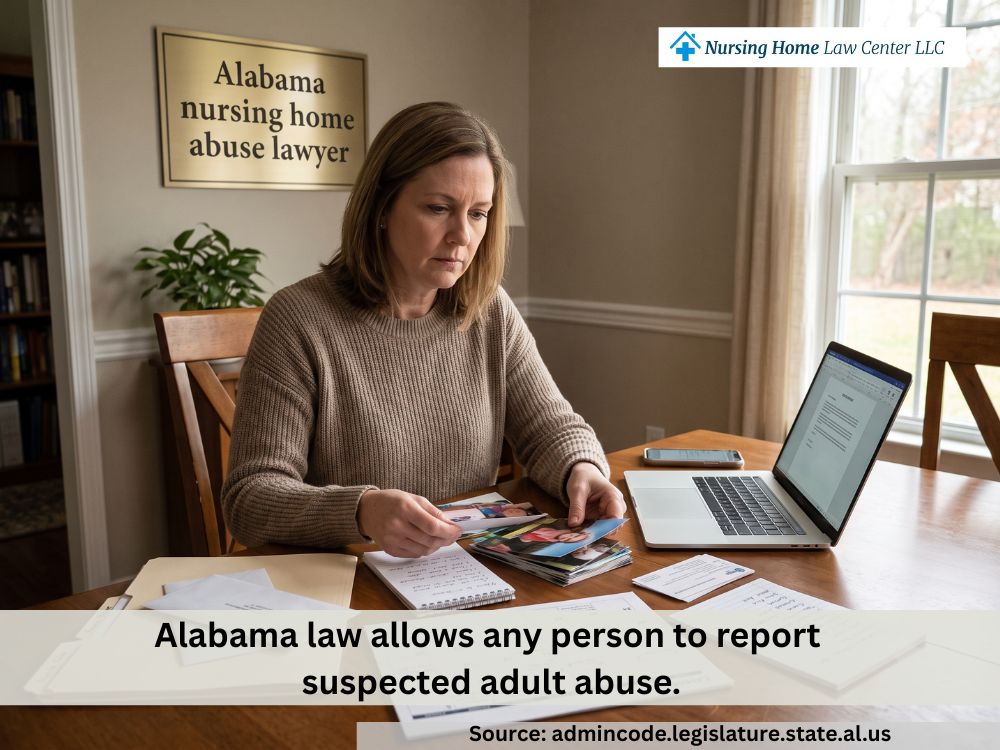
The Alabama Office of the State Long-Term Care Ombudsman Program helps residents of nursing homes and other long-term care facilities resolve complaints about care, resident rights, discharge concerns, visitation problems, and facility treatment. Complaints may be filed in writing, by phone, or in person, and complainants do not have to give their name.
Families should contact the ombudsman when the concern involves:
Complaints may be filed in writing, by phone, or in person. The Alabama Ombudsman Program can be reached at 334-242-5753 or
RSA Tower
201 Monroe Street
Suite 350
Montgomery, AL 36104
The state has 13 Area Agencies on Aging (AAAs) which implement senior services in different counties.
If the concern involves Medicaid billing, fraud, misuse of Medicaid funds, or abuse tied to Medicaid-funded care, families may contact Alabama Medicaid or the Alabama Attorney General’s Medicaid Fraud Control Unit.
Alabama Medicaid states that recipients, providers, and the public may report suspected fraud, abuse, or misuse of the Alabama Medicaid program by calling 1-866-452-4930, writing to the Program Integrity Division, or using the online fraud and abuse reporting option. A person reporting suspected fraud or abuse is not required to give their name, and information provided is kept confidential.
The Alabama Attorney General’s Medicaid Fraud Control Unit investigates and prosecutes allegations of fraud against the Alabama Medicaid program and Medicaid providers. The unit also investigates allegations of patient abuse in Medicaid-funded facilities.
Families should use this reporting path when the concern involves:
Some complaints involve an individual professional rather than only the nursing home as a facility. In those cases, families may also report the conduct to the appropriate licensing board.
The Alabama Board of Nursing handles complaints involving nurses and states that unsafe practice, substandard practice, unprofessional conduct, substance abuse, and practicing beyond the scope of a license may warrant notification to the board. The board does not process anonymous complaints.
The Alabama Board of Nursing can be reached at 1-800-656-5318.
Their physical address is:
RSA Plaza, Suite 250
770 Washington Ave.
Montgomery, AL 36104
Their mailing address is:
Alabama Board of Nursing
PO Box 303900
Montgomery, AL 36130-3900
The Alabama State Board of Medical Examiners and Medical Licensure Commission receives and investigates complaints against physicians and assistants to physicians. The board states that it does not regulate hospitals, nursing homes, or other healthcare facilities, so families should use this route for physician or physician assistant misconduct rather than facility-wide neglect.
The Alabama Board of Medical Examiners can be reached at 334-242-4116, and the Alabama Medical Licensure Commission can be reached at 334-242-4153. To file a complaint, fill in the form and mail it to the address provided.
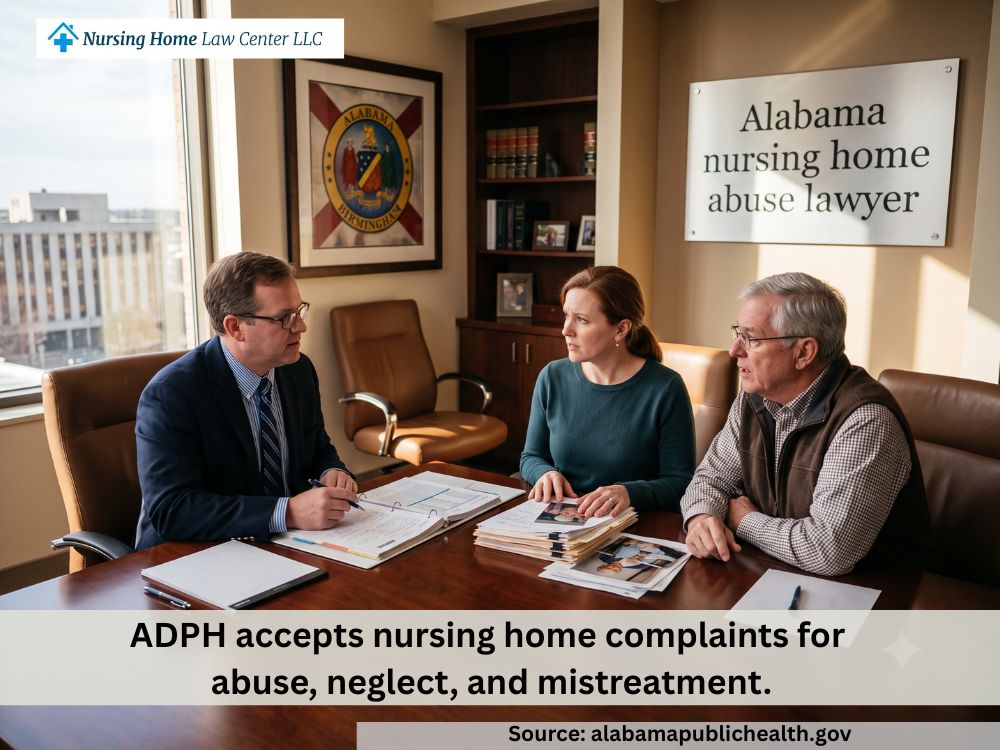
For misconduct by a nursing home administrator, families may contact the Alabama Board of Examiners of Nursing Home Administrators. The board can be reached at 334-271-2342, and complaint forms must be submitted in writing and signed with contact information included. They can be sent via email or to
Alabama Board of Examiners of Nursing Home Administrators
Katrina Magdon
4156 Carmichael Road
Montgomery, AL 36106
To report nursing home abuse in Alabama, ensure the resident is safe, document the facts, and report the concern to the agency that has authority over the issue. You do not need to prove abuse before filing a complaint. Suspicion based on injuries, resident statements, unsafe conditions, sudden decline, or inconsistent facility explanations may be enough to justify a report.
A strong Alabama nursing home abuse report should give the agency enough detail to identify the resident, understand the risk, and determine whether immediate action is needed.
Families should include:
Keep the report factual and separate what was personally observed from what the resident, another family member, staff, or witness said. Avoid guessing about motives, but include any pattern of repeated injuries, ignored call lights, missed medications, or changing explanations from the facility.
Nursing home abuse and neglect in Alabama can come in many forms, including physical abuse, emotional abuse, exploitation of financial resources, poor medical care, unsafe staffing, or failure to provide proper care. Families should report suspicions promptly when the nursing home gives vague explanations, delays care, or refuses to provide clear records.
Warning signs of nursing home abuse that may justify a report include:
Alabama law also makes it unlawful to abuse, neglect, exploit, or emotionally abuse a protected person. Under Ala. Code § 38-9-7, residence in a nursing home, mental institution, developmental center, or other convalescent care facility is prima facie evidence that the person is a protected person.
What happens after a report depends on the agency involved:
An agency investigation can help document facility failures, but it is not the same as a civil claim for compensation. Even when a state agency investigates, families may still need a nursing home abuse lawyer to obtain records, identify all liable parties, review staffing and care documents, and determine whether the facility’s negligence caused injury or wrongful death.
If the nursing home retaliates after a complaint, document it immediately. Retaliation may include discharge threats, substandard care, restricted visitation, isolation, intimidation, refusal to communicate, or sudden changes in how staff treats the resident.
Some Alabama agencies allow anonymous reports of nursing home abuse, including DHR, the Alabama Department of Senior Services, the state’s Ombudsman Program, as well as Alabama Medicaid.
Even when anonymous reporting is allowed, providing contact information may help investigators follow up, clarify details, and act faster. Families who fear retaliation should tell the agency about that concern when making the report.
Families may report concerns to the nursing home administrator, director of nursing, charge nurse, social worker, or corporate office, but serious abuse or neglect should also be reported outside the facility. Internal reporting alone can leave the family dependent on the same facility that may have ignored the warning signs.
If the facility changes its explanation, delays medical care, refuses to provide records, discourages outside reporting, or blames the resident without explaining staff supervision, document those facts. A facility’s negligence may involve both the original harm and the failure to investigate, report, or protect the resident after warning signs appeared.
Reporting suspected abuse in Alabama can trigger an agency investigation, inspection, ombudsman intervention, APS response, law enforcement investigation, Medicaid fraud review, or professional licensing review. A report focuses on resident safety, facility compliance, and possible regulatory or criminal action.
A nursing home abuse lawsuit, on the other hand, focuses on proving that the facility, staff, administrator, ownership company, contractor, or medical provider caused harm through abuse, neglect, or negligence. A nursing home abuse settlement in Alabama may seek compensation for medical expenses, pain and suffering, emotional distress, relocation costs, disability, disfigurement, or other damages.
A state report may help create a record, but it does not automatically produce compensation for nursing home abuse and neglect. Families may still need legal help to obtain the resident’s chart, staffing records, care plans, wound records, medication administration records, incident reports, inspection history, surveillance footage, and witness statements.
Families should contact an Alabama nursing home abuse lawyer when a resident suffered injury or death because of suspected nursing home abuse or neglect.
Legal help may be especially important when:
Our experienced attorneys can provide guidance through each step of the process of taking legal action, including:
Our law firm will help collect and analyze critical evidence, including:
If your family needs help understanding how to file a complaint after your loved one suffered abuse in a nursing home in Alabama, you do not have to rely only on the facility’s explanation. Reporting elder abuse or neglect can help protect the resident’s well-being and alert state agencies, but a personal injury lawsuit may also be necessary when the facility’s negligence caused serious harm.
Our nursing home abuse attorneys can review what happened, explain which Alabama reporting agencies may apply, preserve evidence, and explain your legal options to file a claim. Contact Nursing Home Law Center for a free case review. There are no upfront attorney fees, and you pay nothing unless we help you recover compensation.