
Experienced Attorneys Protecting the Rights of the Neglected and Abused
The Nursing Home Law Center is committed to providing the legal resources necessary to hold negligent facilities accountable.

Wisconsin nursing home lawsuit settlements provide financial compensation when a resident is injured because a facility failed to provide proper care, prevent abuse, monitor residents, or respond to warning signs of decline.
These cases may involve falls, pressure ulcers, medication errors, dehydration, malnutrition, physical abuse, poor hygiene, broken bones, or wrongful death.
Settlement value depends on how the facility failed the resident, whether staff members ignored known risks, and how the resident’s injuries affected the resident and family members.
Our Wisconsin nursing home abuse attorneys review medical records, incident reports, and facility history to determine whether you have grounds for legal action and help you hold responsible parties accountable. Contact us for a free legal consultation.
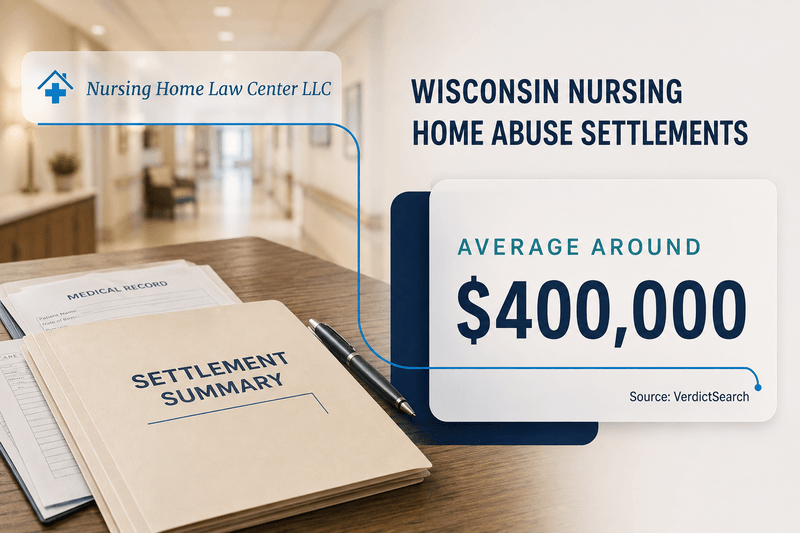
The average nursing home abuse settlement in Wisconsin is $400,000.
The following Wisconsin nursing home cases illustrate how families have recovered compensation for injuries and wrongful deaths caused by neglect, understaffing, and unsafe facility conditions.
A 74-year-old resident of a Port Washington senior living community was buried under debris after a retaining wall on the property collapsed, and she died from the injuries the next day.
Her estate brought a claim against the nursing facility and the contractor responsible for building the wall.
An 89-year-old Kenosha assisted living resident with dementia wandered outside and froze to death after staff failed to notice her absence for approximately seven hours.
Her son pursued a nursing home wrongful death claim, alleging staff ignored the door alarm and failed to follow required safety checks.
Certain injuries show up again and again in Wisconsin nursing home claims because they often trace back to preventable staff failures rather than an unavoidable decline in health.
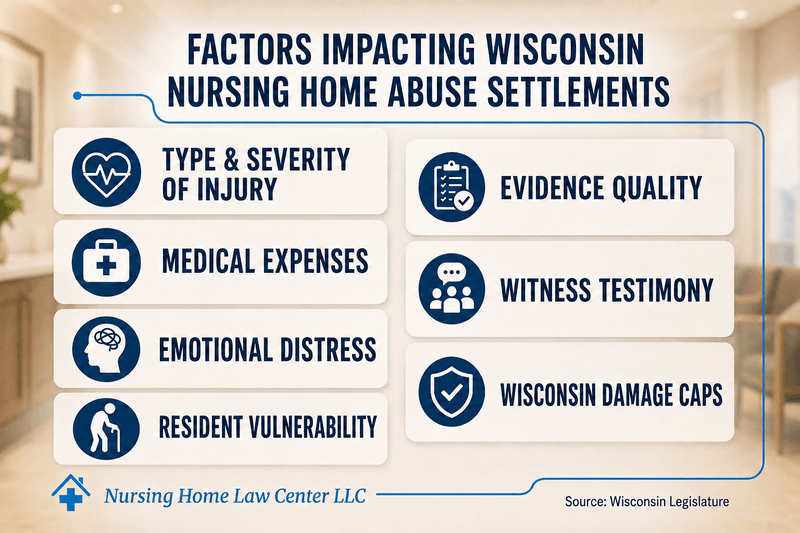
Settlement value in a Wisconsin nursing home case depends on several factors, including:
Falls, pressure ulcers, infections, medication errors, choking, fractures, malnutrition, dehydration, and assault can each involve different damages. Furthermore, whether the injury required hospitalization, surgery, led to permanent disability, or death significantly affects settlement value.
The cost of hospitalization, surgery, ongoing treatment, and rehabilitation directly shapes settlement value, since these documented costs form the economic foundation of the claim.
Beyond physical injury, the psychological toll on the resident and the trauma experienced by family members who witnessed the decline can add significant value to a claim.
Dementia, mobility limits, swallowing risks, diabetes, or prior wounds may show the facility knew the resident needed closer supervision, but didn’t provide it.
Missing records, late charting, inconsistent notes, or altered records can affect settlement negotiations and case value.
Family members, staff, roommates, visitors, and outside providers may help establish what actually happened to the resident, contributing to a higher settlement amount.
Noneconomic damages for residents in Wisconsin nursing home facilities are generally capped at $750,000 for both independent and hospital-affiliated facilities under Wis. Stat. § 893.555 and Wis. Stat. § 893.55, while economic damages are unlimited. The $750,000 limit may not apply in cases of intentional abuse or assault against a resident. If the facility’s negligence results in an adult resident’s death, Wis. Stat. § 895.04 caps noneconomic damages to $350,000 for the loss of society and companionship.
The type of compensation available depends on the injuries and whether the resident survived. Recoverable damages in a Wisconsin nursing home case may include:
Wisconsin allows punitive damages when a facility acted maliciously or with intentional disregard for a resident’s rights, but caps the amount at twice the compensatory damages awarded or $200,000, whichever is greater, under Wis. Stat. § 895.043. Punitive damages are not available in wrongful death cases.
A Wisconsin nursing home settlement typically takes anywhere from several months to a few years, depending on the severity of the injury, how many defendants are named, and how much medical evidence must be gathered and reviewed before a fair settlement figure can be reached.
The filing deadline depends on the type of Wisconsin nursing home claim.
Wisconsin nursing home injury claims generally must be filed within three years from the date of the injury or one year from the date the injury was discovered, as outlined in Wis. Stat. § 893.54(1m). In most cases, no claim may be filed more than five years after the act or omission.
A wrongful death claim must generally be filed within three years of the date of death under Wis. Stat. § 893.54.
Because different deadlines may apply depending on the facts of the case, families should take legal action to seek compensation and hold facilities accountable as soon as possible. Once the deadline passes, families generally lose the right to pursue compensation altogether. Even before then, failing to act quickly can make it harder to obtain evidence, locate former staff members, and preserve witness statements.
Before accepting any settlement offer, Wisconsin families should take steps to protect their loved one and strengthen their case.
Most Wisconsin nursing home abuse lawsuits settle before trial, but reaching a fair settlement usually requires thorough investigation, medical record review, expert input, and negotiation with the facility’s insurer or defense counsel. Our nursing home neglect and abuse lawyers can help with:
Our nursing home abuse law firm has secured fair compensation for families and victims harmed by negligent facilities. The results below reflect real outcomes secured through our legal process for residents and their loved ones.
Karen’s husband was admitted to a nursing facility after hip replacement surgery. Staff failed to reposition him regularly, and severe pressure sores developed, leading to untreated infections and ultimately, his death.
Our legal team uncovered gaps in his medical records and evidence that facility management ignored repeated warning signs.
Ruth and Dorothy were both sexually assaulted during overnight shifts by a certified nursing assistant, but were unable to report the incidents due to their cognitive limitations.
The nursing home sexual abuse settlement addressed the residents’ quality of life, emotional distress, and the facility’s failure to properly screen and supervise staff and stop repeated violations.
Susan’s mother died after developing severe pressure wounds that progressed to a bone infection at a care facility.
We shaped the settlement amount based on missing incident reports, delayed medical treatment, and the family’s argument that responsible parties could have prevented her death with proper professional care.
Sebastian, a longtime nursing facility resident with a known fall risk, was found on the floor of his room after staff left him unsupervised during a shift change. He suffered a subdural hematoma and a fractured hip.
We helped his family pursue compensation for his declining quality of life.
Betty wandered into an unlocked storage closet at her care facility and ingested cleaning chemicals left within reach. She died shortly after being transported to the hospital.
Our investigation unveiled understaffing and failure to secure hazardous materials, helping her family hold the facility accountable for a death that proper supervision would have prevented.
Gabriel suffered serious injuries after being physically attacked by another resident during an unsupervised period at a group home.
The settlement addressed his pain and suffering, and the facility’s failure to protect him and other residents from a known danger despite prior incident reports.
Helen choked during a meal at her nursing facility after staff served her food inconsistent with her prescribed swallowing precautions. She died before emergency responders arrived.
We resolved the case without formal litigation once our investigation confirmed the facility deviated from her care plan.
Linda, a nursing home resident with limited mobility, was injured when a facility transport van collided with another vehicle while she was inadequately secured in her wheelchair.
Our lawyers secured maximum compensation for her ongoing care needs.
If your loved one suffered serious harm at a Wisconsin assisted living facility or nursing home, contact us for a free legal consultation. Our legal team can review medical records to evaluate your loved one’s injuries, identify the responsible facility, and outline your legal options. We represent clients in claims against poorly rated nursing homes throughout Wisconsin, including Green Bay, Madison, Milwaukee, Racine, and beyond.
Our attorneys work on a contingency-fee basis, meaning you owe no attorney fees unless we recover compensation for you. To speak with an experienced lawyer, call (800) 926-7565 or complete the online contact form.