
Experienced Attorneys Protecting the Rights of the Neglected and Abused
The Nursing Home Law Center is committed to providing the legal resources necessary to hold negligent facilities accountable.

Knowing how to report nursing home abuse in Kansas can protect a loved one from further harm. Call 911 when a loved one is being physically assaulted, appears to have suffered sexual abuse, needs urgent medical treatment, or cannot remain in the nursing home without facing immediate danger. Afterward, report nursing home abuse to the Kansas offices overseeing adult care homes, resident rights, Medicaid services, and professional conduct.
The Kansas Department for Aging and Disability Services is the primary agency responsible for investigating nursing home abuse. Adult Protective Services, the long-term care ombudsman, the Kansas Attorney General, or a licensing board may also be involved.
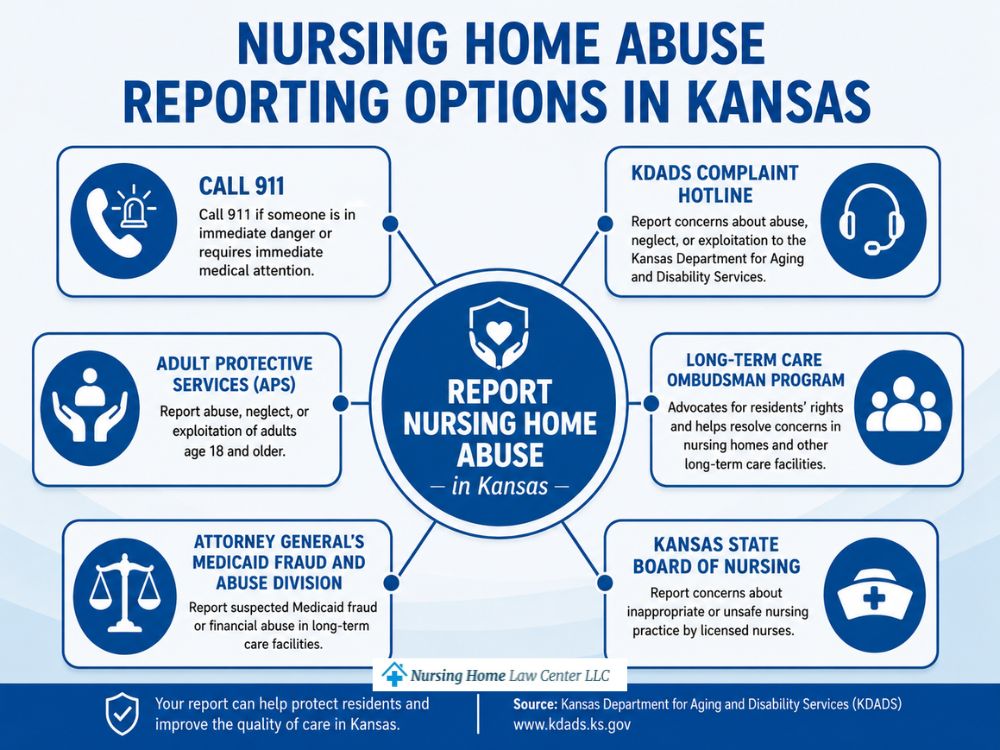
There are several ways for families to report nursing home abuse or neglect. The appropriate state agency depends on the type of mistreatment, the resident’s condition, and whether the care facility is licensed, Medicaid-funded, or suspected of criminal conduct.
Call 911 if the resident faces immediate danger, sexual assault, physical abuse, theft, restraint, or urgent medical risk. Give the nursing home name, room number, injuries, suspected perpetrator, and whether the threat continues. Ask police for the incident report.
The Kansas Department for Aging and Disability Services (KDADS) regulates nursing homes and other licensed adult care homes, including assisted living facilities, and investigates complaints involving abuse, neglect, exploitation, and inadequate care.
Contact the Kansas Department for Aging and Disability Services about poor staffing, medication mistakes, pressure injuries, delayed treatment, poor hygiene, sudden weight loss, falls, or nursing home neglect.
The KDADS can be contacted Monday through Friday, 8 a.m. to 5 p.m., excluding holidays, through the following channels:
Phone: (800) 842-0078
Email: KDADS.ComplaintHotline@ks.gov
Fax: (785) 296-0256
The Kansas Department for Children and Families operates Adult Protective Services for adults unable to safeguard their health, safety, or finances. To report elder abuse, neglect, or financial abuse, call (800) 922-5330 at any hour.
Contact the APS when suspected abuse involves a relative, guardian, visitor, community caregiver, abandonment, coercion, or exploitation affecting the resident’s well-being.
The Kansas long-term care ombudsman advocates for residents in assisted living facilities and other long-term care facilities. You can report concerns about your loved one’s rights, care-plan disputes, missing property, discharge threats, restricted visits, or retaliation.
The ombudsman can be contacted Monday through Friday, 8:30 a.m. to 5 p.m. by phone:
Toll-free: 877-662-8362
Local: (785) 296-3017
The Kansas Attorney General’s Medicaid Fraud and Abuse Division may investigate provider fraud and patient abuse or neglect. Examples include billing for Medicaid services never delivered, altering records, hiding neglect, diverting funds, or charging for nursing home care not provided.
Use the Attorney General’s complaint channel or call (785) 296-2215.
A separate licensing complaint may be appropriate for unsafe conduct by an APRN, RN, LPN, or licensed mental health technician. The Kansas State Board of Nursing may investigate medication diversion, false charting, impairment, abandonment, or ignored physical changes.
Use the Board’s online complaint portal or call (785) 296-8401.
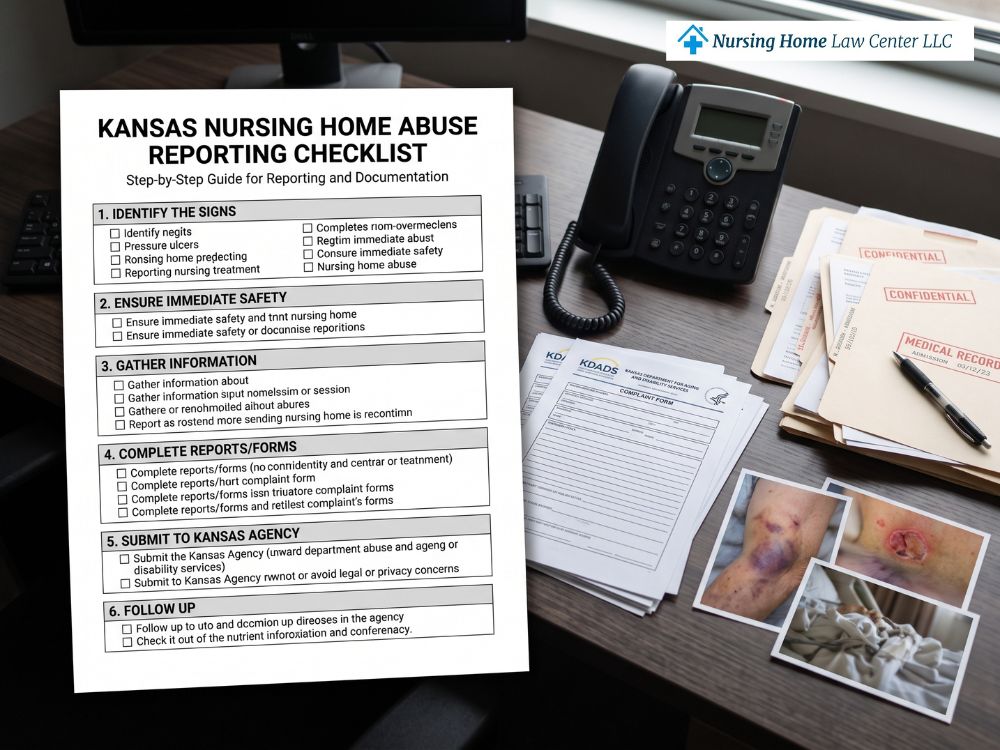
Call 911 if the resident is being assaulted, has a serious injury, needs urgent medical treatment, or cannot safely remain near the suspected abuser. Do not let an internal review delay emergency care.
Record the date, approximate time, room or unit, staff members present, possible witnesses, and your loved one’s exact words. Include any earlier concerns reported to the Kansas nursing home and how administrators responded.
Take clear pictures of visible injuries and unsafe conditions when it is safe and lawful to do so. Relevant evidence may include unexplained bruises, restraint marks, swelling, torn clothing, soiled bedding, pressure sores, broken equipment, medication packaging, or hazardous room conditions.
Ask a healthcare provider who is not employed by the nursing home to evaluate the resident. The examination may identify fractures, dehydration, malnutrition, infection, untreated wounds, overmedication, or another condition associated with nursing home neglect. An outside assessment can also create medical documentation linking the care failure to the resulting harm.
Complaints involving abuse, neglect, falls, unsafe conditions, staffing problems, medication errors, pressure injuries, infections, or other violations inside a licensed nursing home should generally be reported to the Kansas Department for Aging and Disability Services.
The Kansas Long-Term Care Ombudsman can assist with resident-rights violations, discharge threats, restricted visitation, retaliation, care-planning disputes, and complaints the facility has failed to resolve. The KDCF Adult Protective Services may also become involved when a vulnerable adult is being abused, neglected, or financially exploited.
Keep complaint forms, emails, photographs, screenshots, fax confirmations, certified-mail receipts, police reports, medical records, witness information, and notes from every phone call in one secure location.
Ask the agency to confirm receipt of the complaint and save the assigned case or reference number. Request an explanation of the next steps and how additional evidence should be submitted.
If the nursing home or investigating agency does not respond, send a dated written follow-up and retain a copy. Do not rely solely on verbal statements that the issue is being handled.
Reporting nursing home abuse or neglect may lead to an inspection, protective action, licensing consequences, or a criminal investigation. Those proceedings do not automatically compensate the resident or family. An attorney can separately investigate the claim and pursue compensation through a personal injury or wrongful death lawsuit.
Give as much detail as possible without delaying the report. Include:
K.S.A. 39-1402 requires specified professionals with reasonable cause to believe that an adult care home resident has suffered abuse, neglect, or exploitation to report immediately to the Kansas Department for Aging and Disability Services. The statute also permits other people with reasonable cause to make a report. The report should identify the reporter, resident, known next of kin, caretaker, conduct, and facts useful to the investigation.
Nursing home abuse takes many forms. Repeated injuries, missing records, evasive answers, or sudden changes should not be dismissed.
Warning signs that warrant reporting include:
Families should report nursing home abuse when the explanation conflicts with the evidence or staff repeatedly dismiss concerns. Taking prompt action can protect the loved one and other residents from further harm.
The Kansas Department for Aging and Disability Services determines jurisdiction and urgency. An investigation may include an unannounced visit, interviews, observation, and review of care plans, incident reports, medication records, and staffing information.
When violations are substantiated, the Kansas Department for Aging and Disability Services may require corrections, issue deficiencies, make referrals, or pursue enforcement actions. A Kansas professional licensing board may separately review professional conduct. Suspected assault, sexual abuse, financial exploitation, theft, or other criminal conduct may also be investigated by local law enforcement.
A state investigation focuses on resident safety and regulatory compliance, not compensation or civil justice. A Kansas nursing home abuse attorney may need to obtain additional records, consult medical experts, identify every responsible party, and pursue damages through legal action.
Report retaliation immediately. Discharge threats, restricted family access, isolation, intimidation, reduced assistance, or refusal to communicate can threaten the resident’s health and well-being.

KDADS accepts anonymous reports about adult care homes. The Kansas Department for Children and Families also accepts anonymous APS reports. The Attorney General’s Office of Inspector General allows a person to report suspected abuse, fraud, or exploitation without giving a name.
Mandatory reporters should follow the identification requirements under Kansas law rather than assuming they may remain anonymous.
Anonymous reporting may be harder to contact for clarification. A reporter worried about retaliation can provide contact information while asking how confidentiality will be handled.
Family members may raise a minor concern with the administrator, director of nursing, charge nurse, or social worker. Keep the complaint in writing.
Do not rely only on the nursing home when the allegation involves immediate risk, physical abuse, sexual abuse, severe neglect, theft, falsified records, retaliation, or evidence that could disappear. File a complaint outside the facility when management may be involved, or previous complaints were ignored.
A failure to investigate, report abuse, or protect residents after warning signs may become evidence of nursing home neglect.
A report asks an agency to investigate safety, licensing, crime, professional misconduct, or Medicaid-funded care. A lawsuit seeks accountability, financial compensation, and civil justice.
When nursing home abuse or neglect causes injury, emotional harm, financial loss, disability, or death, a Kansas nursing home abuse settlement may compensate the resident or family members.
Family members need not wait for the state investigation before reviewing legal options. Surveillance, staffing records, electronic data, and witness memories can disappear.
Families do not have to wait for law enforcement or another state agency to finish its investigation before speaking with an attorney. A nursing home abuse attorney can conduct an investigation independent of the care facility and government offices. Early legal action may preserve evidence and help the family pursue justice.
Seek legal counsel when:
A legal investigation may preserve and analyze:
The evidence may reveal understaffing, delayed treatment, unsafe transfers, weak infection controls, false documentation, or failure to shield residents from dangerous employees or other residents. A lawyer can identify each responsible party, explain legal options, calculate damages, and seek justice through legal action.
Nursing Home Law Center can explain how to report nursing home abuse in Kansas and provide comprehensive legal support tailored to families seeking justice.
Our nursing home abuse attorneys can preserve critical evidence, review medical and facility records, examine Kansas inspection findings, and investigate whether the nursing home, its employees, contractors, or another responsible party failed to protect the resident.
Call us at (800) 926-7565 or fill out our contact form to schedule a free consultation.