
Experienced Attorneys Protecting the Rights of the Neglected and Abused
The Nursing Home Law Center is committed to providing the legal resources necessary to hold negligent facilities accountable.

How to report nursing home abuse in Iowa depends on whether the resident is facing immediate danger.
Call 911 when a loved one is being assaulted, has suffered life-threatening injuries, requires urgent medical treatment, or cannot safely remain in the nursing home.
After the immediate threat has been addressed, notify the agencies responsible for investigating abuse, neglect, and exploitation in Iowa nursing homes. Reports may be directed to the Iowa Department of Inspections, Appeals, and Licensing, Iowa HHS, or the State Attorney General, the long-term care ombudsman, or the professional licensing board that oversees an involved nurse or other healthcare provider.
Families may need to contact more than one agency when reporting nursing home abuse.
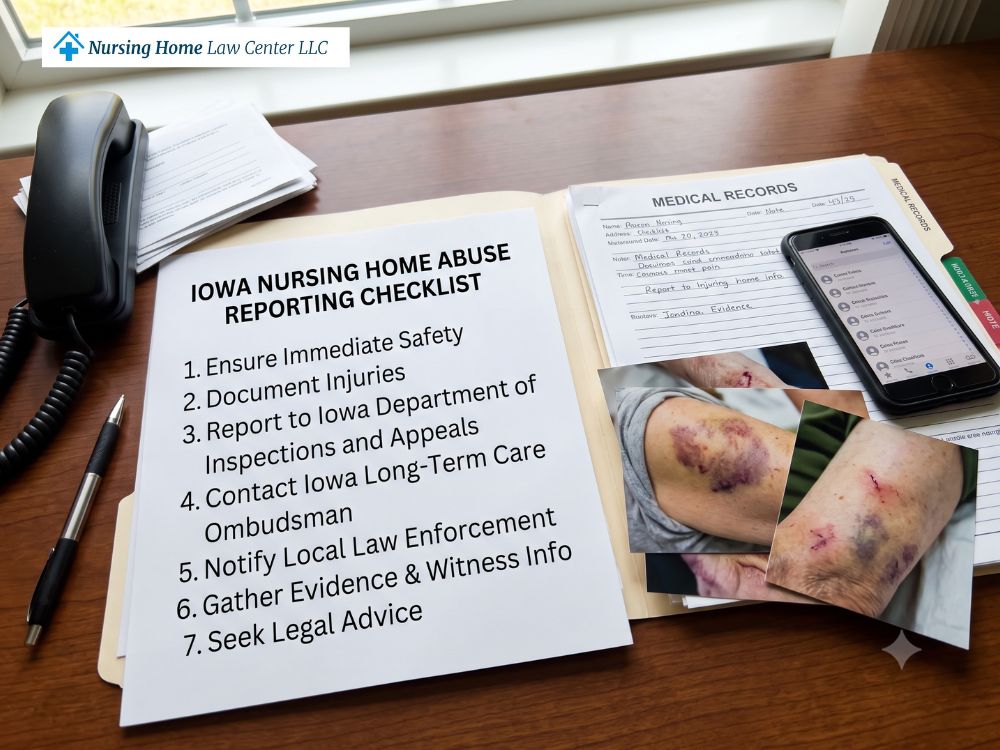
Law enforcement may investigate physical abuse, sexual abuse, threats, theft, confinement, or other conduct that could support criminal prosecution. Tell the dispatcher that the incident involves a vulnerable nursing home resident. Give the facility name, room number, known injuries, suspected perpetrator, and any reason the resident remains at risk.
The Iowa Department of Inspections, Appeals, and Licensing (DIAL) regulates nursing homes and other licensed health facilities. This is usually the primary agency for complaints involving poor treatment, unsafe conditions, medication mistakes, inadequate staffing, poor hygiene, infection-control failures, or other forms of nursing home neglect.
DIAL also accepts reports concerning staff and suspected nursing home abuse occurring inside a licensed health facility. Its investigators may inspect the nursing home, interview witnesses, review records, and determine whether the facility violated state or federal requirements.
A report may be submitted through DIAL’s online complaint portal. Families can also contact the Health Facilities Division at (877) 686-0027. Include as much detail as possible: dates, names, injuries, medical consequences, prior complaints, and the nursing home’s response.
Iowa HHS handles reports of dependent adult abuse through Adult Protective Services. Contact APS when suspected elder abuse, neglect, or exploitation occurs in a community setting. Reports may be made 24 hours a day at (800) 362-2178.
The Iowa Office of the State Long-Term Care Ombudsman advocates for people living in nursing homes, assisted living programs, group homes, and other long-term care facilities.
An ombudsman can help when a loved one faces discharge threats, retaliation, restricted visitation, ignored complaints, care-planning disputes, or violations of resident rights.
The statewide toll-free number is (866) 236-1430. Residents and families may also submit an inquiry through the program’s online form.
Report suspected Medicaid provider fraud to the Iowa Medicaid Fraud Control Unit at (877) 446-3787. Relevant conduct may include billing Medicaid services never provided, falsifying care records, diverting resident funds, concealing neglect, or charging for a level of care the nursing home did not deliver.
The Medicaid Fraud Control Unit may conduct criminal, civil, or administrative investigations.
Misconduct by an individual professional may justify a separate licensing complaint. Iowa’s professional boards oversee nurses, physicians, nursing home administrators, social workers, therapists, and other licensed workers. Complaints can be filed online.
The appropriate board may investigate falsified records, medication diversion, practicing while impaired, patient abandonment, boundary violations, or conduct falling below professional standards. Depending on its findings, a board may impose disciplinary action against the worker’s license.
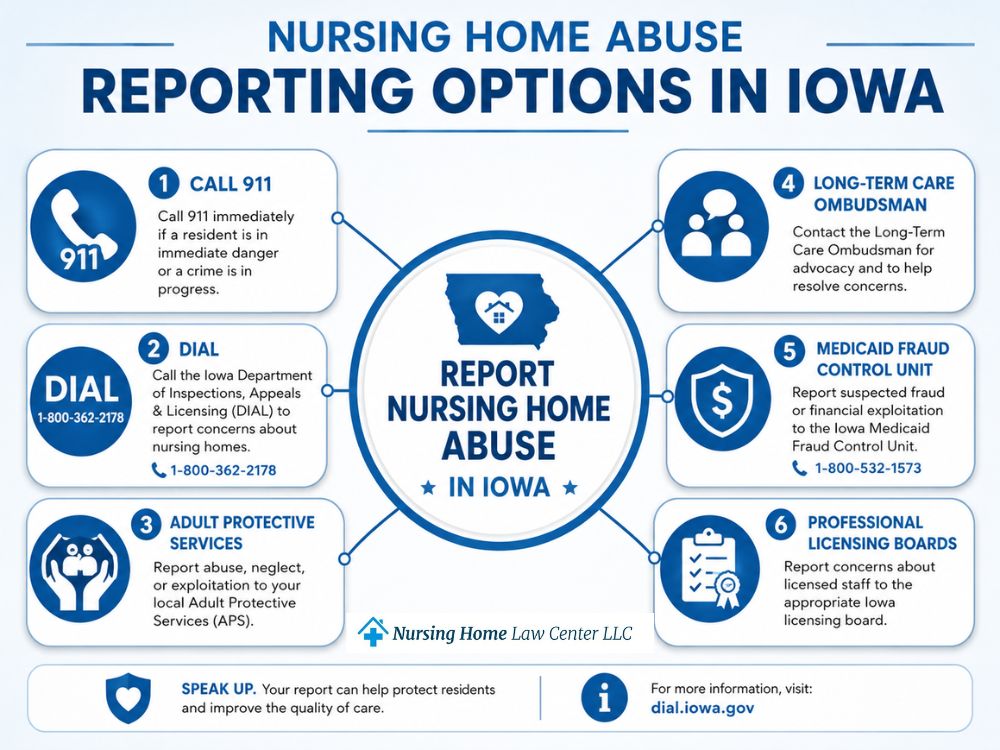
Call 911 for immediate danger. Do not allow nursing home staff to postpone emergency care while management conducts an internal review.
Write down the date, approximate time, room number, names of staff, potential witnesses, and your loved one’s exact words. Include prior concerns raised with the nursing home facility and how management responded.
Photograph visible injuries and unsafe conditions. Relevant evidence may include bruises, restraint marks, swelling, torn clothing, soiled bedding, pressure ulcers, broken equipment, or hazardous room conditions.
Ask a clinician who is not employed by the nursing home to evaluate your loved one. The examination may reveal a fracture, malnutrition, dehydration, untreated wounds, infection, overmedication, or another condition linked to nursing home neglect. An outside assessment can help create evidence that medical experts may later use to connect poor care with the resulting injury.
Complaints involving unsafe conditions, falls, abuse or neglect, poor staffing, medication errors, infections, or other violations inside licensed health facilities should generally be submitted to the Iowa Department of Inspections, Appeals, and Licensing. The long-term care ombudsman can assist with resident-rights concerns, discharge threats, visitation disputes, retaliation, and unresolved care-planning problems.
Keep complaint forms, emails, photographs, screenshots, certified-mail receipts, police reports, medical records, witness details, and notes from every phone call in one place.
Ask the agency to confirm that it received the formal complaint. Save any case number and request information about what will happen next.
Send a dated written follow-up when the nursing home or investigating agency does not respond. Avoid relying solely on verbal assurances that the complaint is “being handled.”
Reporting nursing home abuse or neglect may trigger an inspection, protective measures, or criminal investigation. An Iowa nursing home abuse lawyer can help recover compensation through a personal injury or wrongful death claim.
An effective complaint gives the investigating agency enough information to identify the resident, locate the nursing home, and assess urgency.
Include:
The warning signs of nursing home abuse that warrant reporting are:
After receiving a complaint, the Iowa Department of Inspections, Appeals, and Licensing may assess the allegations, determine the level of urgency, and assign the matter for investigation. Under Iowa law (§ 135C.38), DIAL generally initiates an on-site nursing-home inspection within two working days for alleged immediate jeopardy, 10 working days for a high-level complaint without immediate jeopardy, or 45 calendar days for other qualifying complaints.
Depending on the reported conduct, investigators may review medical and care records, interview the resident, speak with nursing home staff and witnesses, inspect the facility, or examine whether similar concerns affect other residents.
When an investigation identifies violations, the agency may require corrective action, issue citations, refer the matter to another authority, or take additional enforcement steps. Reports involving assault, theft, sexual abuse, or other possible crimes may also prompt an investigation by law enforcement. A professional licensing board may separately investigate an individual caregiver’s conduct.
Still, a regulatory investigation does not automatically recover compensation for the injured person. A nursing home abuse attorney may need to identify every responsible party, obtain additional evidence, consult medical experts, and pursue damages through a separate civil claim.
Watch closely for retaliation after reporting abuse or neglect in a nursing home or assisted living facility. Discharge threats, isolation, restricted visitation, reduced assistance, intimidation, abrupt changes in treatment, or refusal to communicate with family should be documented and reported immediately. Iowa Code § 135C.46 protects residents from retaliation or reprisal connected with complaints and grievances.
Anonymous reporting options differ by agency. The Iowa Department of Inspections, Appeals, and Licensing states that personal information is kept confidential from everyone except staff investigating the report.
Mandatory reporters cannot remain anonymous when submitting dependent adult abuse reports to HHS. They must provide their names and contact information.
The Iowa Office of the State Long-Term Care Ombudsman provides confidential advocacy to residents and families. A person concerned about identification can call 866-236-1430 before disclosing details and ask how the office will protect their information.
Some professional licensing channels use different rules. The Iowa Board of Nursing expressly accepts anonymous complaints, but warns that withholding contact information may restrict an investigator’s ability to obtain records, clarify facts, or verify allegations.
Family members who fear retaliation should say so at the outset and request that their identities remain confidential. Report any discharge threat, restricted visitation, intimidation, isolation, or decline in care that occurs after the complaint.
Families can raise a concern with the nursing home administrator, director of nursing, charge nurse, or facility social worker. A written internal complaint may force the Iowa nursing home to address an immediate care failure and creates a dated record showing when management received notice.
Report to an outside agency when the loved one faces immediate danger, the allegation involves sexual or physical abuse, severe nursing home neglect, theft, falsified records, retaliation, previous concerns were ignored, or evidence that could disappear.
The nursing home’s failure to investigate complaints or protect residents after warning signs may become part of the civil claim.
Keep records of every internal response. Note who received the complaint, what was promised, whether treatment was delayed, and whether evidence changed afterward. Preserve care-plan notes, emails, portal messages, and written replies.
Reporting nursing home abuse in Iowa may lead to an inspection, citations, or a referral to law enforcement. It does not, by itself, require the nursing home to compensate the resident or family.
A civil lawsuit serves a different purpose. When nursing home abuse or neglect causes physical injury, emotional trauma, financial loss, or death, an attorney may pursue damages from the facility and other responsible parties. Any Iowa nursing home lawsuit settlement would arise through that separate legal process, not from filing a regulatory complaint.
A report addresses safety and compliance; a lawsuit seeks to prove liability and recover compensation for the harm caused.
Family members do not need to wait for DIAL, law enforcement, or another agency to complete its investigation before seeking legal advice. Early involvement from a nursing home abuse attorney may help preserve records, identify witnesses, and prevent important evidence from disappearing.
Consider consulting an experienced attorney when:
An Iowa nursing home neglect attorney can investigate the resident’s treatment independently of the facility and any state inquiry. The investigation may reveal inadequate staffing, lack of supervision, delayed medical treatment, poor nutrition or hydration, unsafe transfers, poor wound care, weak infection controls, or a failure to protect residents from abusive employees or other residents.
To build the claim and pursue maximum compensation, our attorneys will collect and examine:
When abuse or neglect harms a loved one in an Iowa nursing home or another long-term care facility, Nursing Home Law Center can help families understand which agencies should be contacted and seek justice under federal and state law.
Our nursing home abuse lawyers can preserve evidence, review medical records, examine inspection findings, and investigate whether the nursing home, its staff, or another responsible party failed to protect the resident.
Call us at (800) 926-7565 or fill out our contact form to schedule a free case review.