
Experienced Attorneys Protecting the Rights of the Neglected and Abused
The Nursing Home Law Center is committed to providing the legal resources necessary to hold negligent facilities accountable.

Nursing home dehydration settlements provide financial compensation when a nursing home failed to provide adequate fluids, monitor fluid intake, respond to signs of dehydration, or transfer a resident for medical care after a dangerous decline. Dehydration in nursing homes is often preventable because staff are responsible for daily observation, care planning, assisting residents with meals, and enough fluids for residents who cannot safely drink without help.
A nursing home dehydration lawsuit may involve severe dehydration, chronic dehydration, acute kidney failure, urinary tract infections, low blood pressure, pressure ulcers, sepsis, hospitalization, or wrongful death. Nursing home dehydration cases are especially serious when nursing home residents have cognitive impairment, swallowing problems, dementia, mobility limits, or medications that affect blood pressure and kidney function.
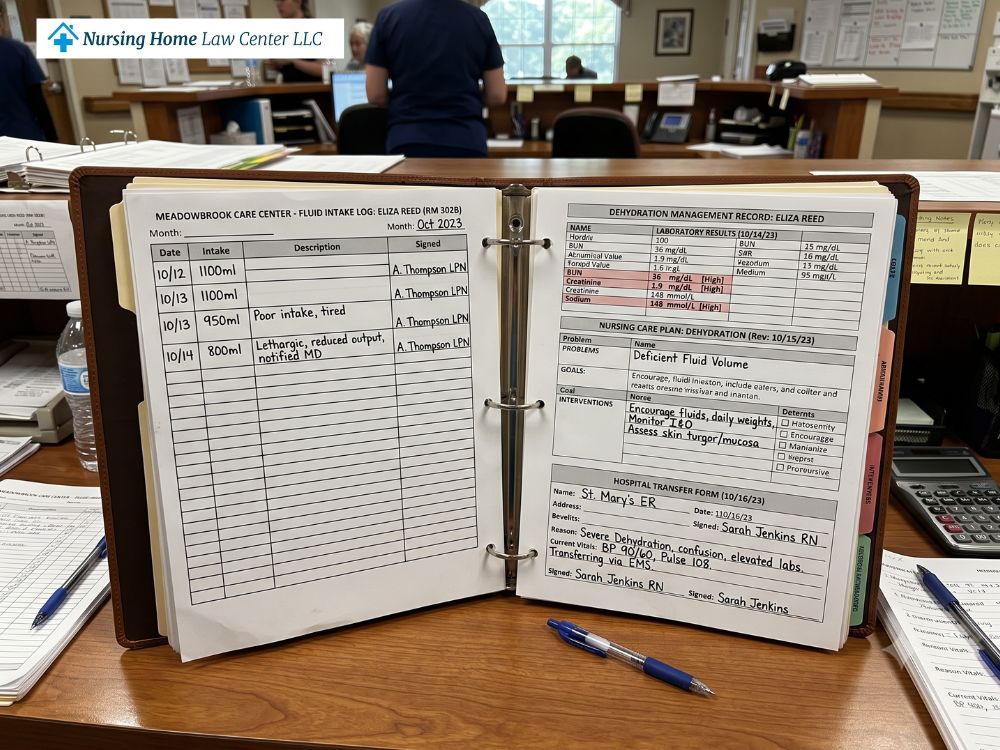
Our nursing home dehydration lawyers review medical records, fluid intake logs, care plans, hospital records, witness statements, and facility history to determine whether nursing home abuse, neglect, or negligence caused the harm. If the evidence shows that the nursing or assisted living facility failed to maintain health, provide adequate hydration, or prevent dehydration, your family may be able to file a nursing home dehydration lawsuit and seek justice. Contact us for a free case evaluation.
The average nursing home dehydration settlement is $2.2 million, while the median settlement is $1.1 million. Reported settlement values range from $300,000 to $13.5 million.
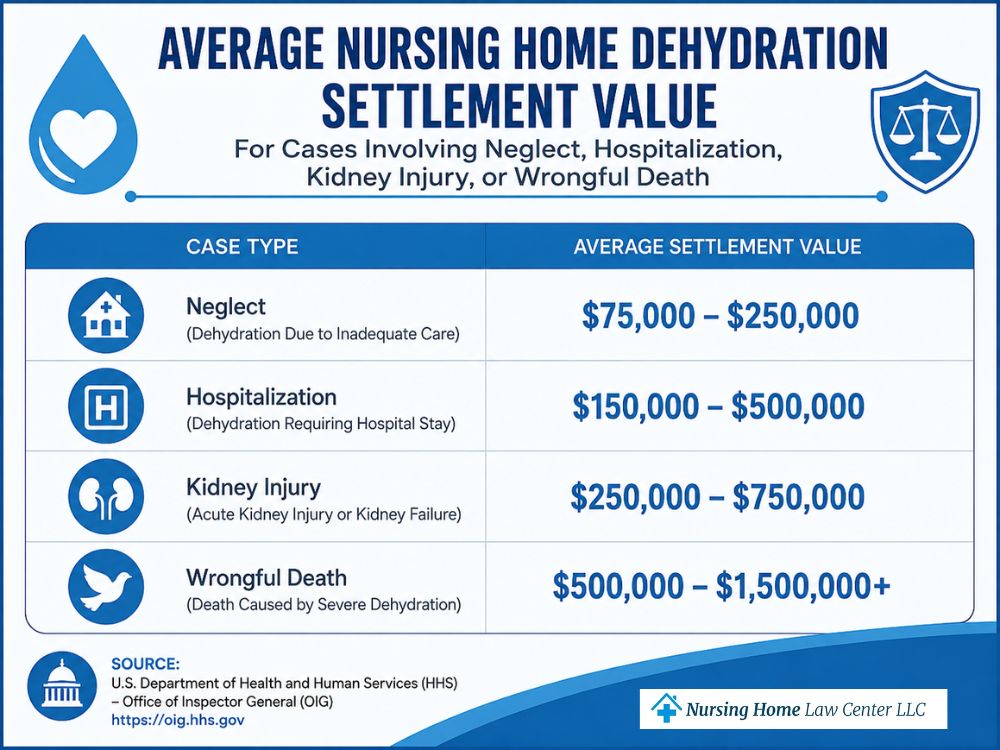
The value of a nursing home dehydration lawsuit depends on the facts of the case. Lower-value cases may involve dehydration that was treated before permanent harm occurred. Higher-value nursing home dehydration cases often involve severe dehydration, acute kidney failure, pressure sores, infection, hospitalization, physical pain, or death.
Settlement value also depends on whether the nursing home had notice of the resident’s risk. Medical records showing poor fluid intake, low blood pressure, abnormal kidney function, decreased urine output, weight loss, confusion, or other signs of dehydration can support a stronger claim.
Elvira Nunziata, 92, lived at Pinellas Park Care and Rehab Center in Florida. Her son filed a wrongful-death action after she died from injuries sustained when she fell down a flight of stairs while strapped into her wheelchair. The lawsuit alleged that the fall was the culmination of substandard care over roughly 14 months, including abuse, neglect, fiduciary-duty breaches, and inadequate corporate oversight.
Plaintiff’s counsel argued that Nunziata had dementia, previously attempted to open exit doors, and should not have been left in a position where she could access an emergency-exit stairway. Former employees also testified about understaffing, supply shortages, and institutional problems at the facility.
An expert testified that Nunziata lay at the bottom of the stairway in a pool of blood for about an hour before being found. The expert also described poor care before death, including scabies, UTIs, pneumonia, malnutrition, dehydration, and other conditions. This was also a nursing home sexual abuse case example, as Nunziata experienced unexplained vaginal bleeding during her roughly yearlong stay at the home, and an inspection by state authorities had uncovered evidence of a similar event prior to her arrival.
Dorothy Douglas, 87, was transferred to Heartland of Charleston, West Virginia, after completing hospital treatment for a urinary tract infection. Her son alleged that she was able to communicate and walk with a walker when admitted, but that her condition deteriorated sharply during a 19-day stay. He reported that she became dehydrated and malnourished, lost 15 pounds, became unresponsive, and was later transferred to another facility and then to Cabell Huntington Hospital.
Douglas’ son filed claims against the facility, corporate parent, management company, licensee, and related defendants, alleging violations of the West Virginia Nursing Home Act, professional negligence, breach of fiduciary duty, and medical malpractice. His West Virginia nursing home neglect lawyer focused on understaffing, high employee turnover, poor supervision, and failure to provide proper nutrition and hydration.
The defense denied liability and argued that Douglas’ decline was caused by preexisting conditions, Alzheimer’s disease, and lack of intake after transfer to another facility. To win the West Virginia nursing home abuse lawsuit, plaintiffs’ experts argued that Douglas died from renal failure due to complications of dehydration.
Joseph Offutt, 92, was transferred to Harborside Healthcare–Madisonville Rehabilitation and Nursing Center after a stroke left him with difficulty swallowing and left-sided weakness. He had previously been hospitalized because his wife could no longer keep him nourished and hydrated at home. After only nine days at the facility, he was sent back to the hospital with severe dehydration and died two days later.
His family’s Kentucky nursing home neglect lawyers alleged that the facility failed to monitor fluid intake, provide water flushes through his feeding tube, and maintain adequate hydration. The claim also alleged inadequate staffing, failure to keep family informed, and failure to provide adequate care.
The defense denied the allegations and argued that Offutt’s doctor had not ordered water flushes. Still, in this notable Kentucky nursing home abuse case example, it was found that the defendants failed to comply with their duties and that this failure was a substantial factor in causing Offutt’s injury or death.
Stephen Tate, a man in his 60s, lived at Signature HealthCARE of Warren after suffering a traumatic brain injury, blindness, and schizophrenia. In 2019, he lost 21 pounds, had difficulty eating safely, and allegedly was not given enough help with meals or fluids. Plaintiff’s counsel argued that staff knew he needed supervision while eating but failed to provide it, placing him at higher risk for aspiration.
The estate sued the facility and two related consulting companies, alleging negligent care and resident-rights violations. The claim focused on failure to supervise meals, failure to maintain proper hydration and nutrition support, lack of staffing, poor training, and failure to act on early signs of decline. The Ohio nursing home neglect lawyer also argued that Tate was sometimes documented as receiving care that former staff said was not actually provided.
In November 2019, Tate aspirated and vomited in his room. A nurse contacted an off-site doctor, who ordered transfer to the hospital, but counsel alleged there was a delay before 911 was called. Tate was diagnosed with aspiration pneumonia, multi-organ failure, protein-calorie malnutrition, septic shock, reduced kidney function, infected wounds, and other severe conditions. He was hospitalized for about a month, transferred to hospice, and died at age 69.
To win this Ohio nursing home neglect lawsuit, it was found that all three defendants breached the standard of care and negligently violated Tate’s resident rights.
Doris Cote, 86, was admitted to The Forum at Desert Harbor, a skilled nursing facility in Peoria, Arizona, for short-term rehabilitation after septic arthritis in her shoulder. During and after her stays, she suffered multiple falls, developed a coccyx wound, stopped eating and drinking, and was later transferred to another hospital with renal failure and symptoms of overmedication.
Her estate filed claims against the facility’s corporate owner, related entities, and the administrator, alleging elder abuse, wrongful death, and failure to properly monitor her condition. The Arizona nursing home neglect lawyers argued that the facility had notice of care problems before Cote’s admission because state inspection reports had already identified multiple deviations from accepted standards, which was the basis for this Arizona nursing home neglect settlement.
Genevieve Calandro, 91, fell from a wheelchair at Radius Health Care Center in Danvers, Massachusetts. When she was taken to the hospital, doctors found a festering wound on her back, acute appendicitis, a bloodstream urinary tract infection, kidney failure, uncontrolled diabetes, and severe dehydration. She died about one month later from systemic organ failure caused by infection.
Her estate’s Massachusetts nursing home neglect lawyer alleged that the facility was grossly negligent in her care. Family members claimed they had repeatedly been told she was doing well, even though she had complained to them and was later found with multiple serious conditions. In this Massachusetts nursing home neglect case example, the defense acknowledged some substandard care but argued that the care provided was not the proximate cause of her death.
Bobby Copeland, 71, was a long-term resident at Heritage Healthcare at Holly Hill in Valdosta, Georgia, where he required rehabilitation and skilled nursing care after paralysis from a prior fall. He began vomiting and complaining of a distended abdomen, but the only medical staff present overnight was a licensed practical nurse, who contacted an off-site physician assistant. No testing was ordered until the next day, and Copeland was later hospitalized with severe bowel obstruction, aspiration of vomit, sepsis, dehydration, a UTI, and acute respiratory failure.
With the help of a Georgia nursing home neglect attorney, his estate filed a lawsuit alleging professional negligence, ordinary negligence, violations of the Georgia Bill of Rights for Residents of Long Term Care Facilities, and fraud. The family argued that the facility failed to provide trained staff, failed to assess Copeland’s condition, and failed to provide care when his symptoms required urgent medical review.
The Georgia nursing home neglect settlement was obtained even though the defense denied nursing home negligence, arguing that Copeland had chronic medical problems and that his decline was expected over time.
Voncil Sherrod, 76, was admitted to High Pointe Health and Rehabilitation in Memphis, Tennessee, with serious preexisting medical conditions, including heart disease, vascular disease, diabetes, prior strokes, and a prior feeding tube after losing her ability to swallow. During her stay, her family alleged that she was not repositioned as required, was left in poor hygiene conditions, and suffered dehydration, malnutrition, septic shock, and worsening wounds.
Her family sued the facility, corporate entities, nursing director, and other defendants for ordinary negligence and medical malpractice. The Tennessee nursing home neglect lawyer alleged understaffing, missed physician orders, failure to administer pain medication, failure to control blood sugar, and false chart entries made when Sherrod was not at the facility or when the staff member was not scheduled to work.
In this Tennessee nursing home neglect case example, the defense denied liability, arguing that Sherrod was already gravely ill and that her deterioration was caused by severe underlying vascular disease, diabetes, and other medical problems rather than facility care.
Helen Brubaker, 75, entered Heritage St. Joseph Gardens in Fort Worth, Texas, a facility that cared for chronically infirm residents needing skilled nursing care. During her stay, she suffered several falls, bruises, lacerations, bed sores, malnutrition, dehydration, metabolic acidosis, and respiratory distress before her death.
The estate sued the facility and related entities for negligence, gross negligence, and malice. The claim alleged that staff knew Brubaker was at risk for falls and injury but failed to take protective measures. To obtain the nursing home malnutrition settlement, it was alleged that the facility consciously disregarded her suffering.
Mildred Smith, 87, lived at a healthcare and rehabilitation center in Little Rock, Arkansas, for several years before she was injured during a nursing home wheelchair van trip. After the van stopped suddenly, she fell from her wheelchair, broke her ankle, and suffered bruising to her face, arm, and leg. Her estate alleged that the facility then failed to provide proper care, causing weight loss, malnutrition, anemia, dehydration, infection, contractures, and severe pain before her death.
The estate’s Arkansas nursing home neglect lawyers filed a lawsuit against the facility and its management company, alleging negligence, medical malpractice, and violations of the Arkansas Residents’ Rights Act. The Arkansas nursing home neglect settlement was further based on claims that prior surveys had put the defendants on notice of staffing, wound prevention, treatment, and quality-of-care problems affecting nursing home residents.
George A. Dahmer, 72, was transferred to Lake Worth Manor Nursing Home after hospitalization for end-stage dementia. During his 63-day stay, his wife alleged that he lost 30 pounds, became immobile, developed infected bed sores, and was severely dehydrated before being transferred to JFK Medical Center. He died shortly afterward from bronchial pneumonia.
With the help of a Florida nursing home neglect lawyer, his wife filed a wrongful death lawsuit against the facility, a related corporate defendant, and his physician, alleging negligent care and medical malpractice. The basis for obtaining this Florida nursing home neglect settlement was that staff failed to turn him, check his skin, monitor his medicine, and provide overall care while he became increasingly weak and dehydrated.
Clara Thacker, 87, lived at Upshur Manor Nursing Home for nearly 10 months. Her estate and adult daughter alleged that she suffered repeated episodes of dehydration and malnutrition, along with multiple infected pressure sores, because the facility failed to provide care.
The Texas nursing home neglect lawyer named the facility operator, management companies, administrator, nursing director, and a licensed vocational nurse. The plaintiffs claimed that the defendants failed to staff and train the nursing department, failed to implement infection-control measures, failed to follow physician orders, and failed to meet Thacker’s basic needs. They alleged that these problems were tied to understaffing known to the corporate defendants.
The defense denied the allegations and argued that staffing levels were sufficient. It also contended that Thacker’s injuries were unavoidable because of her age and underlying medical conditions.
As the defendant’s parent company was in bankruptcy at the time, the bankruptcy court approved the Texas nursing home neglect settlement. Funding reportedly came from insurance proceeds and a solvent third-party general partner.
Susie Norris, 86, entered Vicksburg Convalescent Home with dementia, blindness, prior stroke history, and hypertension. Her daughter alleged that inadequate care caused Norris to develop severe bedsores, sepsis, dehydration, and malnutrition, which contributed to her death about 14 months later.
The lawsuit alleged negligence against the facility operator and administrator. The plaintiff claimed the facility had been understaffing, fell below minimum staffing requirements, failed to treat painful wounds, and made fraudulent chart entries showing care was provided when Norris was allegedly not even present at the facility.
The defense argued that staffing was adequate and that Norris’ bedsores were unavoidable because of her age and physical condition. The nursing home wrongful death settlement was obtained about one month before trial.
Ruby Andersen, 76, lived in a state-licensed residential care facility for the elderly on the campus of Zuckerberg San Francisco General Hospital. She had diabetes, hearing impairment, schizophrenia, fall risk, and a recent dementia diagnosis. Her physician had recommended transfer from the assisted living facility to a higher-care setting, but she remained at the facility without an escort requirement.
Andersen left the facility alone and became trapped in an interior stairwell of a nearby city-owned engineering building. She was found dead 11 days later. When pursuing the nursing home elopement settlement, her family members alleged that she died from starvation and severe dehydration after the facility and city failed to protect her from foreseeable harm.
The lawsuit alleged elder abuse, wrongful death, and dangerous property conditions. The plaintiffs argued that the facility should not have retained a resident with dementia without safeguards, and that the nearby building had unlocked access and a defective alarm that failed to alert staff or security. The California nursing home neglect settlement was obtained even though the defense denied reckless disregard and argued that Andersen was permitted to live independently and did not require an escort.
Jacola Birdow, 74, lived at Palestine Healthcare Center with insulin-dependent diabetes, peripheral vascular disease, prior strokes, seizure disorder, dementia, and a feeding tube. Her son sued the facility operator, management companies, administrator, nursing director, assistant nursing director, and a licensed vocational nurse, alleging that facility neglect caused serious injuries during her stay.
The lawsuit claimed that staff failed to monitor Birdow for falls, manage her diabetic condition, follow physician orders, protect her skin, and implement infection-control measures. The plaintiff also alleged that understaffing prevented staff from providing enough supervision and daily care.
Birdow fell twice, fracturing both legs. She later developed sores around her leg casts and on her coccyx, became dehydrated and malnourished, suffered diabetic distress, and ultimately required bilateral leg amputations. She also claimed permanent disfigurement, phantom pain, and months of painful wound care.
The defense denied the allegations and argued that Birdow’s falls and wounds were unavoidable because of her underlying medical condition. Funding for the nursing home fall settlement reportedly came from insurance proceeds and a solvent third-party general partner because the defendant’s parent company was in bankruptcy.
Geraldine Hopkins, 76, was a long-term resident at Kearsley Rehabilitation and Nursing Center in Philadelphia. She had dysphagia and difficulty swallowing, and her estate alleged that the facility failed to address her declining oral intake, weight loss, wounds, and overall deterioration.
Hopkins was later transferred to Lankenau Medical Center, appearing cachectic and ill after several days of poor intake. On admission, her sodium level indicated hypernatremia caused by dehydration due to poor oral intake. She also had poor oral care, bleeding gums, a fungal infection, plaque buildup, and a Stage II pressure wound on her buttock and heel.
Her estate’s Pennsylvania nursing home neglect lawyer argued that staff failed to document her swallowing problems, update her care plan, provide timely nutritional interventions, assist with meals, and ensure sufficient fluid intake. The case won, even though the defense in this Pennsylvania nursing home neglect lawsuit argued that Hopkins’ condition was declining because of age, dementia, COVID-19-related deterioration, and her underlying medical issues.
Juan Lopez, 65, was admitted to Riverdale Nursing Home in the Bronx, New York City, while suffering from Stage IV colon cancer. His doctor prescribed a chemotherapy medication, and the facility’s staff managed the drug administration. His estate alleged that a nurse improperly transcribed the prescription, causing daily toxic overdoses.
After the medication error, Lopez allegedly developed diarrhea, vomiting, appetite loss, rashes, diminished mental function, and severe dehydration. He was transferred to Montefiore Medical Center, received extensive treatment, developed fatal pneumonia, and died several weeks later. The State Department of Health investigated and found that the facility’s staff had violated several laws.
The estate’s New York nursing home neglect lawyers alleged negligent medication administration and failure to timely detect the effects of the overdose. Even though the defense argued that Lopez’s death was caused by his cancer rather than the facility’s conduct, the parties reached a pretrial nursing home neglect settlement in New York.
Walter Collins, 71, entered Central Nursing Home in Chicago, Illinois, while suffering from Alzheimer’s disease. His estate alleged that staff allowed him to become dehydrated, underfed, and overmedicated. The claim also alleged that he spent long periods in bed, developed bed sores, became septic, and later died.
With the help of an Illinois nursing home neglect lawyer, the estate sued the facility and its medical director for negligence, seeking wrongful death damages and compensation for Collins’ pain and suffering before death. The Illinois nursing home neglect settlement was obtained even though the defense argued that the facility provided appropriate care and that Collins was elderly, sick, and likely to die soon regardless of the care provided.
Elisa Patane, 87, entered St. Teresa’s Nursing and Rehabilitation Center with dementia, heart failure, hypothyroidism, poor appetite, and a documented risk for decubitus ulcers. During her first weeks at the facility, her hydration and nutrition levels allegedly declined, and she developed wounds that later progressed into infected Stage IV ulcers.
Patane was transferred to a hospital after becoming unresponsive. Doctors diagnosed malnutrition, dehydration, sepsis, and infected necrotic wounds affecting her sacrum, heel, and thigh. She also suffered drainage from fistulas involving her bowel and colon. She died shortly afterward, with sepsis from the infected ulcers identified as the cause of death.
Her son sued the facility, alleging gross negligence, medical malpractice, and violations of New York health regulations. The claim argued that staff failed to identify her wound risk, monitor hydration and nutrition, update treatment goals, reposition her properly, and inform family when her appetite declined and wounds became infected.
The defense denied that staff violated accepted standards and argued that Patane received protein supplements and appropriate care. Besides the nursing home sepsis settlement, the agreement also required the facility to establish new guidelines for decubitus ulcer care.
Elisabeth Delorme, 84, became a resident of Lutheran Care at Moorestown. About three months later, she was hospitalized with malnutrition, dehydration, and a Stage IV decubitus ulcer on her left hip. She died several weeks after that admission.
Her daughter, acting as personal representative of the estate, filed a lawsuit against the nursing home, its administrator, and its director of nursing. Her New Jersey nursing home neglect lawyer claimed that staff failed to properly assess, turn, reposition, and monitor Delorme before her condition became fatal.
The defense argued that Delorme received wound-specialist treatment, nutritional interventions, an air mattress, cushions, and turning schedules. It also claimed the wound was unavoidable because Delorme was medically compromised and experiencing failure to thrive.
The New Jersey nursing home neglect settlement was obtained after mediation.
Louise Hemingway, 88, was a nursing home resident who required assistance with daily living because of dementia and mobility limitations. She fell from her wheelchair during transport and fractured her right femur. After transfer to a regional medical center, she was diagnosed with a urinary tract infection, dehydration, and acute chronic kidney failure.
Her estate’s South Carolina nursing home neglect lawyer alleged that the facility failed to provide care planning, staffing, training, supervision, and safe transport. The claim also alleged that Hemingway’s bacterial infection, dehydration, and renal failure resulted from the facility’s negligence and contributed to her decline and death.
Even though the defense denied that the facility violated the standard of care and argued that staff provided appropriate skilled care, the parties reached a nursing home neglect settlement in South Carolina.
Nursing home dehydration occurs when facilities fail to match care with resident needs. Some residents forget to drink. Some cannot hold a cup. Some have swallowing restrictions. Others lose fluids through fever, diarrhea, vomiting, diuretics, or infection. In each setting, the facility must identify the risk and maintain adequate hydration.
Common causes include inadequate staffing, poor training, lack of meal assistance, failure to keep water within reach, missed care-plan updates, ignored lab results, failure to monitor residents after illness, and delayed physician contact. Negligent nursing homes may also record fluid intake without actually confirming that nursing home residents drank the fluids offered.
Dehydration can also occur in assisted living facilities. When assisted living facilities accept elderly residents who need hydration support, they must have systems to notice dehydration symptoms and arrange medical care.
The warning signs of dehydration may be subtle at first, especially for nursing home patients with dementia or cognitive impairment. Family members should watch for early signs and changes in condition.
Dehydration leads to the following symptoms:
Progressing quickly in elderly residents, dehydration can even contribute to sepsis.
Nursing home dehydration claims often involve injuries that show the resident was not receiving adequate care. A nursing home dehydration lawyer may investigate whether dehydration caused or worsened the injury.
Serious dehydration can cause acute renal failure because the kidneys do not receive enough blood flow. Renal failure cases may involve abnormal BUN, creatinine, sodium, or electrolyte results. When dehydration in nursing homes damages kidneys, the resident may require IV fluids, hospitalization, nephrology care, or ongoing monitoring.
Poor hydration can contribute to urinary tract infections and can make infections harder to recover from. Nursing home dehydration settlements may increase when infection progresses to sepsis, hospitalization, or death.
Dehydration can cause dizziness, weakness, low vital signs, and confusion. When a dehydrated nursing home resident falls, the claim may involve both fall prevention failures and hydration failures.
Nursing home dehydration cases may involve pressure wounds because poor fluid status can contribute to fragile skin and delayed healing. If the facility failed to provide adequate nutrition, maintain adequate hydration, or reposition the resident, the case may support both a bedsore claim and a dehydration lawsuit.
Serious dehydration can cause physical pain, confusion, organ strain, and life-threatening complications. In fatal cases, the estate may pursue wrongful death lawsuits against negligent nursing home facilities. Depending on the state, compensation may include medical bills, funeral costs, medical costs, pain before death, or other damages.
A nursing home dehydration lawsuit depends on records showing what the facility knew, what the resident needed, and whether staff responded.
Compensation awarded in nursing home lawsuits involving dehydration can cover the harm caused by the facility’s conduct.
In non-fatal cases, compensation may include medical bills, hospital care, rehabilitation, kidney treatment, infection treatment, future care, and out-of-pocket medical expenses.
Compensation may also include damages for physical pain, emotional distress, and disability resulting from dehydration.
If the resident dies, depending on state law, recoverable damages may include medical bills, burial costs, loss of companionship, pain before death, or punitive damages.

A nursing home neglect lawsuit involving dehydration may settle in several months, but complex cases can take more than a year. The timeline depends on whether the resident survived, whether the facility disputes causation, how complete the medical records are, and whether expert review is needed.
A case may take longer when the nursing home argues that dehydration was caused by illness rather than neglect. Disputes may also arise when several facilities were involved, when assisted living facilities were late in transferring the resident to a nursing home or hospital, or when the chart does not clearly show hydration intake.
The legal process may include record collection, expert review, a settlement demand, arbitration, litigation, discovery, depositions, mediation, and court approval. A nursing home dehydration lawyer from our team can explain the likely timeline after reviewing the resident’s medical records and facility records.
The resident may file a dehydration lawsuit if they survived and have legal capacity. If the resident cannot act, a guardian, conservator, or power of attorney may be able to file a nursing home claim depending on state law.
If the resident died, the authorized estate representative may need to file a nursing home fatal injury claim. A fatal injury lawsuit often has different rules from a non-fatal injury claim, including deadlines, distribution rules, and court approval requirements.
An elderly dehydration lawyer from the Nursing Home Law Center can identify who has authority to file a nursing home case and how the claim should be brought.
Our legal team investigates nursing home dehydration claims by reviewing the resident’s timeline, records, facility chart, lab results, care plans, staff conduct, and hospital transfer records. We look for evidence that the facility failed to provide adequate hydration, ignored signs of dehydration, or delayed treatment.
Our legal team can help by:
If your loved one suffered serious dehydration, renal failure, infection, pressure wounds, hospitalization, or fatal injury in a nursing home, contact Nursing Home Law Center for a free case review. An elderly dehydration attorney from our team can review the facts, explain whether you can file a dehydration lawsuit, and help your family seek justice.
With over 100 years of combined experience in helping families recover compensation through successful nursing home lawsuits, our nursing home abuse and neglect lawyers work on a contingency fee basis, meaning you pay no attorney fees unless compensation is recovered. To speak with an experienced attorney, call (800) 926-7565 or complete the online contact form.