
Experienced Attorneys Protecting the Rights of the Neglected and Abused
The Nursing Home Law Center is committed to providing the legal resources necessary to hold negligent facilities accountable.

A Colorado assisted living abuse lawyer represents residents and families after neglect, abuse, or unsafe care in an Assisted Living Residence (ALR) causes injury or death. Claims may involve inadequate supervision, unsafe placement, medication errors, falls, elopement, abuse, or failures to respond when a resident’s condition changes.
At Nursing Home Law Center, we investigate whether an assisted living residence complied with Colorado licensing and care requirements, obtain evidence of care failures, and identify the parties that may be responsible. Families can contact us for a free case review to understand their legal options.
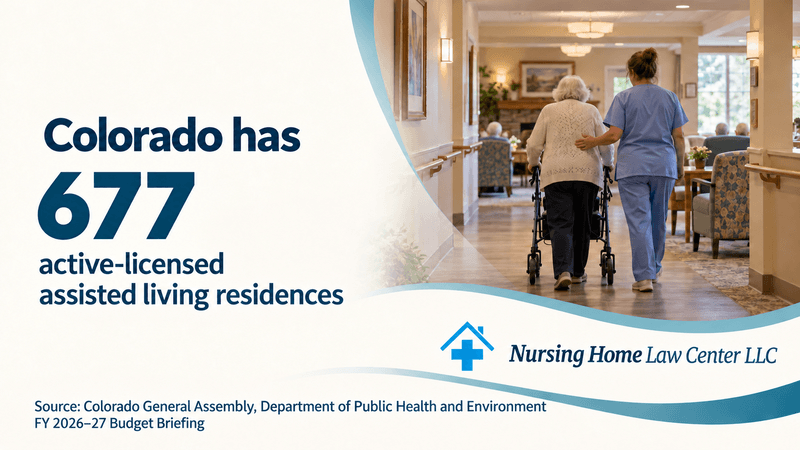
Colorado has 677 active-licensed assisted living residences, according to state licensing data reported in a Colorado General Assembly budget briefing.
CDPHE’s Health Facilities and Emergency Medical Services Division regulates ALRs under its Standards for Hospitals and Health Facilities, with 6 CCR 1011-1, Chapter 7 applying specifically to assisted living residences.
Under 6 CCR 1011-1, Chapter 7, Part 2.7, an ALR houses three or more unrelated adults and provides room and board, personal services, protective oversight, social care for impaired capacity to live independently, and regular 24-hour supervision, though not to the extent continuous medical or nursing care is required.
A facility may be licensed as an ALR only, or hold added Medicaid certification as an alternative care facility, as a Supportive Living Program residence delivering the Brain Injury waiver’s Supported Living Program services, or as a residence certified to serve residents with mental illness.
An ALR may operate a secure environment under Part 25 and offer memory care within it, subject to the pre-admission assessment and disclosures in Parts 25.4 and 25.5. Staff serving residents with dementia must complete the training outlined in Part 7.8(B).
Before move-in, Part 11.1 limits admission to residents whose needs the ALR’s existing staff, environment, and services can fully meet, based on a pre-admission assessment of physical, mental, and social needs, preferences, and capacity for self-care. Part 12.6 then requires a comprehensive post-admission assessment with input from the resident, the resident’s representative, and a practitioner, and Part 12.10 requires a care plan based on it.
Under Part 11.2, an ALR may not accept a resident who needs regular 24-hour medical or nursing care; cannot self-administer medication unless the residence has staff qualified to administer it; has an acute illness, incontinence, or mobility limitation the residence cannot safely manage; or requires a secure environment the residence does not provide. Other restrictions apply to certain pressure sores, dangerous conduct, and restraint needs.
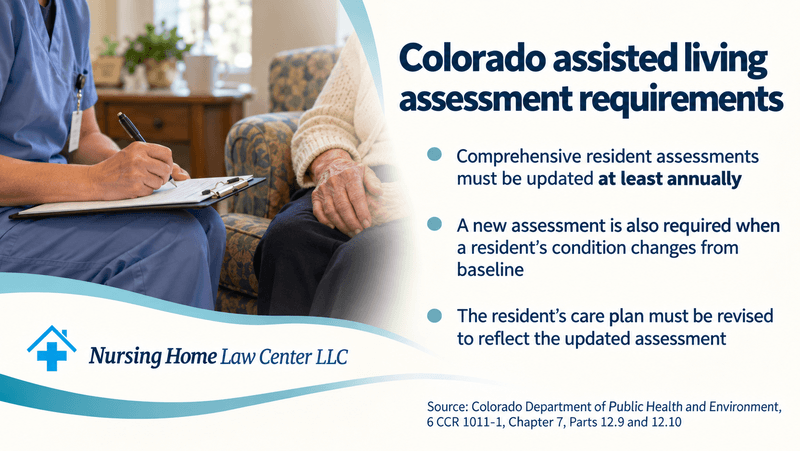
Under 6 CCR 1011-1, Chapter 7, Part 12.9, an ALR must update a resident’s comprehensive assessment annually and whenever the resident’s condition changes from baseline, and revise the care plan accordingly under Part 12.10.
Part 12.5 requires the ALR to contact the resident’s practitioner after a significant change in baseline, signs of infection, an injury, or a condition that would originally have barred admission. The ALR must call 911 after a fall if the resident is unconscious, has declined from baseline, reports increased pain, or requests it under Part 12.17.
Services beyond the ALR’s scope, such as tube feeding, IV medication, or unstable ostomy or catheter care, may be provided by an external provider, with the ALR coordinating that outside care under Parts 12.3 and 12.11.
hBefore discharging a resident for increased needs, the ALR must document efforts to meet those needs through outside services or a higher level of care under Part 11.14. Under Part 11.16, involuntary discharge generally requires 30 days’ written notice, which may be shortened when needs exceed the ALR’s capability or the resident poses a danger. Part 9.3 allows residents to grieve within 14 days and appeal to CDPHE.
| CDPHE-licensed assisted living residence (ALR) | |
|---|---|
| Typical residents | Adults who do not need regular 24-hour nursing care and whose needs the residence can fully meet under its assessment |
| Services and level of care | Room and board, personal services, protective oversight, social care, and regular 24-hour supervision |
| Legal guidance after abuse or neglect | Claims are evaluated by Colorado assisted living abuse and neglect lawyers |
| Nursing home facility | |
| Typical residents | Residents who require continuous skilled nursing, rehabilitation, or substantial medical care |
| Services and level of care | Round-the-clock nursing and medically directed services |
| Legal guidance after abuse or neglect | A Colorado nursing home abuse lawyer investigates the state and federal nursing facility standards |
| Adult Group Home | |
| Typical residents | Adults with intellectual or developmental disabilities certified through a Program Approved Service Agency |
| Services and level of care | Residential habilitation, protective oversight, and supportive services enabling community living |
| Legal guidance after abuse or neglect | A Colorado group home abuse lawyer examines the home’s certification and residential support duties |
Colorado places licensing oversight for both assisted living residences and nursing facilities within CDPHE’s Health Facilities and Emergency Medical Services Division, though the two operate under separate rule chapters and standards.
CDPHE issues initial and renewal licenses, conducts annual inspections, investigates complaints, and can require a plan of correction, impose fines, restrict admissions, or suspend, revoke, or decline to renew a license under C.R.S. §§ 25-27-104 and 25-27-106.
The Department of Health Care Policy and Financing separately certifies alternative care facilities and Supportive Living Program residences for Medicaid participation under 10 CCR 2505-10, Section 8.7000. CDPHE also enforces the secure environment and dementia-training standards in Chapter 7, Parts 7.8(B) and 25, through the same licensing and inspection process rather than a separate dementia-care credential.
Colorado does not license ALR administrators through a separate board, unlike nursing home administrators, who hold a DORA license. Instead, ALR administrators must meet the qualifications and training CDPHE requires under Chapter 7, Part 6.
Local governments handle zoning approval under § 25-27-105.5, and facilities must comply with the state’s Building, Fire, and Life Safety Code under 8 CCR 1507-31.
CDPHE’s Health Facility Search tool and licensed-residence list under § 25-27-109 provide public inspection findings and licensure records.
Colorado’s assisted living sector includes national operators alongside several companies with a particularly substantial presence in the state. These include:
The operator associated with a Colorado community should be verified against CDPHE licensing records when investigating a claim. A branded residence may involve separate licensees, property owners, and management entities, each of which may have a different role in the resident’s care.
Colorado’s Standards for Hospitals and Health Facilities, 6 CCR 1011-1, Chapter 7, require ALRs to:
An assisted living regulatory violation may be evidence of an unsafe practice or breach of duty, but it does not automatically establish civil liability or create a private right to sue.
Colorado assisted living claims often stem from failures involving admission, reassessment, supervision, care planning, or transfer. Examples include:
A bad outcome alone does not prove negligence in assisted living facilities. The evidence must connect the resident’s injury to a duty the assisted living residence actually owed and failed to meet.
Which agency to contact depends on the licensing and what happened. A complaint to facility management never substitutes for an emergency call or an official report. Colorado residents have several channels available depending on the nature of the concern:
Abuse and neglect in an assisted living facility can support different civil claims depending on what happened and who was responsible. Potential claims may include negligence for failures involving supervision, personal care, medication, assessment, or transfer; negligent hiring or supervision; premises liability for unsafe conditions; assault or battery for intentional misconduct; and breach of the resident agreement.
Medical malpractice requirements may apply when the defendant and services qualify under Colorado health care liability law. If abuse or neglect causes a resident’s death, eligible family members may have a wrongful death claim under Colorado law, while separate survival rules may apply to claims belonging to the resident before death.
Claims involving a government-operated facility may also be subject to the Colorado Governmental Immunity Act, including additional notice and procedural requirements. A Colorado assisted living abuse lawyer can determine which claims and deadlines apply to the circumstances.
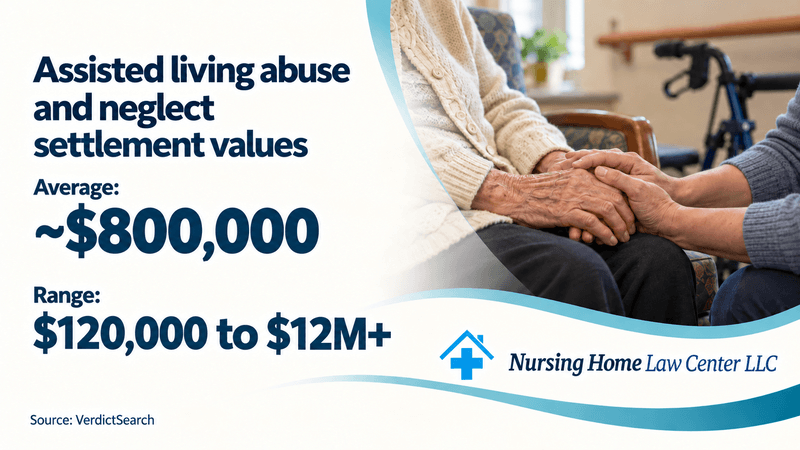
Assisted living case settlements in Colorado vary substantially. In a broader multi-state sample reviewed through VerdictSearch, assisted living settlements averaged about $800,000, with reported settlements ranging from $120,000 to more than $12 million.
The value of a Colorado claim depends on factors such as the severity and permanence of the resident’s injuries, whether additional care or relocation became necessary, the quality of the evidence, the number of responsible parties, available insurance or assets, and the damages permitted under Colorado law.
Nursing Home Law Center can confirm the facility’s license category and permitted level of care, review the admission assessment and residency agreement, and obtain service plans and reassessment records.
We also examine changes in condition and transfer decisions, preserve incident reports, surveillance video, call-system logs, and other electronic records, and obtain medication, staffing, training, and background-check records to support your assisted living abuse claim.
Reviewing licensing surveys, complaints, and corrective-action history can reveal whether the facility retained a resident whose needs exceeded its capabilities. Our legal team identifies the operator, management company, staffing provider, and other potentially responsible parties, consults relevant experts, and calculates damages to pursue the appropriate claim.
Reach out to our experienced assisted living abuse lawyers today for a free case review.
Potential defendants include the licensed operator, a management or parent company, individual employees, a staffing agency, a medication provider, a transportation contractor, a property owner, or a healthcare provider. Liability depends on each party’s actual role, duty, and conduct in causing the injury.
Most personal injury claims must be filed within two years under C.R.S. § 13-80-102, the same deadline that generally applies to wrongful death claims. Medical malpractice claims carry their own two-year deadline with a three-year repose period under § 13-80-102.5. Claims against a government-operated facility require a notice of claim within 182 days of discovering the injury under C.R.S. § 24-10-109, part of the Colorado Governmental Immunity Act.
Discovery-rule and tolling issues should be reviewed promptly with an attorney to ensure a claim is filed before the applicable deadline expires.
You can recover compensation for both financial losses and personal suffering. This includes economic damages for medical bills, future care costs, relocation expenses, and stolen or misused funds, alongside noneconomic damages for physical pain, emotional distress, and loss of life enjoyment. Additionally, wrongful death costs or punitive penalty awards can be recovered if the abuse caused death or involved extreme, reckless misconduct by the facility.