
Experienced Attorneys Protecting the Rights of the Neglected and Abused
The Nursing Home Law Center is committed to providing the legal resources necessary to hold negligent facilities accountable.

A California assisted living abuse lawyer represents residents and families after neglect, abuse, or unsafe care in a Residential Care Facility for the Elderly (RCFE) causes injury or death. These cases can involve failures in supervision, medication assistance, dementia care, fall prevention, staffing, or responding to changes in a resident’s condition.
At Nursing Home Law Center, we investigate whether an RCFE met California licensing and care requirements, gather evidence of neglect or abuse, and identify the parties that may be legally responsible. Families can contact us for a free case review to understand their options for pursuing compensation.
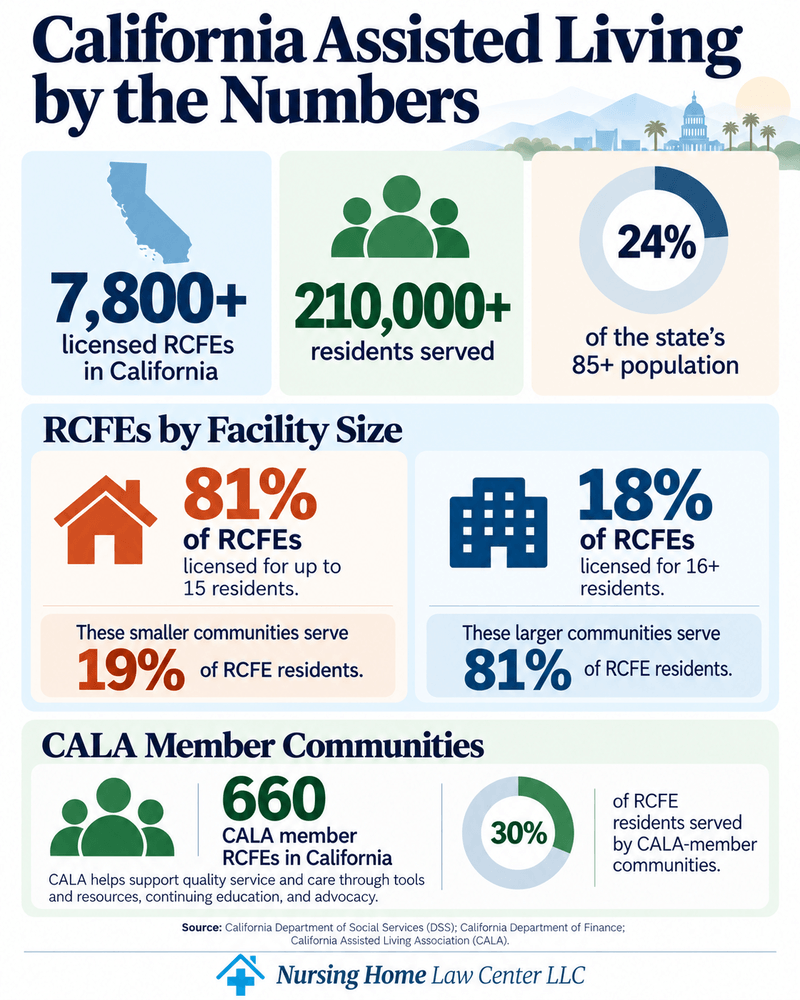
More than 7,800 Residential Care Facilities for the Elderly, or RCFEs, operate in California. The California Department of Social Services licenses RCFEs through its Community Care Licensing Division under Health and Safety Code section 1569 and following, with operating standards set out in Title 22 of the California Code of Regulations, Division 6, Chapter 8.
California does not license separate RCFE tiers based on resident acuity. RCFEs instead vary widely in licensed capacity, from small residential homes serving six or fewer residents to large assisted living communities. Different staffing, physical-plant, fire-safety, and operational requirements may apply depending on facility size and resident needs.
Licensees may also operate a dementia special care program or obtain a hospice care waiver. The dementia special care programs are defined in Health and Safety Code sections 1569.625 through 1569.628 and require specific staff training and disclosure before a facility may advertise dementia care.
An RCFE provides non-medical care, supervision, and assistance to adults aged 60 and older. Residents under 60 may be admitted if their needs are compatible with those of the other residents in the home.
Before admission, Article 8 of Title 22, Division 6, Chapter 8 requires an evaluation of suitability, a pre-admission appraisal, and a medical assessment covering functional capabilities, mental condition, and social factors under Sections 87456 through 87462.
Facilities must reappraise residents under Section 87463 and provide the basic services listed in Section 87464, including personal care, supervision, and assistance with self-administered medication. Facility staff may assist residents with self-administered medications, but only staff authorized by law may administer injections.
Article 11 identifies allowable, restricted, and prohibited health conditions. Under Section 87615, an RCFE cannot admit or retain a resident with Stage 3 or 4 pressure sores, a gastrostomy or nasogastric tube, a tracheostomy, a serious infection such as staph, or a need for help with all activities of daily living.
Under Article 8, Section 87463 of Title 22, Division 6, Chapter 8, facilities must reappraise residents as often as necessary and after significant changes, including physical trauma such as a fall or stroke, emotional trauma, or any condition that triggers a prohibited or excluded health condition.
Staff must immediately notify the resident’s physician and responsible person of significant changes in condition. Under Section 87465(g), staff must also immediately call 911 when an injury or other circumstance creates an imminent threat to the resident’s health, subject to limited exceptions involving advance directives, hospice care, or an on-site licensed health professional.
Under Article 11, if a resident develops a condition the facility cannot legally manage, the Department may issue a health condition relocation order under Section 87637. The facility must prepare a written relocation plan designed to safely transfer the resident and minimize transfer trauma, and the relocation period may not exceed 30 days. Residents may request an interdisciplinary team review under Section 87638.
Section 87224 of Article 4 generally requires 30 days’ written notice for an RCFE eviction. With prior Department approval, a facility may use three days’ notice when a resident’s behavior threatens their own health or safety or that of others. A 60-day notice requirement applies when eviction results from a change in the facility’s use.
| Residential Care Facility for the Elderly (RCFE) | |
|---|---|
| Typical residents | Adults 60 and older, or younger residents whose needs are compatible with the group |
| Services and level of care | Personal care, supervision, meals, assistance with self-administered medication, and permitted health-related services |
| Legal guidance after abuse or neglect | Claims are evaluated by California assisted living abuse and neglect lawyers |
| Skilled Nursing Facility (SNF) | |
| Typical residents | Residents who require continuous skilled nursing, rehabilitation, or substantial medical care |
| Services and level of care | Round-the-clock nursing and medically directed services |
| Legal guidance after abuse or neglect | A California nursing home abuse lawyer investigates state and federal nursing facility standards |
| Adult Residential Facility (ARF) | |
| Typical residents | Adults 18 to 59 with physical, developmental, or mental disabilities who need care and supervision |
| Services and level of care | Community-based non-medical supervision and support authorized by the facility’s license |
| Legal guidance after abuse or neglect | A California group home abuse lawyer examines the facility’s certification and residential support duties |
Assisted living facilities are primarily licensed through state-specific systems. The California Department of Social Services (CDSS) licenses and oversees RCFEs through its Community Care Licensing Division, which handles initial applications, renewals, and administrator certification under Article 7 of Title 22, Division 6, Chapter 8. Local building and fire authorities issue occupancy and fire clearance approvals before state licensure.
CDSS imposes additional training and disclosure requirements on facilities that advertise or operate dementia special care programs, under Health and Safety Code sections 1569.625 through 1569.628.
CDSS conducts unannounced evaluation visits and investigates complaints under Health and Safety Code section 1569.33, issuing notices of deficiency and requiring correction plans under Article 13, Section 87756. Continued noncompliance can lead to civil penalties, admission restrictions, license suspension, or revocation.
The Long-Term Care Ombudsman Program, housed within the California Department of Aging, independently investigates abuse and quality-of-care complaints in RCFEs alongside CDSS.
For low-income residents who qualify, the Department of Health Care Services administers the Medi-Cal Assisted Living Waiver in select counties under federal CMS approval.
Inspection reports, citations, and licensing status are publicly searchable through the CDSS Care Facility Search website.
California’s more than 7,800 Residential Care Facilities for the Elderly include independent operators as well as large companies managing communities throughout the state. Some of the more prominent multi-community operators include:
California RCFE ownership can be layered. The community’s consumer-facing brand, property owner, management company, and entity holding the CDSS license may be different companies, so the responsible parties must be determined from the records for the individual facility.
Under Article 8, Section 87468 of Title 22, Division 6, Chapter 8, residents retain rights to dignity, privacy, freedom from abuse and unusual punishment, a grievance process, and disclosure of the facility’s policies. Admission agreements must specify basic and optional services, rates, and terms of modification under Article 9, Section 87507.
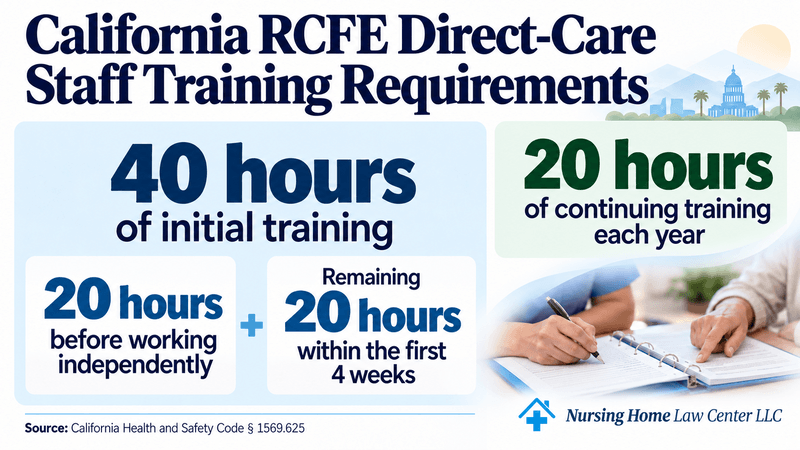
California does not impose a single fixed staff-to-resident ratio for RCFEs. Instead, facilities must maintain sufficient qualified staff to meet residents’ needs. Direct-care staff who assist with activities of daily living generally must complete 40 hours of initial training, including 20 hours before working independently and the remaining 20 hours within the first four weeks of employment, plus 20 hours of continuing training each year. Required subjects include dementia care, resident rights, medication policies, personal care, emergency response, and restricted health conditions.
Facilities must provide personal assistance with dressing, eating, and bathing as indicated in the resident’s appraisal under Article 8, Section 87464. Facilities licensed for sixteen or more residents, or with separate floors or buildings, must maintain a signal system so residents can call for help under Article 5, Section 87303.
Under Article 8, Section 87465, staff may assist with self-administered medication and must document centrally stored drugs, but only legally authorized personnel may administer injections.
Article 12 requires dementia-specific training, secured environments, and elopement safeguards for residents who wander. Postural supports cannot include tying, depriving, or limiting a resident’s hands or feet under Article 11, Section 87608.
Facilities must report incidents threatening resident welfare, including abuse or unexplained absence, within statutory timeframes under Article 4, Section 87211, alongside mandated reporting obligations under California’s Elder Abuse and Dependent Adult Civil Protection Act.
Under Articles 4, 9, and 10, RCFEs are required to maintain emergency disaster plans, sanitary food service, infection control, and resident recordkeeping.
A regulatory violation may be evidence of an unsafe practice or breach of duty in assisted living settings, but it does not automatically establish civil liability or create a private right to sue.
A California assisted living claim often traces back to a facility admitting or retaining a resident beyond what Article 8’s evaluation and reappraisal process permits, since that failure creates the conditions for harm before any incident occurs.
When staff fail to update the service plan after a fall, hospitalization, or documented weight loss, or ignore a resident’s repeated calls for help, the resulting outcomes, such as dehydration and malnutrition, can support a claim because they trace to a failure of supervision or reassessment rather than an unavoidable decline.
Medication assistance by unqualified staff, rather than by staff trained under Article 7, can lead to missed doses or dangerous errors that may form the basis of a negligence claim. A resident who elopes from a facility lacking required safeguards, or who suffers a preventable fall during unsafe mobility or toileting assistance, may have a viable claim rooted in inadequate staffing or training.
Ignored aggression between residents, an unscreened employee’s access to vulnerable residents, or delayed physician and family notification can support claims involving resident-to-resident abuse, sexual abuse, or financial exploitation.
A bad outcome alone does not prove negligence in an assisted living facility. The evidence must connect the resident’s injury to a specific breach of the facility’s assessment, supervision, service plan, or transfer duties.
The agency responsible for a report depends on the type of harm and its urgency. A report to facility management does not replace an emergency call or an official complaint. To make an official report, use the contacts below.
The correct agency to report assisted living abuse or neglect in California depends on the facility’s license. Unlike RCFEs, California nursing homes are licensed and investigated separately by the California Department of Public Health.
While elder abuse and neglect describe conduct, pursuing a civil case against a California RCFE requires a recognized legal theory.
Available theories may include negligence for failing to provide supervision, personal care, or promised services, negligent hiring or supervision of an unqualified or dangerous worker, premises liability for an uncorrected unsafe condition, and assault or battery for intentional harmful contact. A breach-of-contract claim may apply under the terms of the residency agreement.
California’s Elder Abuse and Dependent Adult Civil Protection Act, Welfare and Institutions Code, section 15657, provides a distinct statutory remedy when neglect rises to the level of recklessness, oppression, fraud, or malice, proven by clear and convincing evidence, and can support enhanced remedies beyond ordinary negligence.
Medical malpractice claims apply only when the defendant and service qualify under Code of Civil Procedure, section 340.5, California’s medical-liability statute of limitations.
Wrongful death and survival claims follow California’s separate rules under Code of Civil Procedure, sections 377.60 and 377.30 governing who may file and what survives the resident’s death.
If a public entity operates the facility, the Government Claims Act requires that a claim be presented within six months of injury or death under Government Code, section 911.2 before a lawsuit may proceed.
Because every case depends on its own facts, a California assisted living abuse lawyer can help you understand which of these options may apply to your situation.
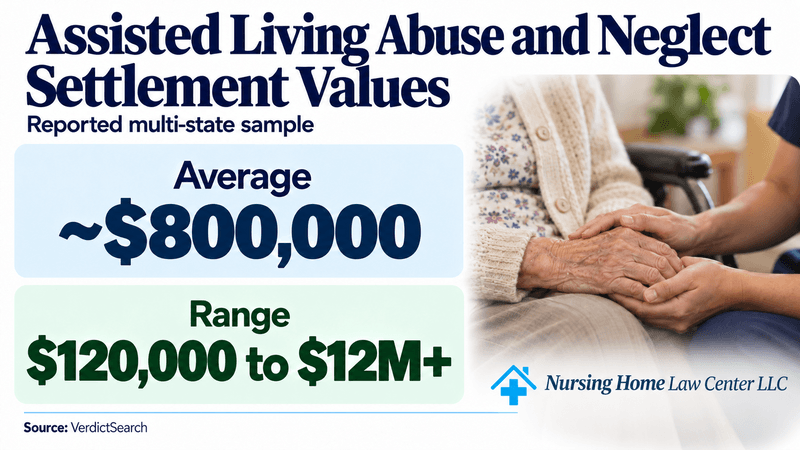
A multi-state sample reported through VerdictSearch revealed an average payout of $800,000, with settlements ranging from $120,000 to over $12,000,000.
As many resolutions are confidential, reported results are incomplete, and case values depend heavily on the facts, there is no reliable statewide average for California assisted living abuse and neglect settlements.
In general, settlement value depends on injury severity, future care needs, available evidence, responsible parties, insurance or other assets, California’s damages rules, and whether the resident survived.
A couple of reported California examples include:
Nursing Home Law Center can confirm the facility’s license category and permitted level of care, then review the admission assessment, residency agreement, and service plans.
We obtain reassessment records, examine changes in condition and transfer decisions, and preserve incident reports, surveillance footage, call-system logs, and electronic records.
We pull medication, staffing, training, and background-check records, and review licensing surveys, complaints, and corrective-action history to determine whether the facility retained a resident beyond its capabilities.
We identify the operator, management company, staffing provider, and other responsible parties, consult relevant experts, and calculate damages to pursue the appropriate claim.
Contact an experienced assisted living facility lawyer today for a free case review.
Potential defendants include the licensed operator, a management or parent company, individual employees, a staffing agency, a medication or pharmacy provider, a transportation contractor, a property owner, or a healthcare provider. Liability depends on each party’s role and conduct.
Most personal injury and wrongful death claims must be filed within two years under Code of Civil Procedure, section 335.1. Qualifying medical malpractice claims are subject to the one-year discovery or three-year injury deadline under Section 340.5. Furthermore, claims against a public entity require a government claim filed within six months under Government Code section 911.2.
Available damages in a California assisted living claim may include medical expenses, future care costs, lost income, pain, and emotional harm. When the heightened requirements of Welfare and Institutions Code section 15657 are satisfied, an elder-abuse claim may also support enhanced remedies, including attorney fees and costs and certain pre-death pain-and-suffering damages. Punitive damages may be available separately when the requirements of California Civil Code section 3294 are met.