
Experienced Attorneys Protecting the Rights of the Neglected and Abused
The Nursing Home Law Center is committed to providing the legal resources necessary to hold negligent facilities accountable.

An Arkansas assisted living abuse lawyer represents residents and families harmed by neglect, abuse, or unsafe conditions in a licensed assisted living facility.
At Nursing Home Law Center, we investigate care failures, review regulatory compliance, and pursue legal accountability against responsible facilities or providers. Contact us for a free case review.
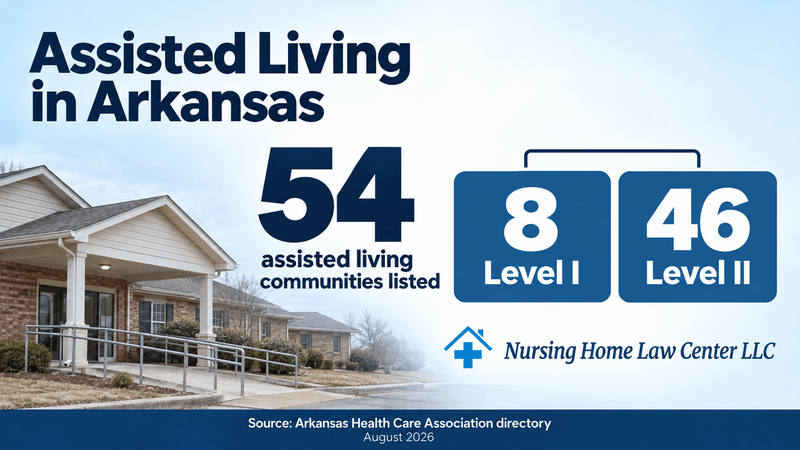
The Arkansas Health Care Association’s facility directory lists more than 54 assisted living communities across the state, of which 8 are Level I and 46 are Level II.
Before admission, both Level I and Level II assisted living facilities must evaluate whether an applicant’s needs can be safely met within the facility’s licensed level of care. The admission requirements are set out in 20 CAR § 410-802 for Level I facilities and 20 CAR § 411-802 for Level II facilities. The resident’s assessment and identified needs are then used to develop the applicable services and care planning required for that facility and resident.
Level I facilities serve residents who can direct their own care and do not require 24-hour nursing supervision. Personal services include assistance with or supervision of activities of daily living and self-administration of medication.
Level II facilities may serve residents who are medically eligible for nursing home level of care, including those enrolled in Arkansas’s Living Choices Medicaid waiver, and must have greater nursing involvement. A resident may not remain in any assisted living facility if their condition requires 24-hour nursing care or other services the facility isn’t authorized to provide, even with a signed agreement releasing the facility from responsibility.
Facilities may operate a separately regulated Alzheimer’s Special Care Unit for residents with a diagnosed dementia, subject to its own staffing, disclosure, and design requirements.
Arkansas regulates assisted living facilities through two rule sets issued by the Department of Human Services, Office of Long Term Care: the Rules for Assisted Living Facilities Level I and the Rules for Assisted Living Facilities Level II. The two rule sets share an identical section-numbering structure, so the same section numbers below apply to both, and each requirement carries the same substance unless otherwise noted.
Under § 505(l) of both rules, facilities must document any change in a resident’s mental or physical condition, including falls, illness, hospitalization, and physician visits, in the resident’s record. When illness or an accident occurs, the facility must notify the resident’s responsible party and physician, and take immediate steps to secure necessary medical attention, including transfer to an appropriate facility.
According to § 507.3 of both rules, written incident and accident reports must be completed within five days of discovery, and the resident’s service plan must be reviewed and amended as part of that review whenever the resident’s condition or service needs change.
Under (20 CAR § 410-806) for Level I facilities and (20 CAR § 411-806) for Level II facilities, either party generally must provide 30 calendar days’ written notice before terminating the occupancy agreement. A facility may discharge a resident immediately when continued residency creates immediate jeopardy, a direct threat, or a substantial risk of serious harm, injury, impairment, or death to other residents.
Finally, under § 602, both rules require 30 days’ written notice before transfer or discharge, except when immediate discharge is needed to protect the resident or other residents, or under the conditions in Ark. Code Ann. § 20-10-1005(a)(1).
| Arkansas Level I or Level II assisted living facility | |
|---|---|
| Typical residents | Adults needing personal care and supervision who are not medically eligible for nursing home level of care (Level I), or who are medically eligible and enrolled in the Living Choices Medicaid waiver (Level II) |
| Services and level of care | Housing, meals, supervision, daily-living assistance, medication support, and limited nursing services |
| Legal guidance after abuse or neglect | Claims are evaluated by Arkansas assisted living abuse and neglect lawyers |
| Nursing homes | |
| Typical residents | Residents who require continuous skilled nursing, rehabilitation, or substantial medical care |
| Services and level of care | Round-the-clock nursing and medically directed services |
| Legal guidance after abuse or neglect | An Arkansas nursing home abuse lawyer reviews compliance with the applicable state and federal nursing facility requirements. |
| Intermediate Care Facility for Individuals with Intellectual Disabilities (ICF/IID) | |
| Typical residents | Adults with intellectual or developmental disabilities who need residential support and supervision |
| Services and level of care | Habilitation, vocational and daily-living training, and program-based residential care |
| Legal guidance after abuse or neglect | An Arkansas group home abuse lawyer examines the facility’s certification and residential support duties |
Arkansas assisted living facilities are licensed, inspected, and disciplined by the Department of Human Services (DHS) Office of Long Term Care (OLTC), which also handles specialized approvals for Alzheimer’s Special Care Unit (ASCU).
Initial project development requires a Permit of Approval from the Arkansas Health Services Permit Agency, along with local planning commission zoning approval and municipal approval.
Physical safety enforcement falls under the Arkansas State Fire Marshal’s Office and local code inspectors, while facility administrators must be certified through an OLTC-approved program. Financing and enrollment for Medicaid waiver participants are co-managed through the DHS Division of Medical Services.
OLTC investigates complaints against facilities and their employees, and a facility found in violation must submit a plan of correction. Depending on the severity and frequency of violations, OLTC may impose civil penalties under Ark. Code Ann. § 20-10-206, restrict new admissions, or move to suspend, revoke, or decline to renew a facility’s license.
Arkansas includes national chains, regional senior living companies, and locally based operators with several communities within the state. Current examples include:
For liability purposes, the operator advertised to residents is only one part of the ownership picture. Arkansas licensing records and corporate documents may identify separate entities responsible for operating, managing, staffing, or owning a particular residence.
Under the Level I and Level II Rules for Assisted Living Facilities, facilities must protect residents’ dignity, privacy, autonomy, and right to file grievances, and must provide a written disclosure statement and occupancy admission agreement before admission.
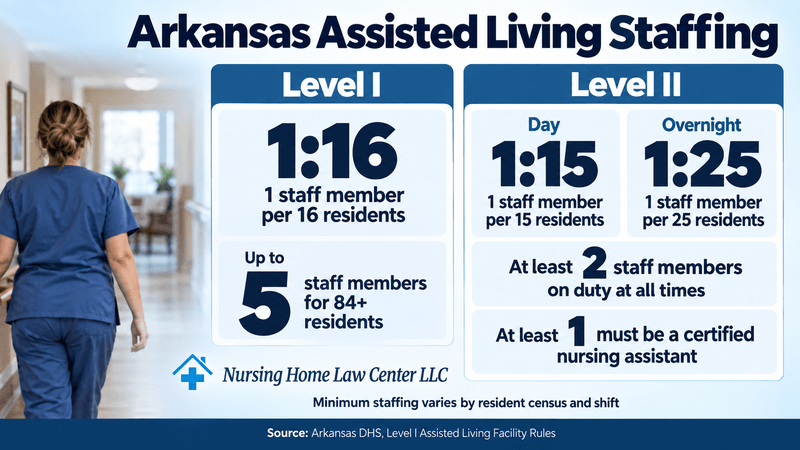
Facilities must maintain adequate staffing to meet resident needs. Level I facilities must meet minimum ratios ranging from one staff member per sixteen residents to five per eighty-four or more, depending on facility size and shift. Level II facilities must maintain one staff member per fifteen residents by day and one per twenty-five overnight, with no less than two staff members at all times, one of whom must be a certified nursing assistant. All staff must complete background checks against the Adult Maltreatment Central Registry before employment.
Facilities must assist residents with mobility, bathing, dressing, toileting, and eating as specified in each resident’s service plan, and must provide 24-hour staff supervision, though this does not require continuous visual monitoring, along with assistance obtaining emergency care. Medication storage and administration are limited to staff acting within the Nurse Practice Act, and all assistance must be documented.
Facilities operating an Alzheimer’s Special Care Unit must follow separate elopement-prevention, egress-control, and staffing safeguards, and address restraints under residents’ rights protections against improper restriction.
Facilities must report suspected abuse, neglect, exploitation, and misappropriation of property to the Office of Long Term Care, generally by the next business day, and must maintain fire-safety, evacuation, sanitation, and infection-control policies along with complete resident records.
A regulatory violation may be evidence of an unsafe practice or breach of duty, but it does not automatically create a private cause of action or establish civil liability.
Several recurring care failures may support a legal claim against an Arkansas assisted living facility, including:
A bad outcome alone does not establish negligence. The evidence must connect the resident’s injury to a breach of the facility’s duty under applicable licensing requirements, the resident’s service plan, or other legal obligations.
Arkansas routes abuse and neglect reports through different agencies depending on the type of harm and whether it involves a crime, a licensing violation, or resident maltreatment. Keep in mind that you must file a report through the relevant channel outlined below. A complaint to facility management does not replace an emergency call or an official report.
Abuse and neglect describe conduct. A civil case must proceed under a recognized legal theory that connects the conduct to a specific injury. Available theories in Arkansas may include negligence, based on a facility’s failure to provide reasonable supervision, personal care, medication assistance, or promised services, and negligent hiring, training, supervision, or retention, when a facility places an unqualified or dangerous worker around residents.
Premises liability may apply when a facility fails to correct or warn of an unsafe property condition. Assault or battery may apply to intentional harmful contact by staff or another resident. Breach of contract may apply when the residency agreement itself, not just general care standards, was violated.
Wrongful death and survival claims proceed under Ark. Code Ann. § 16-62-102, which allows the estate’s personal representative, or an heir if none exists, to bring the claim.
If a public entity operates the facility, separate notice, immunity, and filing deadlines may apply. Some admission agreements include arbitration clauses that may affect where a claim is heard.
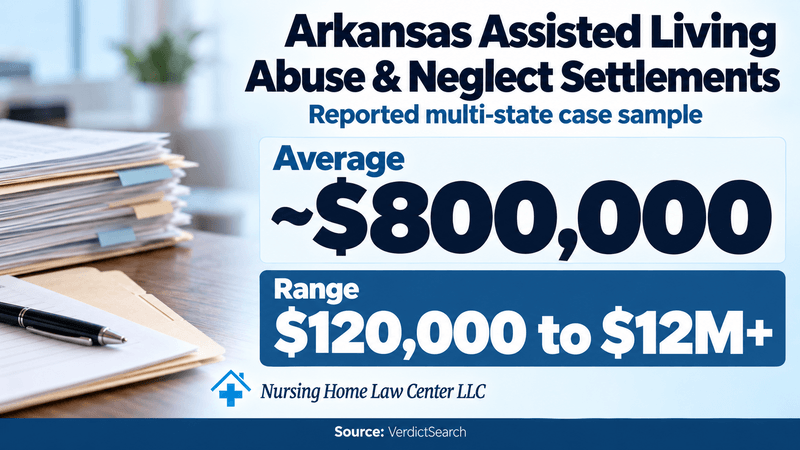
There is no reliable statewide average for Arkansas assisted living abuse settlements. Many resolutions are confidential, reported outcomes are incomplete, and case values depend heavily on the specific facts involved.
That said, a multi-state sample of assisted living abuse and neglect cases reported through VerdictSearch revealed an average reported payout of $800,000, with settlements ranging from $120,000 to over $12,000,000.
Value depends on injury severity, future care and relocation needs, available evidence, the responsible parties, insurance or other assets, Arkansas damages rules, and whether the resident survived.

Nursing Home Law Center can confirm the facility’s license category and permitted level of care, and review the admission assessment and residency agreement. We can also help you obtain service plans and reassessment records, examine changes in condition and transfer decisions, and preserve incident reports, surveillance footage, call-system logs, and other evidence needed to prove assisted living abuse and neglect before they are lost.
Furthermore, our Arkansas assisted living abuse lawyer assists in obtaining medication, staffing, training, and background-check records, reviewing licensing surveys and complaints, and determining whether the facility retained a resident whose needs exceeded its capabilities.
We identify the operator, management company, staffing provider, and other potentially responsible parties, consult relevant experts, and calculate damages to pursue the appropriate claim. Contact our assisted living abuse law firm to discuss your options.
Potentially liable parties include the licensed operator, a management or parent company, individual employees, staffing agencies, medication providers, transportation contractors, property owners, or healthcare providers, depending on their actual role in the incident.
Most negligence claims must be filed within three years under Ark. Code Ann. § 16-56-105. Medical malpractice claims generally have two years under § 16-114-203, and wrongful death claims have three years under § 16-62-102. The applicable deadline depends on the claim type and facts, so it’s best to verify with an assisted living abuse lawyer.
Depending on the claim, damages may include medical expenses, future care or relocation costs, lost income, pain, emotional harm, disability, and financial losses. Punitive damages may be available when the evidence satisfies Arkansas’s heightened statutory requirements, including malicious, intentionally harmful, or sufficiently reckless conduct. Although Arkansas Code § 16-55-208 contains a statutory punitive-damages cap, the Arkansas Supreme Court held that cap unconstitutional. Any award remains subject to the facts of the case and applicable state and federal law.