
Experienced Attorneys Protecting the Rights of the Neglected and Abused
The Nursing Home Law Center is committed to providing the legal resources necessary to hold negligent facilities accountable.

An Alabama assisted living abuse lawyer represents residents and families after neglect, abuse, or unsafe conditions in assisted living or specialty care assisted living facilities result in injury or death.
These cases involve investigating care failures, reviewing regulatory compliance, and pursuing legal accountability against responsible facilities or providers. At Nursing Home Law Center, we can help families understand their legal options during a free case review.
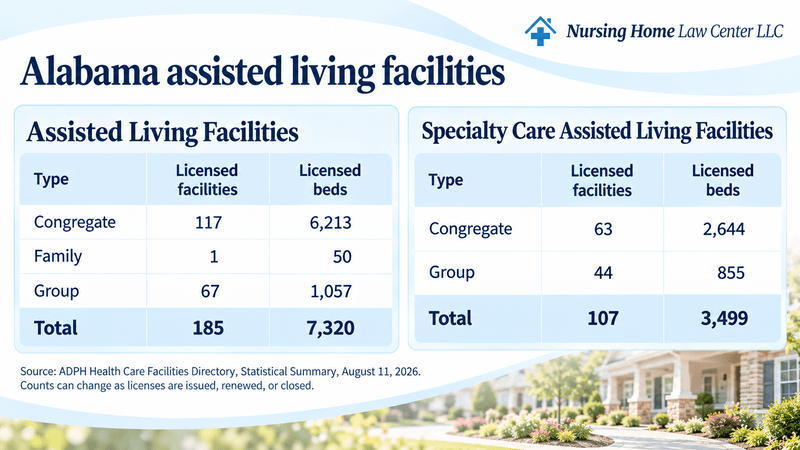
According to ADPH’s Health Care Facilities Directory, there are 185 licensed assisted living and 107 specialty care assisted living facilities in Alabama as of August 2026.
Under Ala. Admin. Code r. 420-5-4-.01(2)(b), an assisted living facility provides residence, health supervision, and personal care to three or more people needing help with daily activities, medication use, diet, or personal safety.
Before admission, Rule 420-5-4-.06 requires a physical examination, eligibility assessment, and care plan. Standard assisted living facilities generally cannot admit someone who requires skilled nursing care, cannot direct their own care, cannot safely self-manage medications or self-administer medications with permitted assistance, exhibits dangerous behavior, requires restricted egress, or has a wound requiring more than basic first aid. All skilled services provided in the facility must be performed by staff of properly licensed or certified agencies rather than delegated to facility staff.
Under Ala. Admin. Code r. 420-5-4-.06 (Resident Care and Services) and r. 420-5-4-.07 (Health Care and Medication Management), standard assisted living facilities must assess residents monthly and as needed, documenting medication-management ability, weight, status changes, and care-plan suitability.
Changes requiring a physician examination belong in the medical-examination record, while any decline requires prompt intervention and a plan update. Facilities must contact a physician after an accident or illness and contact 911 for a potentially fatal or disabling emergency.
Under Ala. Admin. Code r. 420-5-4-.03 (Scope of Care and Services), needs exceeding the facility’s legal or practical capabilities require services, discharge, or prompt transfer, and a resident generally may not return from higher care while those needs continue.
Medical or skilled nursing care expected to exceed 90 days bars retention unless the resident performs the required tasks or directs permitted assistance staff can safely provide. A resident with a terminal illness other than dementia may receive hospice and remain beyond 90 days only while the facility can lawfully meet the resident’s needs.
Under Ala. Admin. Code r. 420-5-4-.05 (Resident Rights and Facility Responsibilities), residents ordinarily receive 30 days’ written notice of involuntary relocation. Exceptions apply when the resident is receiving higher-level care and no longer meets continued-stay requirements, a physician requires emergency relocation to a more skilled setting, or documented conduct is harmful or dangerous.
| ADPH assisted living or specialty care assisted living facility | |
|---|---|
| Typical residents | Adults needing personal care; specialty care residents may have qualifying cognitive impairment |
| Services and level of care | Housing, meals, supervision, daily-living assistance, medication support, and limited health-related services |
| Legal guidance after abuse or neglect | Alabama assisted living abuse and neglect lawyers can evaluate whether care failures support a civil claim. |
| Nursing home facility | |
| Typical residents | Residents requiring continuous skilled nursing, rehabilitation, or substantial medical care |
| Services and level of care | Round-the-clock nursing and medically directed services |
| Legal guidance after abuse or neglect | An Alabama nursing home abuse lawyer investigates the state and federal nursing facility standards. |
| ADMH community residential facility | |
| Typical residents | Adults receiving developmental-disability, mental-health, or substance-use services |
| Services and level of care | Community living, habilitation, behavioral-health support, and program-authorized supervision |
| Legal guidance after abuse or neglect | An Alabama group home abuse lawyer examines the home’s certification and residential support duties. |
Assisted living is primarily governed through Alabama’s licensing system.
The State Board of Health licenses assisted living facilities in Alabama through ADPH’s Bureau of Health Provider Standards. ADPH reviews license applications and renewals, conducts inspections and complaint investigations, and requires correction of cited deficiencies. The State Board may deny an application or downgrade or revoke an existing license.
The Alabama Board of Examiners of Assisted Living Administrators licenses and disciplines administrators. Alabama’s State Health Plan includes a county-based bed-need methodology for specialty care facilities. Facilities must also comply with applicable zoning, building, fire-safety, and evacuation requirements.
Georgia’s assisted living market includes national companies alongside operators with particularly large portfolios in the state. Examples of multi-community providers include:
The company name displayed on a residence may not be the same entity that holds the Alabama facility license or owns the property. Identifying the licensed operator, management company, and ownership entity is therefore important when investigating an abuse or neglect claim.
Alabama’s standard assisted living rules and specialty care rules require facilities to:
Specialty care assisted living facilities in Alabama must also follow the census-based staffing table in Rule 420-5-20-.04, maintain nursing and care-coordination roles, provide dementia training, and use elopement and fall safeguards.
A regulatory violation may be evidence of a breach but does not automatically create a private cause of action or establish liability.
Examples of abuse and neglect that may be grounds for an Alabama assisted living lawsuit include:
As with reporting abuse and neglect in a nursing home, the responsible agencies and communication channels will depend on the injuries sustained by the resident, and a report to management does not replace an emergency call or government complaint.
While elder abuse and neglect describe conduct, a civil case requires a recognized claim. Available theories may include negligence, negligent hiring or supervision, premises liability, assault or battery, and breach of the residency agreement.
Medical-liability law applies only when the defendant and service qualify; wrongful death and survival claims follow Alabama’s separate rules; and public operators may present immunity or other procedural issues.
Consult an assisted living abuse lawyer to fully understand your and your loved ones’ legal options.
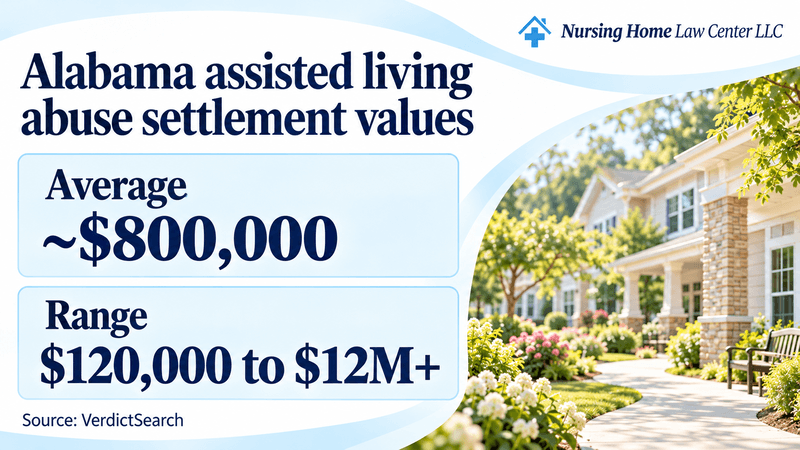
There is no reliable average for Alabama assisted living abuse and neglect settlements, as many outcomes are confidential. A review of case data reported through VerdictSearch revealed an average reported payout of $800,000, with settlements ranging from as low as $120,000 to over $12,000,000.
Value depends on injury severity, future care and relocation needs, evidence, available insurance or assets, Alabama damages rules, and whether the resident survived the injuries.
Nursing Home Law Center can preserve evidence needed to prove assisted living abuse or neglect, obtain records, reconstruct events, consult experts, calculate losses, negotiate a settlement, and file a lawsuit when needed. Contact us for a confidential case review.
Potential defendants in assisted living abuse and neglect claims in Alabama include the licensed operator, a management or parent company, individual employees, a staffing agency, a pharmacy or medication provider, a transportation contractor, a property owner, or a healthcare provider. Liability depends on each party’s duty, conduct, and role in causing the injury.
Most personal injury claims against Alabama assisted living facilities must be filed within two years under Ala. Code § 6-2-38. The same deadline applies to personal representatives bringing a wrongful death action under § 6-5-410. Per § 6-5-482, qualifying medical liability claims follow separate timing and repose provisions. The applicable deadline should be reviewed promptly because incapacity, concealment, claim type, and other facts may affect the analysis.
An Alabama assisted living abuse or neglect claim may seek medical expenses, future care and relocation costs, lost income, pain, mental anguish, disability, and exploitation losses, depending on the claims and injuries involved. In the event of a fatality, Alabama wrongful death damages are punitive and must be pursued by the personal representative. Under Alabama’s survival statute, an unfiled personal tort claim generally does not survive the injured person’s death, while a filed personal claim may survive subject to the statute’s distinctions. For non-wrongful-death tort claims, punitive damages generally require the heightened proof specified in Ala. Code § 6-11-20 and may be subject to statutory limitations and exceptions.