
Experienced Attorneys Protecting the Rights of the Neglected and Abused
The Nursing Home Law Center is committed to providing the legal resources necessary to hold negligent facilities accountable.

Under Va. Code Ann. § 32.1-138 et seq., Virginia requires licensed nursing homes to post and follow policies protecting dignity, care, privacy, grievance rights, and freedom from abuse, neglect, and improper restraints. If your elderly loved one suffered injuries or rights violations, a Virginia nursing home abuse lawyer from our team can investigate the case, explain your legal options, and help pursue financial compensation.
Several forms of elder abuse appear in Virginia nursing homes, and more than one can exist at the same time.
Physical abuse includes hitting, rough transfers, pushing, pinching, and improper restraint use. Physical elder abuse often appears through bruises, fractures, or other serious injuries, including broken bones that the facility cannot explain.
Emotional abuse includes threats, humiliation, intimidation, isolation, and verbal cruelty. Families may notice fear, withdrawal, sleep changes, or agitation around a specific worker. This harm is described as emotional elder abuse and can overlap with psychological abuse.
Financial abuse can involve stolen cash, forged checks, pressure to sign documents, missing valuables, or misuse of benefits. This form of mistreatment is often called financial elder abuse or financial exploitation.
Sexual abuse includes unwanted touching, coerced nudity, assault, and failures to protect vulnerable residents from known predators. Elder sexual abuse may be supported by trauma findings, behavior changes, witness accounts, or a diagnosis of a sexually transmitted disease (STD).
Nursing home neglect means failing to provide the basic care a resident needs. Failures inside a negligent nursing home can include missed turning, ignored call lights, poor hygiene, unsafe transfers, lack of supervision, and failure to report a change in condition.
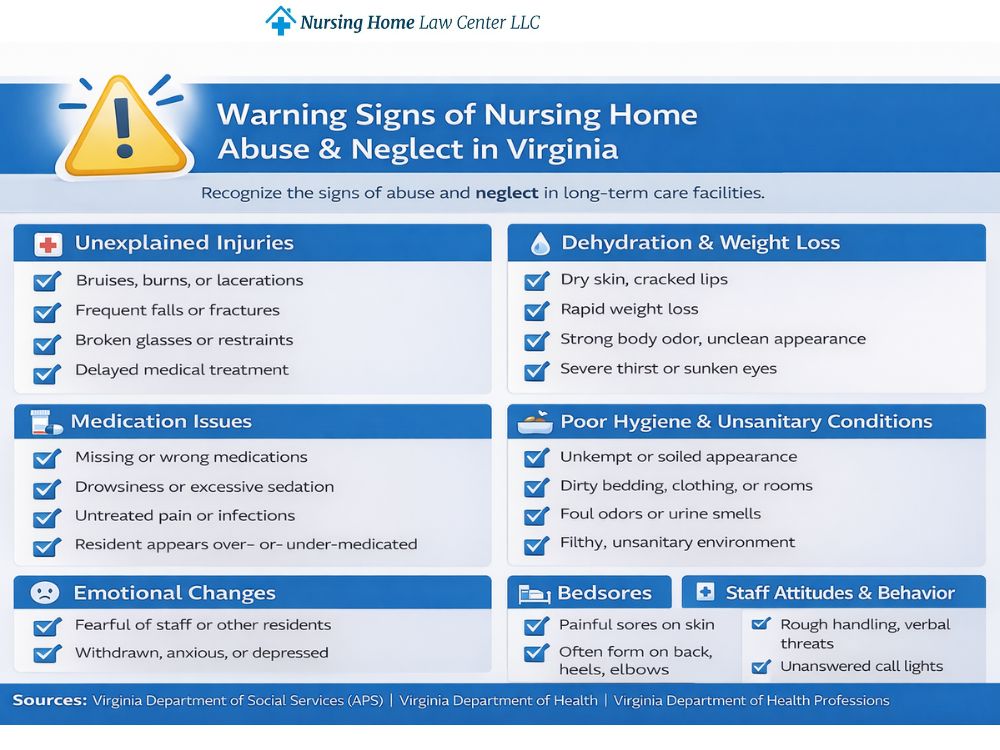
The signs of nursing home abuse often surface before the facility gives a straight answer. We tell family members to watch for bruising, fear, missing belongings, poor hygiene, and other common signs.
We also look for nursing home falls and other unexplained nursing home injuries. A fall victim may sustain broken bones or a subdural hematoma. Other warning common signs include early-stage bed sores or advanced pressure ulcers that progress to sepsis due to infections caused by untreated pressure sores.
We also see malnourished nursing home residents, dehydration, choking accidents, and aspiration pneumonia in nursing homes, as well as signs of medication mistakes, and evidence of sexual abuse, including STDs.
Virginia nursing home residents’ legal rights are governed by Va. Code Ann. § 32.1-138 et seq. and the Omnibus Budget Reconciliation Act of 1987.
Virginia’s resident-rights statute requires nursing homes to implement written protections for dignity, privacy, participation in care, and freedom from abuse. At the federal level, OBRA 1987 and the Nursing Home Reform Act, as part of it, set nationwide standards for certified nursing homes, including resident rights and quality-of-care duties. In our cases, we review both Virginia law and federal law because a single event can violate both.
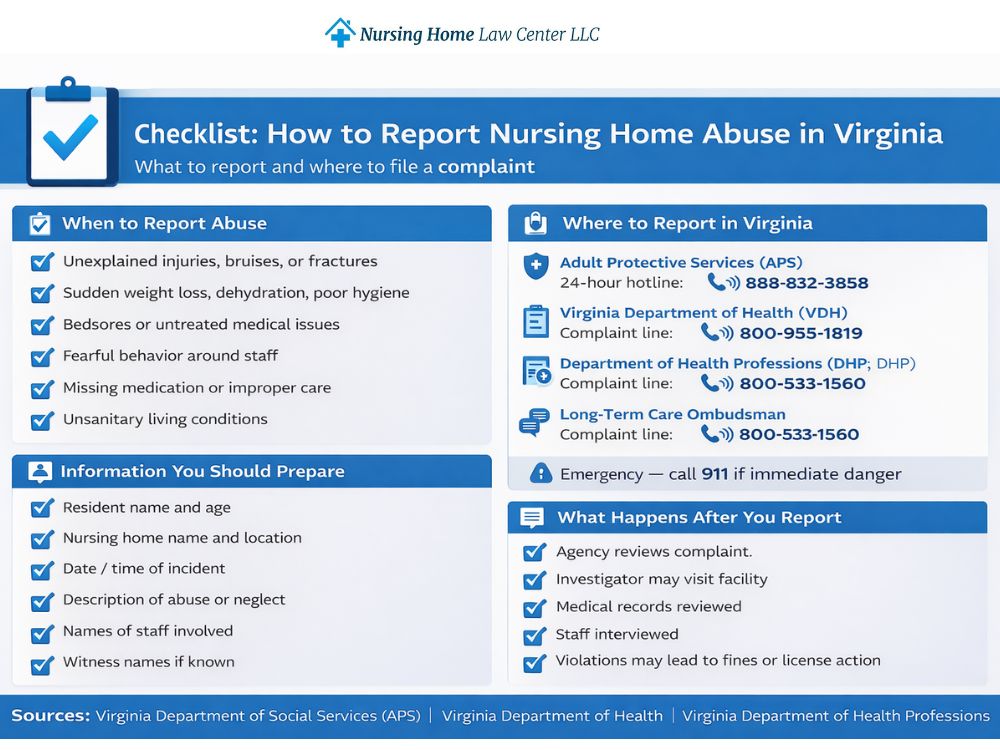
If you suspect nursing home abuse, protect the resident first. If there is immediate danger, call 911. Then build a timeline, photograph injuries and living conditions, and ask for a written incident report and a care plan meeting.
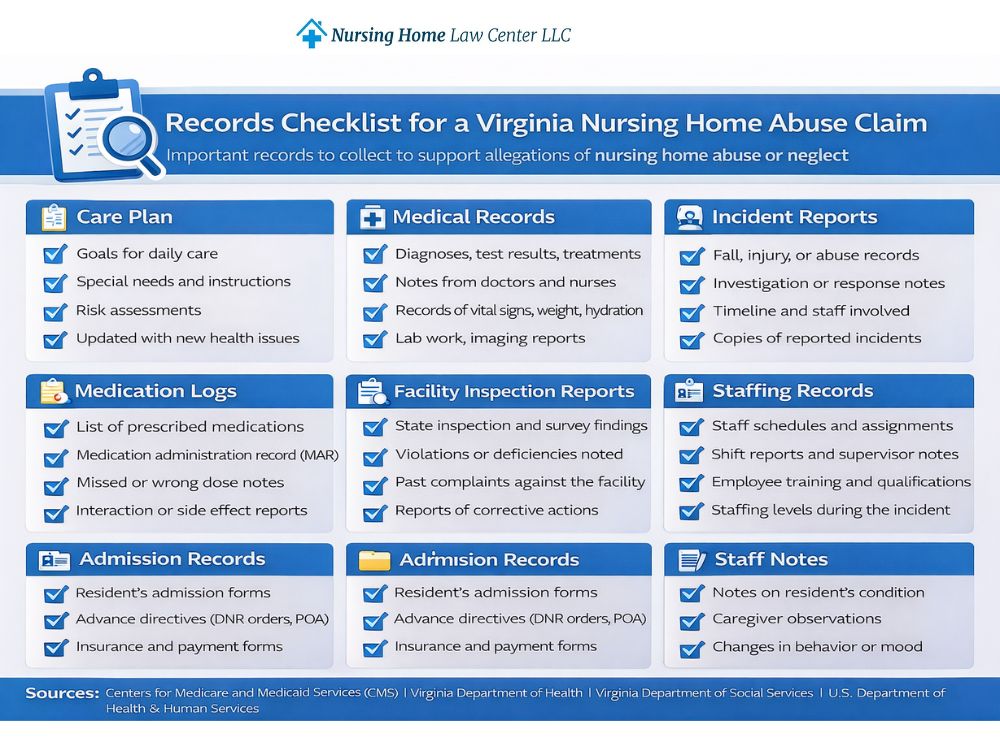
Within the first 24 hours, request the care plan, Medication Administration Record (MAR), incident reports, and staffing assignments for the shift. Ask the facility to preserve video and internal reports. An independent medical evaluation can help document fractures, infection, dehydration, medication harm, or other suspected abuse.
Early legal help also helps us gain access to medical records, identify whether the case sounds in personal injury, medical malpractice, or both, and decide how to pursue compensation before the paper trail gets too thin.
In Virginia, families usually report abuse to 911, the Virginia Department of Health, Adult Protective Services, or the Long-Term Care Ombudsman.
Call 911 when the resident faces immediate harm, needs urgent treatment, or may have been assaulted. Ask the facility for a written incident report and a prompt care plan meeting.
VDH’s Office of Licensure and Certification takes complaints about licensed nursing homes and can review regulatory and care concerns. We usually tell families to provide the resident’s name, the facility, the dates, witnesses, and a short summary, and then ask the facility to preserve the records. VDH lists toll-free 1-800-955-1819 and Richmond metro area (804) 367-2106 phone numbers for complaints and reporting abuse.
Adult Protective Services receives reports of abuse, neglect, or exploitation involving adults age 60 or older, and incapacitated adults age 18 to 59. APS is state-supervised and administered locally through social services offices, making it an important means for reporting suspected abuse. You can file an online report or call the toll-free hotline at (888) 832-3858.
The Ombudsman advocates for residents, helps resolve complaints, and explains rights. Virginia’s Ombudsman can also help families of loved ones in assisted living facilities when they are unsure which agency oversees the facility.
From the first call from families seeking legal representation onward, our nursing home abuse attorney team works with you to protect the resident and preserve evidence. We:
Potentially liable parties in a nursing home abuse lawsuit include:
To prove nursing home abuse, we compare what happened with what the chart should show. Key evidence includes:
Facilities repeat the same defenses. We answer them with timelines, records, and the facility’s own policies.
Possible nursing home lawsuit compensation depends on the severity of the harm and the evidence. Damages can include:
Case value usually turns on severity, preventability, documentation gaps, hospitalization, infection, and facility history. Families sometimes ask about the maximum compensation available, but proof drives value, and each case has its own specifics.
The average nursing home abuse settlement in Virginia is $483,187.
We treat that figure as a rough reference point, rather than a promise. Some cases resolve for less. Others resolve far above that number when records show preventable falls, advanced wounds, assault, or death.
In our experience, value rises or falls with the proof, the severity of the injury, and whether the neglect can be directly tied to hospitalization or permanent decline.
These examples show how different fact patterns and our legal experience can produce strong results.
Martha’s husband entered a skilled Richmond nursing home after hip replacement surgery and later developed severe bed sores that progressed into infection and death. The case resolved for $3,000,000 because the nursing home negligence was deemed preventable, and the outcome was fatal.
Denise and Carla were assaulted by a CNA in the same facility. Their claims were resolved for $2,333,000. The value was driven by the gravity of the sexual abuse, the facility’s supervision failures, and the proof that warning signs were missed.
Helen suffered fall-related injuries in a Northern Virginia facility, which included a subdural hematoma and hip fracture. The defense argued the fall was unavoidable. The records suggested missing fall precautions. Her case resolved for $1,700,000.
If your elderly relative was harmed in a Virginia nursing facility, speak with a nursing home abuse attorney who is well-versed in handling these claims. Our firm offers a free consultation and works on a contingency fee basis, with no upfront fee.
If you’re looking for an experienced attorney, we can review the facts, keep the responsible accountable, and help your family decide on legal action.
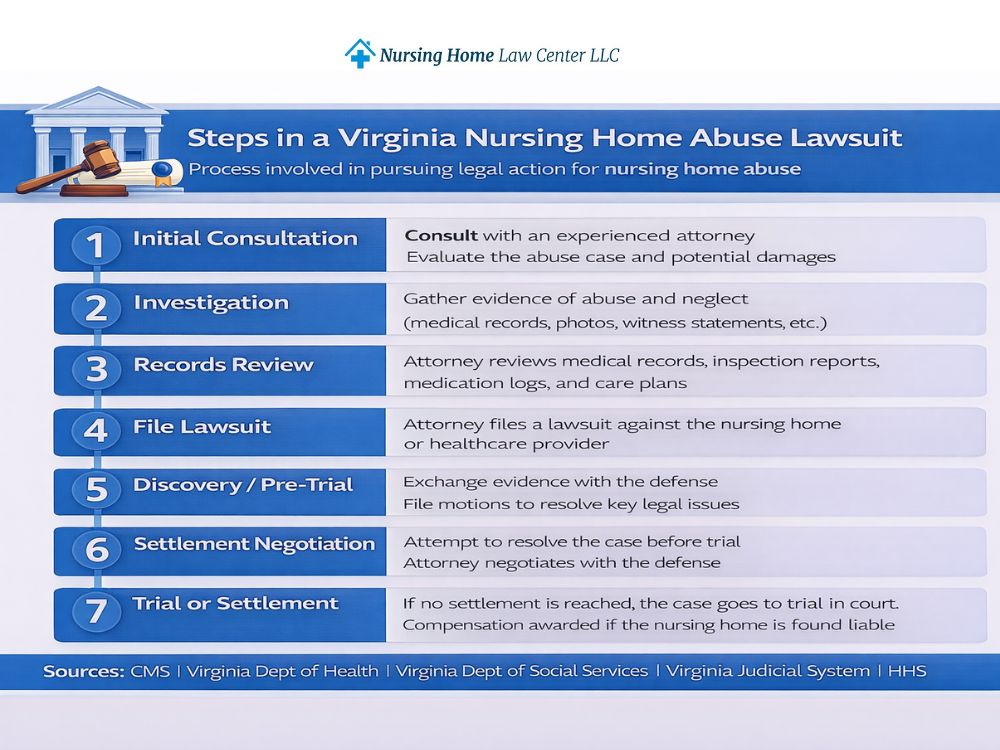
The nursing home neglect statute of limitations usually follows Virginia’s general personal-injury rule. Under Va. Code Ann. § 8.01-243(A), personal injury claims generally must be filed within two years. Under Va. Code Ann. § 8.01-244(B), a wrongful death claim generally must be brought by the personal representative within two years of death. Act early.
An advance directive is a legal document that states treatment wishes and may appoint an agent to make health care decisions if the resident loses capacity. For nursing home residents, this can affect who authorizes releases and who helps us secure records during the investigation.
Nursing home arbitration agreements can affect where the dispute is decided, but they do not erase the underlying claim. Federal rules say a facility cannot require binding arbitration as a condition of admission or continued care, and the agreement must disclose the right not to sign and the right to rescind within 30 days.
The most common causes of nursing home abuse include understaffing, burnout, poor training, weak supervision, unsafe culture, cost-cutting, and negligent hiring. Some claims also involve over-sedation and poor handoff communication.
There are four recognized stages of bed sores. In a lawsuit, the bigger issue is when the wound was first documented, whether the resident was repositioned, and whether the infection was caught in time. Serious bed sores in a nursing home can support a strong neglect claim.
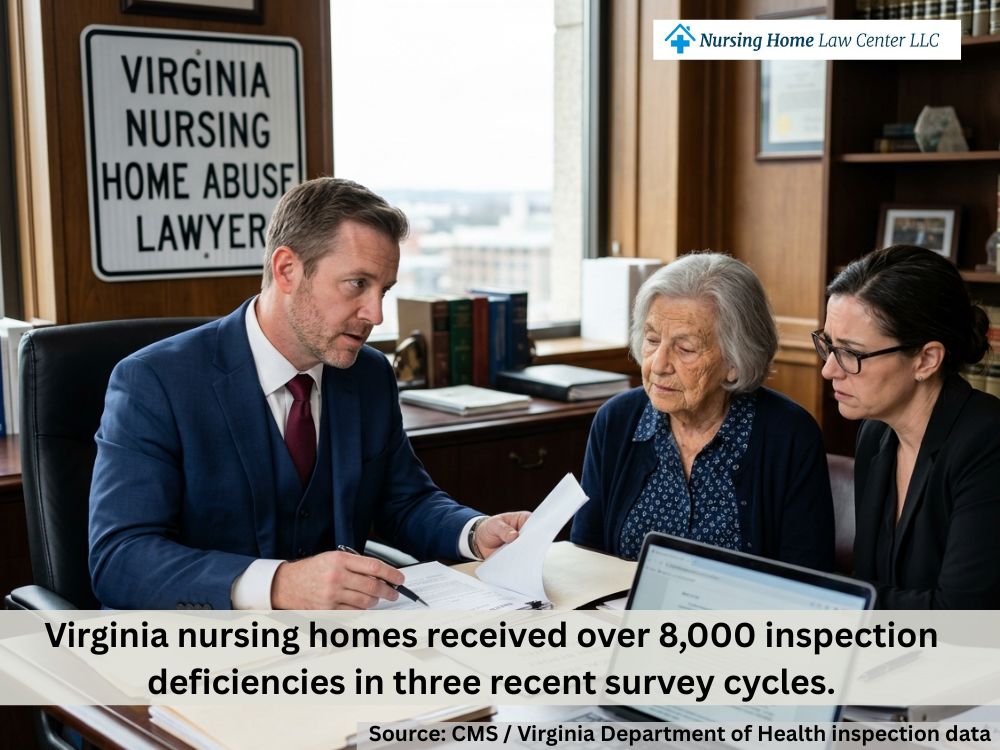
CMS data shows that Virginia has a total of 289 homes, of which 54 (18.7%) have serious deficiencies and 242 (83.7%) have infection-related deficiencies. Virginia’s nursing homes have paid $4.73 million in penalties and had 7 payment suspensions. These nursing home abuse statistics do not prove abuse in every case, but they show why inspection history deserves close review.
The worst nursing homes in Virginia are those that show serious problems in public oversight records, especially poor inspection results, weak staffing or quality scores, and severe recent deficiencies. Medicare- and Medicaid-certified homes are surveyed for compliance with resident-care standards, and deficiencies are ranked by severity and scope, meaning the level of harm and how many residents were affected.
The most serious citations involve immediate jeopardy, where residents faced a risk of serious injury, impairment, or death. CMS star ratings and recent inspection findings also help families identify which homes raise the greatest concern.
Based on these criteria, the worst nursing homes in Virginia include: