
Experienced Attorneys Protecting the Rights of the Neglected and Abused
The Nursing Home Law Center is committed to providing the legal resources necessary to hold negligent facilities accountable.

When a Tampa nursing home fails to provide proper care, residents and family members have the right to take legal action. Under Fla. Stat. § 400.023, a civil claim may be brought for nursing home negligence or violations of resident rights that lead to personal injury or wrongful death. A Tampa nursing home abuse attorney from our law firm can guide you through the legal process and help you seek compensation. Reach out today for a free consultation.
Elder abuse involves the mistreatment of a resident through intentionally harmful actions or a steady failure to provide proper care. According to the National Institute on Aging, elder abuse can be physical, emotional, sexual, financial, or neglectful.
Physical elder abuse includes hitting, shoving, slapping, pinching, rough transfers, or any other force that causes physical harm. In some nursing home abuse cases, the conduct may also amount to battery. Physical abuse can also involve the misuse of physical or chemical restraints, where staff control elderly residents for convenience rather than safety.
Emotional elder abuse involves threats, humiliation, verbal attacks, intimidation, mocking, or deliberate isolation. When a facility creates an atmosphere of fear, a senior resident may stop asking for help, even when basic needs go unmet.
Financial abuse of the elderly occurs when someone uses the resident’s money, property, or accounts for personal gain. In nursing home abuse cases, this can include stolen cash, forged signatures, pressure to change legal documents, misuse of bank cards, or manipulation by someone in a position of trust. A caregiver, staff member, or even a family member may exploit confusion, memory loss, or dependence.
Sexual abuse of the elderly includes coercion, exploitation, or non-consensual sexual contact involving a vulnerable resident. Such cases demand immediate legal action. An experienced nursing home abuse lawyer can help you seek justice against those who have violated your loved one’s dignity.
Nursing home neglect involves the failure to meet a resident’s basic daily needs. That can include missed medications, poor supervision, failure to prevent falls, poor hygiene, dehydration, malnutrition, or delayed treatment for infections and injuries. In nursing home abuse claims, neglect often traces back to understaffing, failing to provide proper training, or a business model that values cost-cutting over proper medical care.
Many of the most common signs of nursing home abuse point to an ongoing pattern within the facility rather than a single isolated event.
Frequent falls can lead to serious injuries, such as broken bones or a subdural hematoma. When a nursing home cannot clearly explain how a resident was hurt, or the explanation changes, it might be an effort to conceal abuse.
Nursing home negligence often shows up in day-to-day care. Poor hygiene in nursing homes may be followed by pressure sores and urinary tract infections. Infections caused by untreated pressure sores may progress to sepsis.
Families may also notice nursing home patients suffering from dehydration, which can cause dizziness, confusion, and weakness.
Choking accidents in nursing homes may happen when staff rush feeding, ignore swallowing precautions, or fail to supervise vulnerable residents. In some cases, those failures can lead to aspiration pneumonia, a serious condition that can become life-threatening very quickly. Unexplained weight loss and malnourished nursing home residents may also suggest that the facility is failing to provide proper nutrition and hands-on support.
Sudden fearfulness, withdrawal, or agitation may point to emotional abuse. Such behavioral changes, accompanied by unexplained genital injuries or sexually transmitted infections, may point to sexual abuse in nursing homes and demand immediate attention.
In severe cases, repeated neglect or abuse may lead to wrongful death. When one avoidable injury leads to another, families should not assume the decline was simply part of aging.
Nursing home residents’ legal rights are governed by state and federal law. These protections influence how our lawyers evaluate care failures in Tampa nursing facilities.
Fla. Stat. § 400.0060 et seq. regulates nursing homes and related health care facilities in Florida. This statute governs resident rights, staffing obligations, licensing, enforcement, and civil remedies.
Fla. Stat. § 825.101 et seq. defines abuse, neglect, and exploitation of elderly persons and disabled adults. Violations may expose the responsible party to criminal penalties in addition to civil lawsuits.
Florida Administrative Code Chapter 59A-4 sets minimum standards for nursing homes, such as resident care, staffing, sanitation, dietary services, medical records, and day-to-day operations inside the facility.
42 U.S. Code § 1395i-3 sets federal requirements for skilled nursing facilities that participate in Medicare. Facilities must promote quality of care, maintain resident dignity, complete and update assessments of the resident’s condition, and provide services necessary to help residents reach or maintain their highest practicable well-being.
The 1987 Nursing Home Reform Act established a national baseline for resident rights and quality-of-care protections in certified nursing homes. It grew out of the Omnibus Budget Reconciliation Act and remains a key foundation for cases involving neglect, inadequate medical care, improper restraints, and loss of dignity.
The first step is to ensure your loved one’s safety. If there is immediate danger, call 911 and get the resident to a hospital for medical treatment. Take photographs of visible injuries, unsafe room conditions, and anything else that may later help tie the injury to the nursing home neglect. Write down dates, names, statements from staff, and every change you have noticed in your family member’s condition.
Within the first twenty-four hours, request the resident’s care plan, medication administration record, incident reports, and staffing assignments for the shifts.
You should also report abuse to the proper agency and speak with a Tampa nursing home abuse lawyer as soon as possible. Quick action helps protect nursing home residents from further harm, preserves evidence, and gives your attorney a better chance to build a strong personal injury claim.
Depending on the urgency and the severity of the misconduct, families may report abuse, neglect, exploitation, unsafe conditions, or resident-rights violations to different local authorities and advocacy programs.
Make sure to obtain a written incident report and request a care plan meeting so there is a record of your concerns and the facility’s response.
Call 911 if a resident faces immediate danger, needs urgent medical care, or may be the victim of violent assault or sexual abuse. Police and emergency responders handle immediate safety threats, secure the scene, and arrange urgent care.
The Florida Agency for Health Care Administration handles complaints about licensed health care facilities, including nursing homes. AHCA regulates facilities, reviews complaints, and can investigate quality-of-care and compliance issues. You can file a complaint online or also call AHCA at 1-888-419-3456.
Adult Protective Services handles reports of abuse, neglect, or exploitation involving vulnerable adults. APS works to prevent further harm and can investigate suspected abuse or neglect of an elderly person. You can file a report online or contact the Florida Abuse Hotline at 1-800-962-2873.
The Florida Long-Term Care Ombudsman helps residents and families with complaints about long-term care facilities. Call 1-888-831-0404. The ombudsman advocates for residents, investigates complaints, and pushes facilities to address ongoing problems.
When nursing home negligence comes to light, families often feel overwhelmed and unsure where to start. Our law firm can step in to shoulder that burden and help you hold negligent facilities accountable.
Potentially liable parties in nursing home abuse cases in Tampa include the facility itself, its management company, ownership entities, outside contractors, nurses, aides, administrators, and any other responsible party whose acts or omissions caused harm. Some cases also involve a parent company that controlled staffing or budgeting decisions. Our nursing home abuse attorneys look beyond the building name to find who actually made the choices that put residents at risk.
Strong cases usually depend on records, timing, and consistency. A nursing home abuse lawyer will conduct a thorough investigation and gather evidence that connects the injury to the nursing home neglect.
Evidence includes care plans, progress notes, medication administration records, incident reports, and staffing assignments. Read together, they show whether the nursing home recognized the resident’s risks, whether staff followed the plan, and whether anyone acted after warning signs appeared. In many nursing home abuse cases, the timeline exposes gaps that a family could never see from the outside.
Certain charting problems show up again and again in nursing home abuse cases. Late entries can suggest that nursing home staff members filled in the record after the fact. Missing monitoring notes may show checks never happened. No escalation after a change in condition can point to neglect. Repeated falls with no intervention often signal that the facility was aware of the risk yet still failed to protect the resident. Those red flags matter because bad records often reflect bad care.
If adequate care was provided, the records should show it. Depending on the resident’s condition, that may include fall-risk assessments, turning schedules, behavior plans, wound notes, hydration monitoring, nutrition records, and updated care plans after any meaningful change.
Common defenses in lawsuits against nursing facilities in Tampa include:
Our personal injury lawyers fight those defenses by examining medical records, staffing levels, incident timing, and prior warnings. If the facility states the resident denied treatment, the chart should show repeated education, follow-up, and a revised care plan. If a resident was at risk of falling, the documentation should show increased supervision and prevention protocols.
Nursing home lawsuit compensation often includes past and future medical costs, such as hospital bills, surgery, wound care, rehabilitation, medications, and other future care needs tied to the injury. Damages may also include emotional pain and suffering, loss of dignity, mental anguish, and other emotional harm that followed the mistreatment.
If repeated neglect or abuse has led to the resident’s passing, a wrongful death claim may allow financial compensation for the resident’s estate and surviving family members’ emotional suffering.
In some cases, punitive damages may also be available under Fla. Stat. § 768.72, but only after convincing evidence of intentional abuse or gross negligence. What drives case value usually comes down to severity, preventability, documentation gaps, hospitalization, infections, and the facility’s prior history of similar problems.
Our law firm has a strong success record, including more than $450 million recovered for injury victims, over 100 years of combined experience, and help provided to more than 5,000 clients. Our experienced nursing home abuse lawyers know how to build cases that expose negligent facilities. Our experienced attorneys have also earned national recognition, including Super Lawyers and the Million Dollar Advocates Forum. We offer a free consultation and contingency-fee representation.
The average nursing home abuse settlement in Tampa is $102,825,831.
Elvira Nunziata, a ninety-two-year-old resident of Pinellas Park Care and Rehab Center, died after falling down a stairway while strapped into her wheelchair. Her son filed suit, alleging the fall did not happen in isolation. He claimed it came after more than a year of substandard treatment, including understaffing, lack of supplies, malnutrition, dehydration, infections, and other serious failures. Trial testimony described a facility where alarms existed but did not protect vulnerable residents, even though staff knew Nunziata had dementia and a tendency to wander. The case also focused on the corporate structure behind the assisted living facility and claims that profit took priority over resident safety. A jury awarded two hundred million dollars, including one hundred forty million in punitive damages, sending a blunt message about the cost of reckless care.
Juanita Jackson entered an Auburndale nursing home for short-term rehabilitation in March 2003, with her family hoping she would regain strength and return home. Instead, they say she suffered a rapid decline. According to the lawsuit, staff knew Jackson faced a fall risk but failed to put basic protections in place. Within two weeks, she fell and sustained a head injury and a fractured arm. Her family also alleged chronic understaffing, dehydration, malnutrition, untreated bedsores, tissue necrosis, overmedication, and prolonged immobility that left her with severe contractures. Jackson was removed from the facility, but her condition continued to worsen, and she died weeks later. At trial, the plaintiff argued the home’s conditions were dangerous across the board, not just in one isolated incident. The jury returned a verdict of one hundred fourteen million dollars, including one hundred million in punitive damages.
Carol Reed developed a skin tear while recovering at Life Care Center of Orlando after a leg fracture. What began as a wound progressed into a stage four bedsore that exposed bone, triggered infections, and led to years of painful treatment. Reed claimed staff failed to reposition her properly, failed to document the wound, failed to report it to key nursing supervisors, and relied on basic bandaging instead of prompt physician involvement. Her legal team also tied the breakdown in care to staffing problems and cost-cutting measures. The defense argued Reed contributed to the outcome by not repositioning herself and by resisting parts of the treatment. The jury assigned most of the blame to the facility, finding it eighty-seven percent liable. Reed’s total damages came to $12,353,604, with a net recovery of $10,747,635.48 after comparative fault.
Leonard Doyle, age eighty-nine, was staying at The Villages Rehabilitation and Nursing Center for short-term rehab when he got out of bed at night and fell while trying to reach the bathroom. He fractured his hip and later underwent surgery, followed by inpatient rehabilitation, home care, and physical therapy. His wife sued on his behalf, arguing the facility failed to supervise him properly, failed to include needed precautions in his care plan, and failed to use safety measures such as regular checks or a bed alarm. The plaintiff also pointed to a large number of falls at the facility during the same year as proof that its policies were not working. The defense claimed the assisted living facility met the standard of care. The jury disagreed and awarded Doyle $3,075,269.20 for medical bills and pain and suffering.
Sidney Gilmore entered Oak Haven Rehab and Nursing Center in January 2020 for a short-term stay, but he later developed a severe Stage IV pressure sore on his sacrum that required repeated hospitalization and extensive treatment. Through his attorney-in-fact, Gilmore alleged the nursing home caregivers failed to keep him clean and dry after incontinence episodes, failed to turn and reposition him regularly, failed to monitor him for skin breakdown, and failed to alert his doctor when his condition changed. His legal team argued that those failures allowed a preventable wound to worsen into an infected, catastrophic injury. Over nearly two years, Gilmore underwent six surgeries, extended wound-vac treatment, antibiotic therapy, and a diverting colostomy. Although the wound eventually healed, he was left with permanent tissue loss. The defense claimed the injury predated admission and argued staff simply failed to document proper care. The jury awarded Gilmore $2,118,000.
If your loved one has suffered abuse or neglect in a nursing home facility in Tampa, our legal team can help you seek restitution and justice. Our nursing home abuse attorneys offer free consultations to discuss your case and review your legal options. There are no attorney’s fees unless we successfully recover. Call us at (800) 926-7565 or fill out our contact form.
Under Fla. Stat. § 825.102, abuse of an elderly person includes the intentional infliction of physical or psychological injury, an intentional act that could reasonably be expected to cause that kind of injury, active encouragement of another person to do it, or unlawfully isolating a resident from family in a way that could cause harm. The same statute also defines neglect as a caregiver’s failure to provide needed care, supervision, food, medicine, or medical services. A Florida nursing home abuse lawyer can use those definitions to frame a claim.
Yes. Fla. Stat. § 400.023 allows civil claims when a nursing home’s negligence or violation of resident rights causes injury or death. A lawsuit may target the assisted living facility, management company, staff, or other liable entities, depending on who controlled the care and who caused the harm.
In Florida, a wrongful death action must be filed by the personal representative of the deceased person’s estate. That representative brings the case for the benefit of the estate and eligible survivors, such as a spouse, children, parents, or other relatives who qualify under Florida law.
Under Fla. Stat. § 400.0236, the statute of limitations allows nursing home abuse victims and family members to file a claim within two years from the incident, or within two years from when it was discovered or should have been discovered with due diligence.
Yes. These cases often turn on records the facility controls, including care plans, MARs, incident reports, progress notes, and staffing assignments. A Tampa nursing home abuse lawyer can help by securing that documentation, identifying gaps or late charting, working with experts when needed, and handling the Florida legal procedures required to bring the case properly.
One of the most common causes of nursing home abuse or neglect is insufficient staffing. When too few workers are assigned to too many residents, basic care slips first: repositioning, toileting, feeding, hydration, supervision, documentation, and follow-up. Understaffing creates ground for falls, pressure injuries, missed medications, untreated infections, and abuse by overworked or poorly supervised staff. Weak training, poor management, and cost-cutting often make the problem worse.
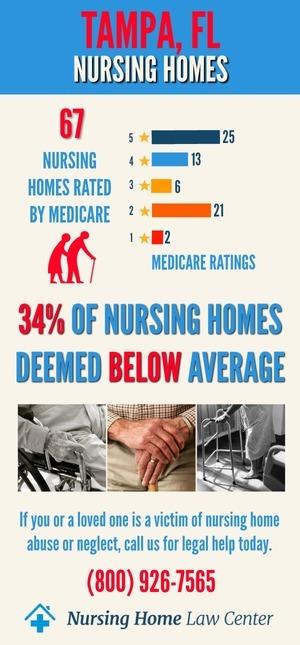
Around 34% of nursing homes in Tampa are deemed below average by the CMS.
The worst nursing homes in Tampa are usually the ones with low CMS star ratings, especially 1-star overall or health-inspection scores, along with recent inspection findings showing actual harm or immediate jeopardy to resident health or safety. Such nursing homes in Tampa include: