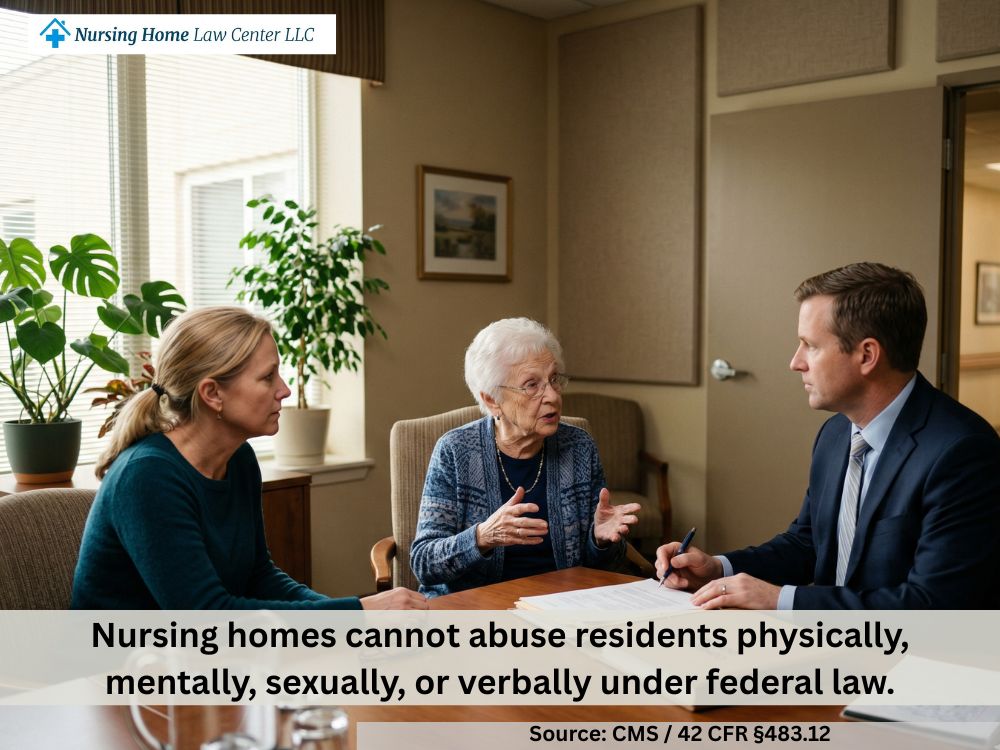
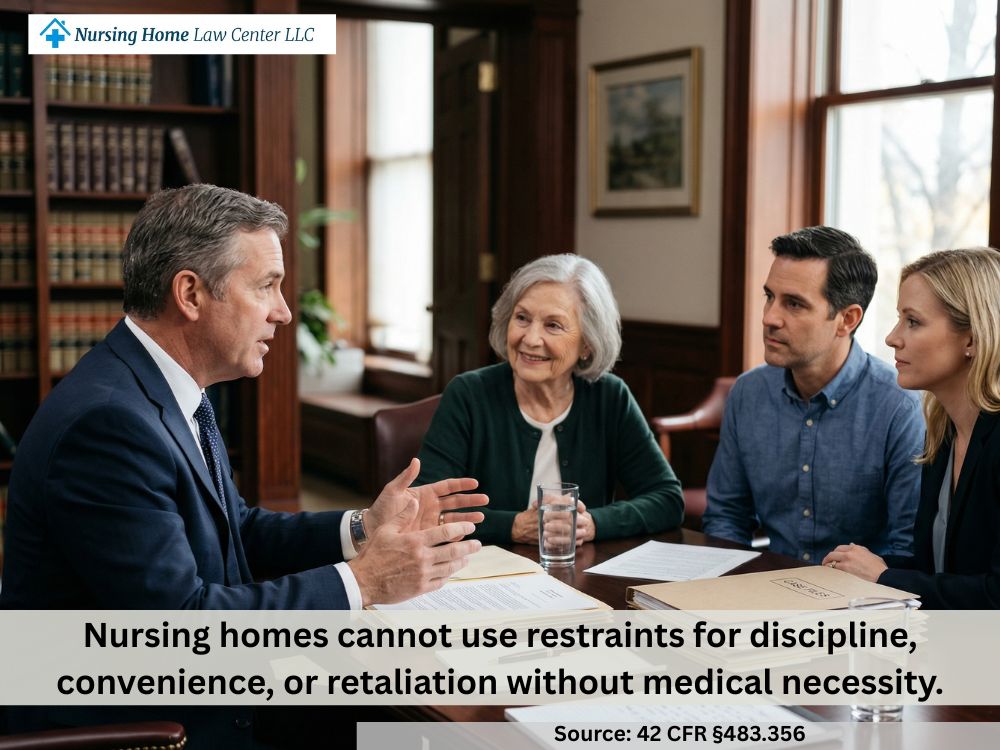
Under 42 C.F.R. § 483.10, things nursing homes are not allowed to do include violating resident rights to dignity, privacy, visitation, care participation, and freedom from retaliation. When a facility crosses these lines and a resident is harmed, our attorneys can investigate the violations and help families pursue a claim.
What Are Nursing Homes Not Allowed to Do?
For a quick overview, here are the things nursing homes are not allowed to do:
Abuse residents
Neglect residents
Use restraints for discipline or convenience
Discriminate
Deny necessary care
Deny privacy
Make decisions without authority
Restrict complaints
Isolate residents from visitors without a valid reason
Control finances without consent
Refuse access to medical records
Transfer or discharge residents without legal grounds
Hire disqualified staff
Retaliate
Abandon residents during closure
Families are often asking whether a nursing facility’s conduct has crossed the line into a nursing home violation. Not every facility commits abuse, but these rules exist because safety risks in long-term care can become severe.
Abuse, Neglect, and Exploitation
A nursing home must protect residents from physical abuse, verbal or emotional abuse, sexual abuse, neglect, financial exploitation, involuntary seclusion, and misappropriation of resident property. Staff members cannot hit, threaten, humiliate, isolate, steal from, or exploit nursing home residents. When there are signs of staff members abusing residents, all alleged violations must be reported and investigated.
Use Physical or Chemical Restraints Without Medical Need
Nursing homes cannot use chemical or physical restraints for punishment, convenience, or staff shortages. A restraint must relate to medical symptoms, be used only when the resident requires it, use the least restrictive alternative, and be re-evaluated. Chemical restraints can include sedating drugs used to control behavior rather than treat a real medical need.
Deny Necessary Health Care or Ignore Medical Care Plans
Nursing homes are not allowed to prevent access to medication, hydration, nutrition, wound care, or infection treatment required by a resident’s care plans. Under federal law, facilities in the Medicare and Medicaid programs must provide services aimed at each resident’s highest practicable well-being and cannot give worse care because of cost-cutting or payment source.
Discriminate Against Residents
A care facility cannot treat residents worse because of race, color, national origin, religion, sex, disability, or, in visitation, gender identity or sexual orientation. Federal rules also require identical transfer and discharge practices regardless of payment source, so many nursing home residents cannot be downgraded because they rely on Medicaid or belong to a protected class.
Improperly Transfer, Discharge, or Evict Residents
Nursing homes cannot evict their residents simply because they complain. Discharge must be based on legal grounds tied to welfare, medical requirements, improvement, safety, nonpayment, or closure, and the resident must receive proper notice explaining the reason and appeal rights. Facilities also cannot force residents to waive Medicare or Medicaid eligibility.
Deny Access to Medical Records, Privacy, or Confidentiality
Nursing home residents have the right to privacy during care and communications, and to the confidentiality of their medical documentation. A facility cannot restrict access to records. Federal rules require inspection access within 24 hours, excluding weekends and holidays, and copies within 2 working days of the request.
Make Decisions for Residents Without Proper Authority
Resident autonomy stays central under the Nursing Home Reform Act. Residents usually keep the right to make treatment decisions, choose schedules and activities, participate in their own care, and select providers where permitted. A proxy or POA may act only within their legal authority, and residents still retain the right to refuse when capable.
Block Complaints or Retaliate for Grievances
Filing complaints can be done orally, in writing, or anonymously, and families can help with the filing process. A nursing home must appoint a grievance official, investigate concerns, and issue a written response in a timely manner. Federal law also bars retaliation against residents and workers who report abuse.
Restrict Visitors Without a Valid Reason
Residents can receive immediate family, other relatives, and other visitors of their choosing, subject to consent and reasonable clinical or safety restrictions. A facility cannot isolate residents from visitors without a valid reason or deny visitation based on race, color, national origin, religion, sex, gender identity, sexual orientation, or disability. Residents can also refuse unwanted visitors, including other residents.
Control a Resident’s Finances Without Consent
A nursing home cannot control a resident’s financial accounts or personal funds without written authorization. It may not coerce a resident or family member to surrender control, require mandatory financial management, impose unexplained charges, or demand a third-party guarantee as a condition of admission. If it holds funds, it must keep separate records and accounts.
Hire or Keep Staff With Disqualifying Abuse Histories
A nursing home administrator should not hire or retain workers with disqualifying abuse, neglect, or exploitation findings; nurse aide registry issues; or active license discipline tied to resident harm. Federal rules bar facilities from employing people with qualifying abuse or misappropriation histories and require abuse-prevention training. Understaffing does not excuse dangerous hiring practices.
Abandon Residents During a Facility Closure
A nursing home closure does not permit abandonment. Federal regulations require written notice of an impending closure, usually at least 60 days in advance, plus a state-approved relocation plan that considers each resident’s needs, choice, services, and location. The nursing home administrator also may not admit new residents after notice.
Force Residents to Waive Rights or Accept Unfair Admission Terms
Admission paperwork cannot override federal or state law. Contracts may not conflict with the resident’s rights, and facilities may not use “sign here or no bed” pressure to strip protections. That includes no forced waiver of Medicare or Medicaid rights and no unfair payment guarantees.
What Federal Regulations Protect Nursing Home Residents’ Rights?
The main federal regulations include: the rights of nursing home residents in § 483.10; abuse protections in § 483.12; transfer and discharge rules in § 483.15; person-centered plan of care in § 483.21; plus quality-of-care, administration, and training requirements tied to the Medicare and Medicaid programs.
These nursing home resident protections support dignity, health care choices, custodial care, and public health.
What Should Family Members Do If a Nursing Home Violates These Rules?
Act promptly when warning signs appear:
Get the resident safe.
Seek medical evaluation if harm is suspected.
Photograph injuries or unsafe conditions.
Request records and incident reports.
File an internal grievance.
Report to the state survey agency or ombudsman program.
Speak with a nursing home abuse lawyer.
When Does a Violation Become a Nursing Home Abuse Lawsuit?
A violation of the Nursing Home Reform Law or other laws and regulations becomes a lawsuit when it causes harm, financial loss, or a pattern of unsafe conduct. Common examples include:
Injury or worsening condition, indicating the resident did not receive proper care
Preventable falls, often tied to supervision, transfer, or mobility failures
Pressure ulcers, showing poor repositioning, skin checks, or nutrition
Infections or sepsis, which are often linked to delayed medical treatment
Financial losses, including theft or misuse of funds
Emotional harm, such as fear, humiliation, or isolation
Pattern of violations, which can help prove the problem was systemic
Wrongful death, where neglect or abuse contributes to a fatal decline
How We Can Help You Take Legal Action When Facilities Fail to Provide Compassionate Care
Our nursing home abuse and neglect attorneys review medical documentation, care plans, staffing, supervision, finances, and discharge decisions to determine whether a nursing home or assisted living facility failed its residents. We handle these cases on a contingency fee basis, so there is no attorney fee unless we recover compensation for you. Contact us for a free consultation.
Jonathan did a great job helping my family navigate through a lengthy lawsuit involving my grandmother's death in a nursing home. Through every step of the case, Jonathan kept my family informed of the progression of the case. Although our case eventually settled at a mediation, I really was...
- Lisa
After I read Jonathan’s Nursing Home Blog, I decided to hire him to look into my wife’s treatment at a local nursing home. Jonathan did a great job explaining the process and the laws that apply to nursing homes. I immediately felt at ease and was glad to have him on my side. Though the lawsuit...