
Experienced Attorneys Protecting the Rights of the Neglected and Abused
The Nursing Home Law Center is committed to providing the legal resources necessary to hold negligent facilities accountable.

Kansas nursing home lawsuit settlements provide financial compensation when nursing home residents suffer harm because a facility failed to deliver adequate care, act on warning signs of neglect, and prevent abuse.
These cases often involve injuries, medication mistakes, dehydration, malnutrition, physical or sexual abuse, unsanitary conditions, or wrongful death. Settlement value depends on the severity of the facility’s failures, whether staff overlooked known risks to the resident, and the lasting impact the injuries had on the resident and their loved ones.
Our Kansas nursing home abuse attorneys investigate medical records, staffing histories, witness accounts, and state regulations to help your family seek justice. Contact us today for a free, no-obligation consultation.
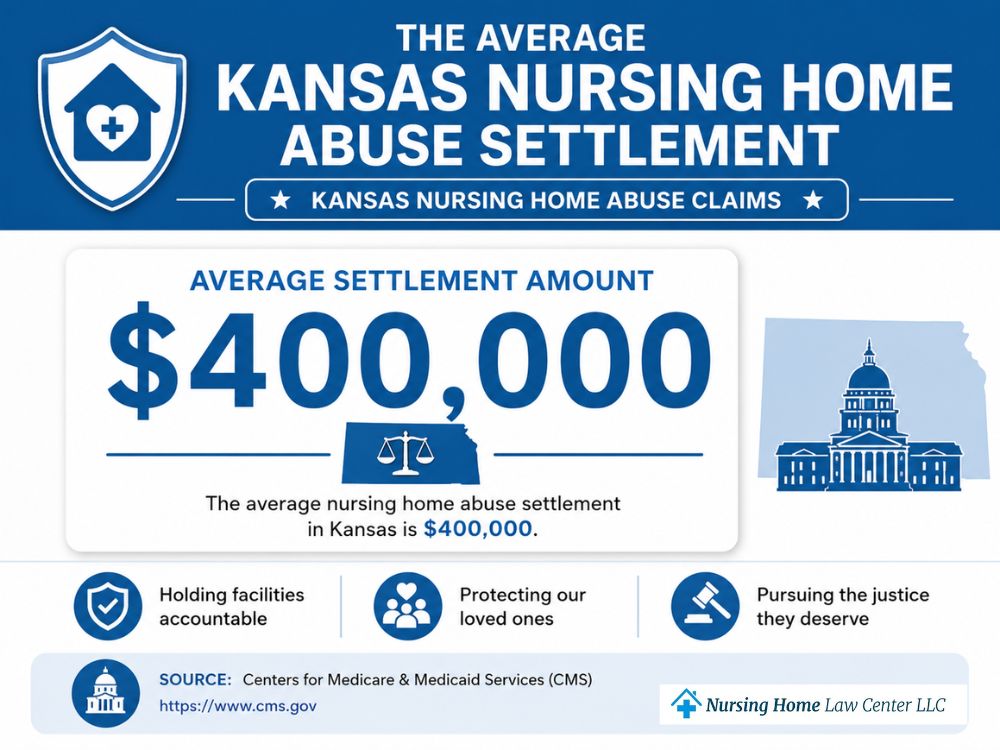
The average in nursing home abuse lawsuits in Kansas is $400,000.
Our client’s husband entered a skilled nursing facility after hip replacement surgery to receive rehabilitative care. During his stay, he developed a pressure sore that progressed to severe infection. He died from sepsis within weeks of his admission.
We evaluated the facility’s repositioning records, wound care documentation, and physician notification timeline to determine liability, helped his widow file a wrongful death lawsuit, and secured compensation for her loss.
Two women residing in a long-term care facility were sexually assaulted by a certified nursing assistant in charge of their care. Both women had significant cognitive impairments that made it difficult for them to communicate what they encountered and report the abuse.
Our investigation examined hiring records, supervision practices, and prior complaints against the employee. The settlement value was shaped by the trauma inflicted on both women and their families, and the facility’s failure to act on earlier warning signs about the employee’s conduct.
Dorothy was admitted to a nursing facility for short-term rehabilitation. Over several weeks, she developed pressure wounds that were inadequately treated. As a result, the wounds became infected, which later progressed to sepsis and led to her death.
Our legal team reviewed nursing notes, wound care logs, and staffing ratios to establish that the facility failed to meet basic care standards and provide the necessary medical treatment.
Gerald, a resident with a documented history of prior falls, fell while left unsupervised in a common area of his assisted living facility, striking his head and fracturing his hip. The fall caused a subdural hematoma requiring emergency surgery and a lengthy hospitalization.
We gathered incident reports, fall-risk assessments, and supervision logs showing the facility ignored known fall risks. The value of the settlement accounted for his medical care, ongoing rehabilitation needs, and the long-term impact of his injuries on his independence.
Norma, a resident with advanced dementia, wandered into an unsecured storage closet at her facility and ingested toxic chemicals left within reach. She suffered severe internal injuries requiring hospitalization.
Our experienced attorneys pursued the nursing home neglect case based on the facility’s failure to secure hazardous materials and monitor a resident known to wander. The settlement value was shaped by the lasting impact of her injuries, the facility’s documented awareness of her wandering behavior, and the fully preventable nature of the hazard.
Frank, an 82-year-old group home resident with fragile health, was repeatedly physically abused by another resident, a form of elder abuse that staff failed to stop despite documented prior incidents. His family noticed unexplained injuries on multiple occasions, but the facility repeatedly downplayed the situation.
Our review of incident logs and staffing records revealed the facility knew of the risk from earlier incident reports but didn’t intervene. This nursing home abuse case was supported by witness statements from fellow group home residents, the facility’s failure to implement a separation plan, and the cumulative physical and emotional toll on Frank given his already fragile health.
Eleanor choked on food improperly prepared for her dietary restrictions at her nursing home. Staff failed to intervene quickly enough, and she died before emergency responders arrived.
We negotiated a settlement prior to litigation after establishing that the facility disregarded her documented swallowing precautions, failed to modify her food texture as required by her care plan, and did not have staff adequately trained to respond to a choking emergency.
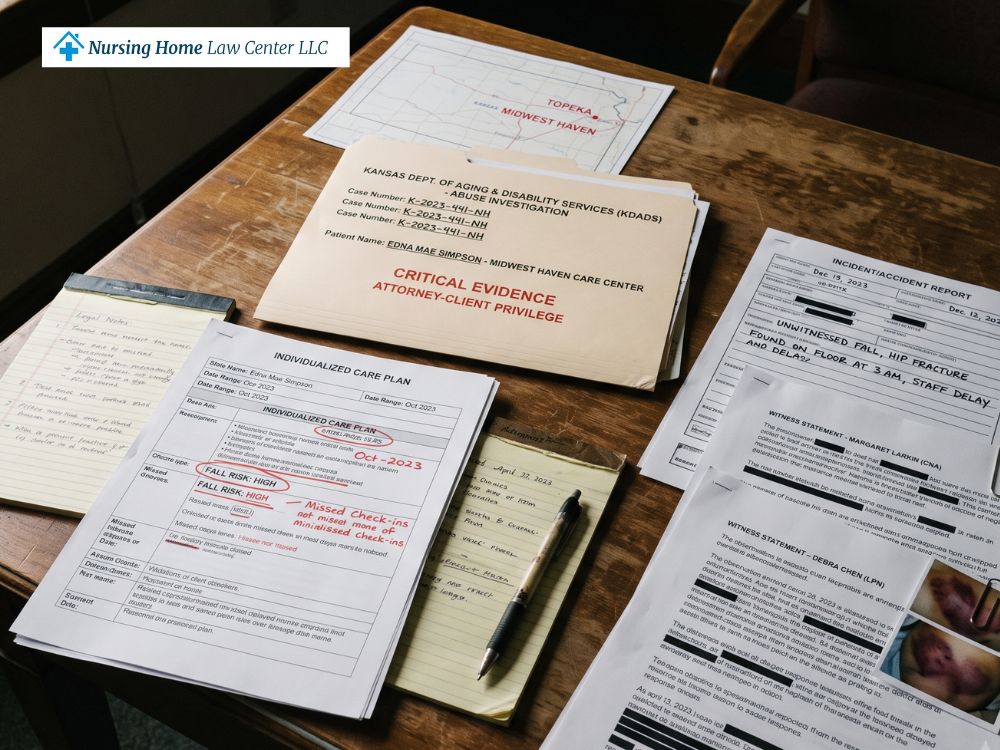
Kenneth, a wheelchair-dependent resident, was injured when his facility’s transport van was involved in a collision caused by inadequate wheelchair securement. The impact threw him forward against the restraint system, causing a fractured hip and spinal injuries that significantly worsened his existing mobility limitations.
We established that the driver and staff failed to follow safety protocols for transporting residents with mobility limitations, causing his serious injuries that further impacted his future mobility.
A federal claim was brought against a nursing home operator after a resident lost approximately 100 pounds and developed pressure sores due to inadequate nutrition, supervision, and sanitary conditions during a multi-year stay.
The claim alleged the operator failed to meet basic standards of care over an extended period, allowing the resident’s condition to deteriorate significantly.
Several issues shape the value of a nursing home neglect case, including:
Falls, pressure ulcers, infections, medication errors, choking, fractures, malnutrition, and dehydration each carry different medical and legal implications, which then shape the damages available.
Hospitalization, surgery, permanent impairment, chronic pain, infection, and death typically increase a case’s value, since these outcomes reflect greater physical and emotional harm to the resident and their family.
Dementia, limited mobility, swallowing difficulties, diabetes, or prior wounds and fall history can show that a facility knew the resident required closer supervision, strengthening the case that the facility’s failures were foreseeable.
Earlier falls, care plan warnings, family complaints, inspection citations, and repeated chart entries documenting the same problem can establish that the facility had notice and failed to act.
Expert medical review is often needed to connect the facility’s conduct directly to the resident’s injury or death, and stronger causation evidence generally supports a higher settlement value.
Missing records, late charting, inconsistent documentation, or signs of altered entries can affect settlement negotiations, since gaps in the record may either hurt or help a resident’s claim.
Family members, staff, roommates, visitors, and outside medical providers can offer firsthand accounts that clarify what happened.
A facility remains liable for the harm caused regardless of its insurance coverage, but its insurance policies can still influence the settlement value, since available coverage often affects how much an insurer is willing to pay to resolve a claim.
Kansas has no cap on economic damages in nursing home abuse lawsuits, meaning a resident or family can recover the full amount of documented losses, such as medical bills, hospitalization costs, and rehabilitation expenses, without any statutory ceiling.
Kansas also no longer caps noneconomic damages in most personal injury cases, following the Kansas Supreme Court’s 2019 ruling in Hilburn v. Enerpipe, Ltd., though wrongful death lawsuits remain subject to a $250,000 cap under K.S.A. 60-1903. Kansas also follows a comparative fault system under K.S.A. 60-258a, meaning a resident’s recovery can be reduced if they are found partially at fault, and barred entirely if found 50 percent or more at fault.
Certain injuries recur in Kansas nursing home neglect and abuse lawsuits because they point directly to gaps in supervision, training, or basic care. Below are some of the most common injuries we see forming the basis of a claim.
The compensation available for nursing home abuse depends on the type of claim filed and the harm the resident and family experienced. Depending on the facts of the case, recoverable damages may include:
Kansas allows punitive damages, but they are restricted and capped under K.S.A. 60-3702. A resident or family must prove by clear and convincing evidence that the facility acted with willful conduct, wanton conduct, fraud, or malice, since ordinary nursing home negligence alone will not support a punitive damages claim.
Punitive damages generally cannot be awarded against a facility for an employee’s misconduct unless the facility authorized or ratified that conduct.
If awarded, punitive damages are capped at the lesser of the facility’s highest annual gross income from any one of the five years before the misconduct, or five million dollars. The court may instead award up to 50% of the facility’s net worth if that income figure is clearly inadequate to penalize the facility, or apply a different cap if the facility profited more than these limits allow.
A Kansas nursing home settlement can take anywhere from several months to a few years, depending on the complexity of the case and how the facility responds to the claim.
Straightforward cases with clear liability and strong documentation may resolve through negotiation before a lawsuit is even filed. Cases that proceed through Kansas’s district court system typically move through discovery, expert review, and pretrial conferences before a settlement is reached. Kansas district courts generally aim to move civil cases toward resolution within set time standards, though prolonged litigation often extends beyond those benchmarks.
Several factors can extend the timeline. Wrongful death cases, as well as those involving severe injuries, disputed medical causation, or corporate nursing home chains with multiple layers of ownership, often require more extensive investigation, including detailed chart review, depositions of staff and administrators, and expert testimony.
For personal injury and wrongful death cases, Kansas law requires that the lawsuit be filed within two years of the date of the incident, under K.S.A. 60-513.
Because deadlines can vary depending on the facts of the case and how a claim is classified, families should not wait to speak with a nursing home attorney. Acting quickly helps preserve critical evidence, locate witnesses, and protect the family’s right to pursue accountability before evidence becomes harder to gather.
Before accepting any settlement offer, families can take several steps to protect the resident’s legal rights and strengthen the value of the claim. We recommend the following actions.
Many nursing home lawsuits in Kansas settle before trial, but reaching a fair settlement usually requires gathering evidence, conducting a thorough investigation, and skilled negotiation with the facility’s insurer or defense team. We provide all the necessary services, including:
If your loved one suffered harm in a Kansas nursing home, contact us for a free case review. Our legal team can evaluate medical records, identify the facility and parties responsible, explain whether you may have grounds for a formal lawsuit, and help you pursue compensation.
We handle Kansas nursing home cases on a contingency-fee basis, meaning you owe no attorney fees unless we recover compensation on your behalf. To speak with an experienced nursing home abuse attorney and learn more about the legal process, call us today at (800) 926-7565 or complete our online contact form for a free, no-obligation consultation.
We help families take legal action against some of the worst-rated nursing homes throughout Kansas, and we are ready to assist you in holding negligent facilities accountable.