
Experienced Attorneys Protecting the Rights of the Neglected and Abused
The Nursing Home Law Center is committed to providing the legal resources necessary to hold negligent facilities accountable.


Georgia’s Bill of Rights for Residents of Long-Term Care Facilities, O.C.G.A. §§ 31-8-100 et seq., protects dignity, privacy, self-determination, and freedom from mistreatment in long-term care. When those protections are broken, nursing home abuse victims and their families deserve answers and a path toward accountability. Book a free consultation with a Georgia nursing home abuse attorney.
Nursing home abuse is intentional harm, reckless conduct, or serious failure to provide proper care that injures residents in a Georgia nursing home, rehabilitation center, or other long-term care setting. It can involve direct violence, humiliation, theft, sexual misconduct, or nursing home neglect so severe that residents suffer preventable decline.
The National Institute on Aging explains that elder abuse can be physical, emotional, sexual, financial, or neglect-based, and that framework fits many institutional elder abuse claims.
Physical elder abuse includes hitting, grabbing, rough transfers, and other force that causes bruises, fractures, or head trauma. We look for evidence of battery, repeated falls, and misuse of physical restraints or chemical restraints. This kind of physical abuse can leave elderly victims with a serious injury or even lead to death.
Emotional elder abuse is a form of psychological or emotional abuse that includes threats, humiliation, intimidation, deliberate isolation, and verbal cruelty. The harm often appears as fear, depression, withdrawal, agitation, or sudden behavioral change. Senior citizens with dementia may show it through mood and body language if they are unable to explain it.
Financial elder abuse happens when a resident’s money, benefits, or valuables are misused. Common warning signs include forged checks, missing property, unauthorized withdrawals, and irregular handling of trust funds. A paper trail often exposes what happened.
Elder sexual abuse includes nonconsensual touching, sexual assault, and exploitation of residents who cannot consent. Families should treat genital injuries, bleeding, torn clothing, panic around staff, or STDs as urgent warning signs. Claims involving sexual abuse may also involve negligent security or negligent hiring.
Nursing home neglect is the failure to provide food, water, supervision, hygiene, repositioning, medication, or timely medical care. It often stems from understaffing, poor training, poor charting, or indifference. Many nursing home victims are harmed by omission rather than open violence.
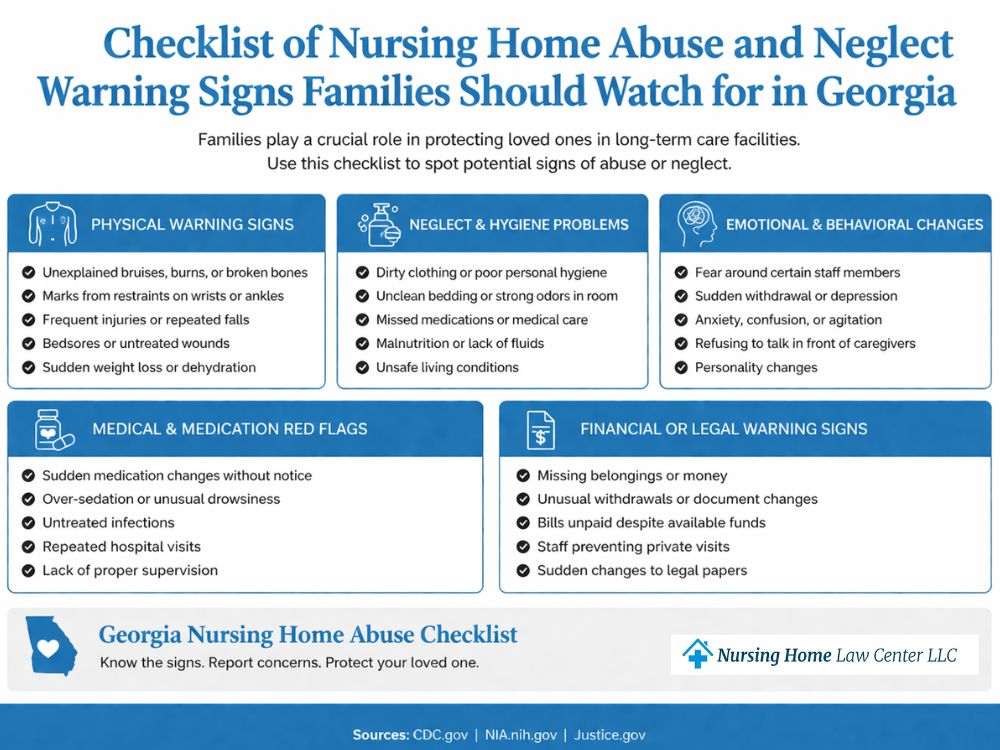
The most important signs of nursing home abuse are changes that do not fit the resident’s baseline.
Families pursuing justice for their abused loved ones trust our nursing home abuse lawyers because we combine a proven track record with focused injury work and have recovered millions while standing with clients through the entire legal process.
Our firm has recovered more than $450 million for injury victims, earned a 98% success rate, and brings over 100 years of combined experience to every case. We have helped more than 5,000 clients, remain available 24/7, and are respected by courts and peers for our focused, ethical advocacy. Because we are 100% injury focused, we understand what these cases demand. We also offer a free case evaluation, and you pay no lawyer fees unless we win.
Our nursing home neglect attorneys focus on cases involving pressure injuries, falls, choking events, elopement, assault, and preventable infections. Families often call us after a loved one has suffered serious harm, and they want someone with extensive knowledge of records, regulations, and the practical failures that happen inside long-term care facilities.
That means listening carefully, identifying the cause of your loved one’s injuries, and building a case that seeks fair compensation for the real losses your family faces.
These case results show how nursing home claims can arise from pressure injuries, unsafe supervision, and transportation failures, and how we hold facilities accountable for these issues. Georgia nursing home abuse settlement value often depends on the severity of the resident’s injuries, the clarity of the facility’s negligence, the strength of the medical proof, and whether the harm led to permanent decline or death.
Margaret entered a facility for rehabilitation and developed pressure wounds that were allowed to worsen. Her estate recovered $2,150,000 after evidence showed delayed wound treatment, poor repositioning, infection, and wrongful death. The value increased because the decline appeared preventable.
Evelyn, a resident with dementia, gained access to chemicals in an unlocked storage area and suffered poisoning. Her family recovered $1,500,000. The case had strong value because the safety failure was basic and foreseeable.
Rosa, a disabled resident, was injured in a nursing home transportation crash and obtained $1,200,000. The settlement reflected serious orthopedic injuries and a straightforward liability story.
Federal and state nursing home laws and regulations work together to ensure the safety and well-being of residents.
Ga. Comp. R. & Regs. r. 111-8-56 sets operating rules for nursing homes, including staffing minimums, medication administration, infection control, restraints, records, and employee screening for prior findings of abuse. Georgia nursing home rules also require staff training on resident rights and abuse prevention.
O.C.G.A. § 30-5-1 et seq., the Disabled Adults and Elder Persons Protection Act, creates Georgia’s reporting and protective-services framework for abuse, neglect, and exploitation.
O.C.G.A. §§ 31-8-100 et seq. protect dignity, privacy, financial autonomy, visitation, and complaint rights in long-term care.
Federal law further reinforces protections. Under 42 U.S. Code § 1395i-3, a skilled nursing facility participating in Medicare must promote quality of life, perform comprehensive assessments, follow a plan of care, maintain infection control, and make survey and complaint reports available.
Because these homes often depend on federal funding, both the federal government and state regulators play a role. The rules enforced through Medicare and Medicaid services do not replace Georgia tort law, but they often supply useful proof of the standard of care required for nursing home residents at the time of the injury.
The 1987 Nursing Home Reform Act established the modern federal framework for resident rights. When a facility breaks those rules, the evidence may support civil litigation for personal injury claims or medical malpractice cases involving licensed staff.
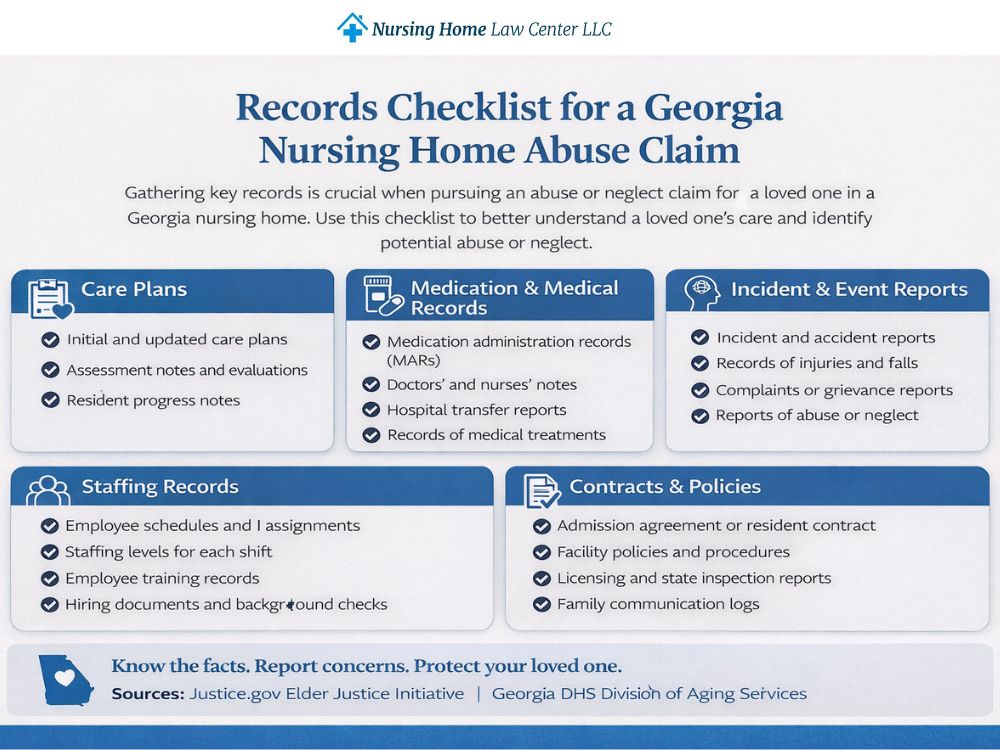
Reporting abuse quickly can protect a resident and preserve evidence. Nursing home abuse in Georgia can be reported to emergency responders, regulators, adult-protection authorities, or the long-term care ombudsman. Be ready to provide the resident’s name, the facility’s name and address, dates, witnesses, photographs, recent hospital information, and any medical records you already have.
Call 911 for violence, sexual assault, medical crisis, catastrophic injuries, or immediate risk of death.
The Georgia Department of Community Health licenses and inspects facilities through its Healthcare Facility Regulation Division. Families can file an online complaint or report by calling 1-866-552-4464.
Adult Protective Services investigates abuse, neglect, and exploitation of older adults or disabled adults who do not live in long-term care facilities. Reports can be made online or by calling 1-866-552-4464 and selecting option “3.”
The Georgia Long-Term Care Ombudsman Program advocates for residents of nursing homes and other assisted living facilities and helps resolve complaints, ensuring that residents’ wishes are upheld within the facilities. Family members can use its website or call 1-866-552-4464 and select option “5.”
A Georgia nursing home lawyer can step in early, protect evidence, and move a family from suspicion to proof. An experienced attorney from our team can help you with:
The average Georgia nursing home abuse settlement or verdict is $9,783,367, based on reported case compilations.
Averages are often skewed by a few very large verdicts. Real case value depends on the seriousness of injury, whether the resident suffered abuse over time, the strength of causation proof, and whether the evidence shows repeated disregard for obvious danger.
Cases involving pressure injuries, sepsis, fractures, choking, or wrongful death often have higher value. Strong charts, prior citations, staff admissions, and proof of understaffing can increase value. Our role is to build the record, seek justice, and pursue compensation for nursing home negligence grounded in the facts.
If you are searching for a skilled Georgia nursing home abuse attorney, our team is ready to listen. We offer a free case review for families who believe a loved one suffered abuse or neglect in a nursing facility, rehabilitation center, or assisted living facility. We work on a contingency basis, so there are no fees unless we recover compensation for you. Contact us today to discuss your concerns and start informed legal action.
A nursing home generally provides a higher level of daily medical and custodial care than an assisted living facility.
Skilled nursing facilities primarily provide skilled nursing care or rehabilitation services and must meet federal requirements.
If a resident was harmed because of a direct caregiver’s negligence or someone else’s negligence inside a nursing home, or the nursing home itself failed to provide proper care, you may have a claim worth investigating.
No. We must show that the defendant owed the resident a duty of care, breached that duty, caused the injury, and that the injury resulted in actual damages.
Georgia’s nursing home neglect statute of limitations is governed by O.C.G.A. § 9-3-33, which generally provides a two-year limitations period from the date of the injury to the person.
Document injuries, request records, move the resident to safety if necessary, and report the situation. If you suspect a loved one is abused or neglected, act quickly.
Report retaliation immediately to DCH and the long-term care ombudsman, and document every change in care, visitation, or discharge pressure.
Some claims resolve in months, while heavily disputed cases can take much longer.
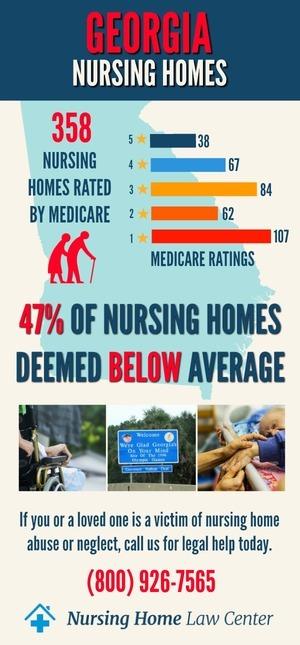
About 47% of nursing homes in Georgia are rated below average by the CMS, which can reflect problems with inspections, staffing, or resident care.
The worst nursing homes in Georgia are those that have the most serious care and safety problems. They are identified through Medicare and Medicaid inspections, deficiency findings ranked by severity and scope, poor CMS star ratings, and recent inspection reports showing serious or repeated violations.
Using those criteria, recent public sources have included: