
Experienced Attorneys Protecting the Rights of the Neglected and Abused
The Nursing Home Law Center is committed to providing the legal resources necessary to hold negligent facilities accountable.

Nursing home sexual abuse settlements provide financial compensation when a facility failed to protect a resident from unwanted sexual contact, ignored warning signs or prior complaints, or failed to supervise staff members. Sexual abuse in a nursing home is often preventable, since staff are responsible for screening employees and supervising vulnerable residents.
A nursing home sexual abuse lawsuit may involve resident-to-resident abuse, staff-on-resident abuse, sexually transmitted infections, physical injuries, and emotional trauma, especially when elderly residents have cognitive impairment.
Settlement value depends on how the facility failed the resident and how the abuse affected the resident and family members.
Our nursing home sexual abuse lawyers gather medical records and witness statements to determine whether nursing home abuse caused the harm. Contact us for a free case evaluation.
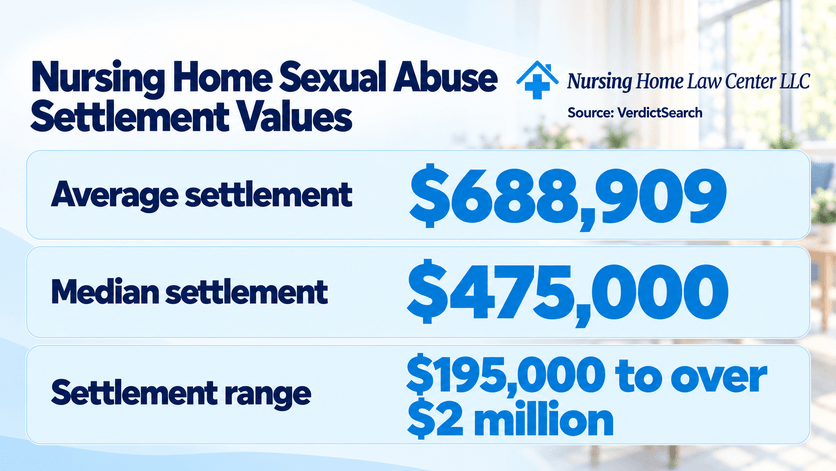
According to case data published by VerdictSearch, the average nursing home settlement involving sexual abuse is $688,909, though the median settlement is $475,000. The gap between these two figures exists because a small number of high-value nursing home abuse cases pull the average upward, while the median reflects a more typical outcome for most elder sexual abuse cases.
Settlement amounts in nursing home sexual abuse cases generally range from $195,000 to over $2,000,000. Cases toward the lower end of this range often involve less severe injuries, limited documentation, or facilities with fewer resources. Cases toward the higher end typically involve repeated abuse, serious injuries, sexually transmitted infections, wrongful death, or clear evidence that the nursing home ignored prior incidents or warning signs.
Several factors influence where a sexual abuse settlement falls within the range, including the strength of the evidence, the severity of harm suffered, whether staff members or facility owners knew about the risk, and the resident’s ability to testify. Every case is different, and settlement amounts depend on the specific facts of the abuse case, the jurisdiction, and the nursing home’s insurance coverage.
Lower-value cases may involve a single incident of unwanted sexual contact that was reported and addressed quickly, with limited lasting harm to the resident. Higher-value cases often involve repeated abuse, serious injuries, sexually transmitted infections, severe emotional trauma, or resident-to-resident abuse that the facility failed to prevent despite known risk factors.
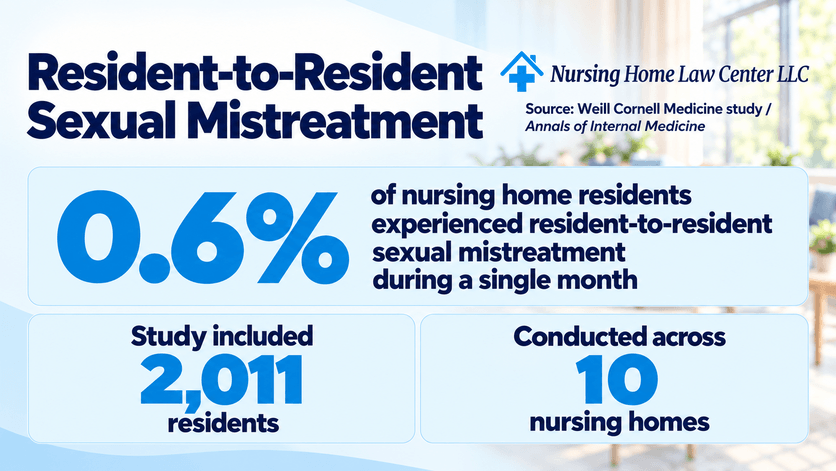
0.6% of nursing-home residents experienced resident-to-resident sexual mistreatment during a single month in a studyof 2,011 residents at 10 nursing homes.
Settlement value also depends heavily on whether the nursing home had prior notice of the danger. Incident reports, complaints from other residents or family members, staffing records, and employee background checks can show that the facility knew about a risk and failed to act. A pattern of prior incidents involving the same staff member or resident can significantly increase settlement value, since it points to systemic failures rather than an isolated event.
Witness testimony from staff members, other residents, or visitors can also strengthen a claim, particularly in cases where the victim has cognitive limitations or dementia and cannot testify clearly about what happened. Medical records, photographs, and facility reports documenting injuries or behavioral changes carry significant weight.
State law plays a role as well. Some states allow punitive damages when a facility acted with gross negligence, while others cap non-economic damages or set shorter deadlines to file suit. The nursing home’s insurance coverage, the number of defendants, and whether the case settles or proceeds to trial also affect the final settlement amount.
The resident’s overall health also matters. Elderly residents with cognitive impairment, physical dependence on staff, or a limited ability to report abuse are often considered more vulnerable residents in the eyes of a jury, which can increase settlement value.
An experienced lawyer can evaluate these factors and help you understand what a fair settlement might look like for your loved one’s specific circumstances.
Below are nursing home settlement examples involving elder sexual abuse cases across the country. These cases involve allegations of sexual abuse, negligent supervision, or facilities’ failure to protect residents.
A 77-year-old resident with Alzheimer’s disease was sexually assaulted by another resident while staff reportedly watched without intervening. She was hospitalized with acute trauma from the assault. Her family alleged the facility failed to provide adequate supervision and a safe environment. The facility argued the sexual conduct was consensual, but the family’s Texas nursing home abuse lawyers maintained her Alzheimer’s made her unable to consent.
A 52-year-old patient with schizophrenia alleged she was sexually assaulted by a janitor at her facility. An investigation revealed the janitor was a registered sex offender the nursing home had hired without a background check. She hired a California nursing home abuse lawyer and sued the facility for negligence, arguing it had a duty to protect vulnerable residents from employees with known histories of sexual offenses.
An 86-year-old nursing home resident was allegedly sexually assaulted by a male resident with dementia and a documented history of sexual misconduct and wandering into other residents’ rooms. He was removed from her room twice in one night, only for him to return a third time. Six weeks after the alleged assault, she was found in her room with a broken leg. Her family sued under the state’s vulnerable adults statute, arguing the facility knew of his history and failed to act.
An 82-year-old nursing home resident with dementia developed swallowing problems, unexplained burns, a fractured wrist, and a sexually transmitted disease during her stay at a long-term care facility. The Massachusetts nursing home abuse lawyers alleged that a known sexual predator had been temporarily housed at the facility during her stay and that staff failed to properly supervise either resident.
A 54-year-old nursing home resident with severe multiple sclerosis and dementia was allegedly sexually assaulted by another resident with schizophrenia and liver disease. Her cognitive limitations left her unable to fully describe what happened. She sued the facility for negligent supervision, arguing that proper oversight would have prevented the assault. The accused resident died before he could be questioned, and her Boston nursing home abuse attorney built the case on circumstantial evidence.
An 89-year-old Alzheimer’s patient was allegedly sexually assaulted at least 13 times by a male resident with a history of similar incidents involving other female residents. Staff reportedly witnessed the assaults and documented them in her records but only asked the man to stop, never notifying police. Because of memory loss due to her advanced Alzheimer’s, she could not recall the abuse beyond a short period. Her family alleged the facility failed to provide adequate supervision and security.
A 72-year-old Alzheimer’s patient was sexually abused by another resident known for wandering the halls and behaving inappropriately toward residents. A nursing assistant reportedly witnessed the assault, but staff waited a full day to contact police, and the facility bathed the resident before a rape kit could be performed. The Missouri nursing home abuse lawyers appointed to this elder sexual abuse case alleged negligent supervision and destroyed evidence.
Sexual abuse occurs when facilities fail to screen, train, and supervise the people who have access to residents. Some abuse comes from staff members with undisclosed criminal histories. Some comes from other residents, particularly those with dementia or cognitive impairment who may act on confusion or lost inhibitions. In both cases, the facility is responsible for identifying risk factors and intervening before abuse occurs.
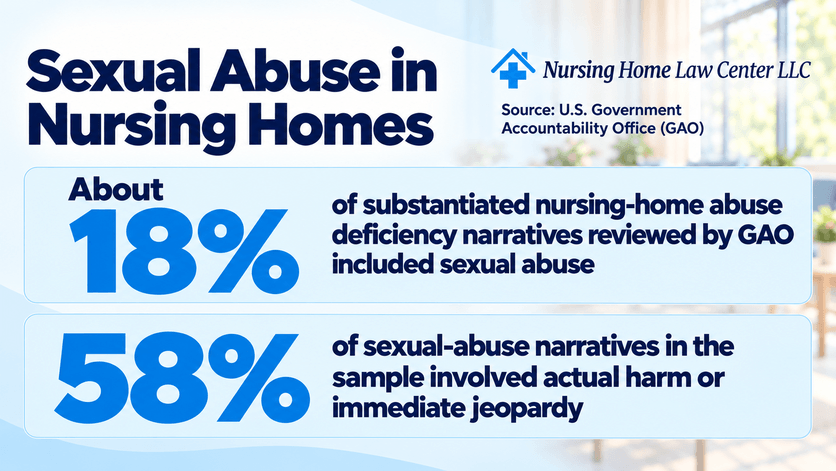
Sexual abuse appeared in about 18% of the substantiated nursing-home abuse deficiency narratives GAO reviewed. 58% of sexual-abuse narratives in GAO’s sample were categorized as severe, meaning actual harm or immediate jeopardy.
Understaffed facilities often cannot monitor high-risk residents closely enough, and some nursing homes minimize or bury complaints rather than notify families or state agencies, allowing prior incidents to repeat.
Social isolation adds to the risk. Residents with limited family contact, physical dependence on staff, or an inability to communicate clearly are at greater risk because abuse is less likely to be noticed or reported. Assisted living facilities face the same responsibility. When these facilities accept vulnerable adults, they must have systems in place to screen employees, monitor residents, and respond immediately when abuse is suspected.
The signs of sexual abuse in elderly residents of long-term care facilities can be difficult to recognize, especially when a resident has dementia, cognitive impairment, or trouble communicating. Family members should watch closely for sudden changes in behavior or physical condition.
Sexual abuse may lead to the following signs:
Because many nursing home residents cannot describe what happened, many families often notice these signs before staff members acknowledge or report them. Any combination of physical injuries and sudden emotional or behavioral changes should prompt a closer look at records, incident reports, and facility reports, since early recognition can prevent future abuse and protect other vulnerable residents in the same nursing home.
Nursing home sexual abuse rarely causes a single, isolated injury. Injuries typically take many forms, including physical harm, psychological trauma, and, in the most serious cases, death.
Both medical documentation and facility records typically play a role in building a strong case. Hospital records show the extent of the resident’s injuries, while facility and staffing records reveal whether warning signs were ignored. Together, this evidence can prove the facility was negligent in how it screened, trained, or supervised the people responsible for a resident’s safety.
The compensation available in a long-term care elder abuse settlement depends on state law and the severity of what the resident and family experienced. Every family deserves to understand the full range of damages a claim may cover, since settlement value is rarely limited to medical costs alone.
Depending on the facts of the case, compensation may include:
Some states cap non-economic or punitive damages, while others allow settlement negotiations to account for the full extent of the abuse and its lasting impact on the resident and their loved one. An experienced nursing home abuse lawyer can help a family understand which types of compensation apply to their specific case and pursue the full value of a claim.
A resident who survived the abuse and has legal capacity may file a nursing home sexual abuse lawsuit on their own behalf. When cognitive impairment, dementia, or a disability prevents the resident from acting, a guardian, conservator, or person holding power of attorney may be able to pursue the claim instead, depending on state law. If the resident died as a result of the abuse or related neglect, the estate’s authorized representative may need to bring a wrongful death claim.
Our nursing home abuse lawyers can help identify who has legal authority to file, whether that’s the resident, a family member, or an estate representative, explain legal options, and guide the family through each step of the legal process.
The deadline to file a nursing home sexual abuse lawsuit varies significantly by state and by the type of claim. Some claims may have relatively short filing deadlines, while discovery rules, incapacity, government-facility requirements, or laws specific to sexual abuse can change the applicable period.
Missing the applicable deadline to file a nursing home lawsuit can permanently bar a family from pursuing compensation, regardless of how strong the evidence is. Because evidence like incident reports, staffing records, and witness statements can disappear quickly, families should not wait to report abuse and take legal action.
An experienced lawyer can confirm the exact deadline that applies to a specific state and case, and can begin the legal process of preserving evidence and pursuing compensation right away.
Before accepting any offer, families should take a few key steps to protect the resident and strengthen the claim.
Our experienced nursing home abuse attorneys take on the heavy lifting so families can focus on their loved one’s recovery while we pursue justice and seek compensation on their behalf. Here’s how we help build a nursing home sexual abuse case:

We have helped families of nursing home sexual abuse victims recover meaningful compensation while holding negligent facilities accountable. The settlements below reflect the outcomes we have secured, though every case depends on its own facts.
Our clients were residents at the same nursing home when a family member discovered that a certified nursing assistant had sexually assaulted both women during overnight shifts. Our investigation showed that understaffing left the CNA unsupervised with vulnerable residents for extended periods, and that the facility had not properly verified his background before hiring him. We’ve seen similar hiring failures at other facilities that skip background checks to fill overnight shifts quickly. We pursued claims on behalf of both women, focusing on the nursing home’s failure to screen and supervise staff.
A nursing home resident with advanced dementia was sexually assaulted by a maintenance worker who was not authorized to be in resident rooms unsupervised. Because her condition made her unable to describe the assault, our team relied on physical evidence and facility access records to build the case. We identified multiple causes of elder abuse at the facility, including lax visitor and staff access policies that allowed non-caregiving employees to enter residents’ rooms alone.
If your loved one suffered sexual abuse in a nursing home, contact Nursing Home Law Center for a free consultation. Our lawyers can review medical records, facility reports, and staffing history to evaluate what happened, identify the parties responsible, explain your legal options, and help you pursue justice.
Every family deserves the chance to seek justice and hold facilities accountable when a resident’s safety was ignored. Whether that means pursuing legal action or negotiating directly with a facility’s insurer, our team can help you seek compensation for the harm your loved one suffered.
We work on a contingency fee basis, meaning your family pays no attorney fees unless we recover compensation for you. To speak with an experienced lawyer, call (800) 926-7565 or complete our online contact form.