
Experienced Attorneys Protecting the Rights of the Neglected and Abused
The Nursing Home Law Center is committed to providing the legal resources necessary to hold negligent facilities accountable.

Nursing home fall settlements provide financial compensation when a facility fails to protect residents from a preventable fall, whether through inadequate supervision, missing safety equipment, or ignoring a known fall risk.
Settlement value depends on how the facility failed the resident and how the fall affected the family physically, emotionally, and financially. Nursing home neglect cases often carry greater value when the resident had a known fall risk, such as dementia, limited mobility, poor balance, or medications that increase the likelihood of falling.
Our nursing home fall lawyers review medical records, incident reports, staffing logs, and care plans to determine whether nursing home abuse or neglect caused the fall. We can help you hold the negligent nursing home liable. Contact us for a free consultation.
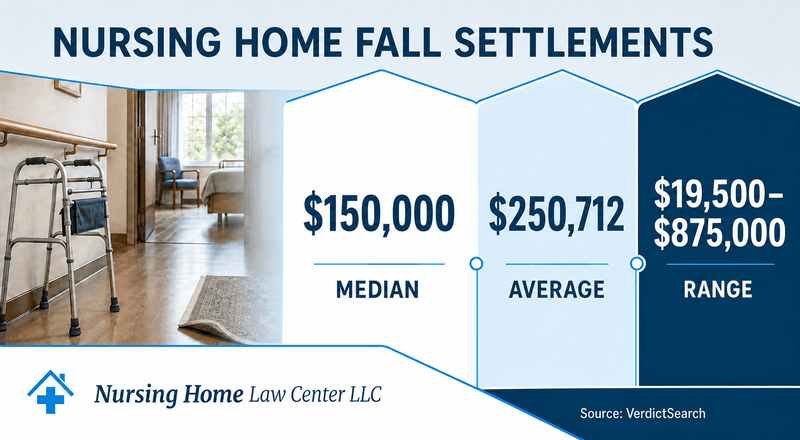
According to national case data reported by VerdictSearch, the average nursing home settlement for fall-related injuries is $250,712. This figure reflects a wide range of outcomes, from $19,500 to $875,000, depending on the severity of the injury and the strength of the evidence against the facility.
The median nursing home settlement, however, is $150,000, a figure that often better reflects a typical case, since it isn’t skewed by the small number of very high-value serious-injury or wrongful-death lawsuits that pull the average settlement upward.
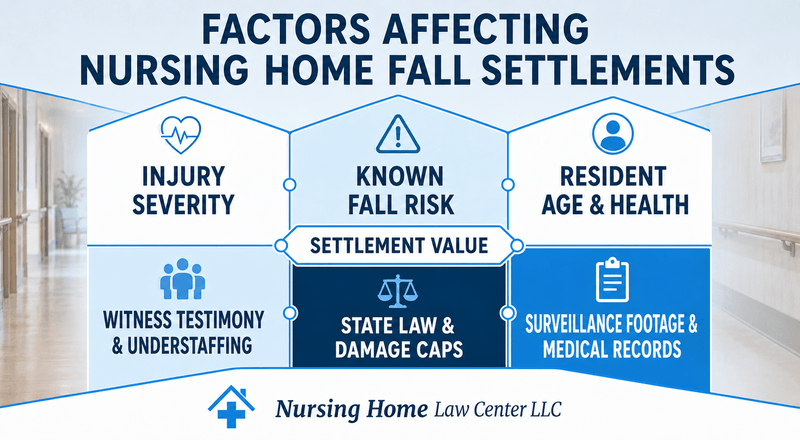
Nursing home fall lawsuit value depends on the injury’s severity, from minor fractures requiring brief medical treatment to a broken hip, subdural hematoma, or wrongful death.
Value also hinges on whether the facility had notice of the resident’s fall risk through documented gait issues, prior falls, or a care plan calling for supervision. The resident’s age and health also shape value, along with witness testimony confirming understaffing, applicable state law and damage caps, and the availability of surveillance footage and complete medical records to support a nursing home negligence claim.
Below you can find elder abuse settlement examples involving nursing home and assisted living falls. These cases illustrate how injury severity, facility negligence, and available evidence shape the outcome of a nursing home fall lawsuit.
An 84-year-old Pennsylvania long-term care resident fell out of a wheelchair while being driven back to her facility after a medical appointment. She suffered a cervical fracture and an aggravation of a prior spinal fracture, then developed a stroke and died weeks later.
The family brought a nursing home wrongful death claim, alleging staff failed to secure her in the transport vehicle properly and that the driver failed to call 911 after the fall, instead attempting to reposition her before continuing the drive. The connection experts drew between the fall and the resident’s fatal stroke significantly increased the settlement value.
A 76-year-old resident was admitted with a physician’s order requiring a lap belt restraint following brain surgery. A staff member failed to transcribe the restraint order, leaving him unrestrained. He fell on two separate occasions, developing a subdural hematoma after the second fall that led to his death.
The Ohio lawyers handling this nursing home wrongful death case focused on the transcription error and the facility’s failure to catch it before either fall occurred. The nursing home’s own admission that the order had been omitted significantly increased the settlement value.
A 63-year-old Massachusetts group home resident fell down a flight of stairs that lacked a safety gate. The fall caused a fractured neck and resulted in permanent quadriplegia.
A Boston nursing home neglect lawyer built the resulting claim around the facility’s failure to install a basic safety barrier despite housing residents with cognitive and physical limitations.
An 82-year-old Ohio nursing home patient, who was fully dependent on staff for her care, fell while using a portable toilet and struck her head, resulting in bilateral subdural hematomas. She died two days later.
This nursing home settlement’s value was shaped by the severity of the bilateral brain injury and the facility’s acknowledgment of her total-care needs at the time she was left alone.
An 82-year-old assisted living resident fell from a Hoyer Lift during a bed transfer, sustaining a femur fracture, a foot fracture, and a resulting gangrenous infection.
The Pennsylvania attorneys appointed to this nursing home negligence claim alleged staff had not been properly trained on lift use, with one staff member admitting she had never received training. Settlement value was substantially increased by staff admissions of inadequate training and a prior citation the facility had received for improperly securing nursing home patients during lift transfers.
A 68-year-old patient recovering from a stroke fell while attempting to reach the bathroom on his own after repeatedly pressing his call button without a response. He suffered a tibial fracture that required two surgeries after an initial external fixation failed.
His Pennsylvania nursing home lawyers alleged staff failed to recognize him as a known fall risk despite his care needs.
A facility resident in her 80s rose from her wheelchair unsupervised and fell, suffering a subdural hematoma, a pelvic fracture, and later requiring hip replacement surgery. She died two weeks later.
The family’s New York nursing home neglect attorney initiated a wrongful death lawsuit alleging chronic understaffing left her unattended despite a documented history of falls. Settlement value was driven by evidence of facility understaffing, prior complaints from the family about inadequate supervision, and the connection between the fall and her death.
A 78-year-old nursing home resident suffered a femur fracture during a bed-to-wheelchair transfer performed by a certified nursing assistant.
The estate’s Virginia nursing home lawyer, who led this negligence claim, argued the facility failed to take adequate precautions to prevent the fall.
A 90-year-old Massachusetts nursing home occupant fell from her bed and struck her head after a cushioned safety mat was not transferred with her to a new care unit. She suffered a cerebral hemorrhage and died three weeks later.
The nursing home lawyers handling the family’s wrongful death claim alleged the facility knew she was on blood thinners and at increased risk of falling, yet failed to carry over a basic safety measure when she changed units.
An 87-year-old resident fell while descending a bus ramp during a facility-organized outing, sustaining broken bonesand a lung injury that led to pneumonia. She died 17 days later.
The New York City nursing home abuse lawyers who reviewed the case focused on the facility’s failure to assist and supervise her, despite her known difficulty ambulating.
A 71-year-old nursing home resident with prosthetic legs injured his forehead and both arms in a fall from his wheelchair during a medical appointment transfer. After a few weeks, he fell again, resulting in a fractured neck and diminished capacity to ambulate and care for himself. He died seven months after admission to the nursing home.
The South Carolina nursing home lawyers representing his estate alleged the facility knew he was a fall risk yet failed to implement adequate precautions across both incidents. Settlement value reflected the compounding effect of repeated falls due to a single known risk factor the facility failed to address.
An 87-year-old New York nursing home resident with dementia fell after wandering from her bed. The claim centered on the facility’s supervision of a resident with a known cognitive impairment affecting her safety awareness.
Settlement value reflected the facility’s responsibility to monitor residents with dementia who are prone to unsupervised movement.
An 83-year-old Massachusetts nursing home resident with Alzheimer’s disease fractured her humerus after falling from her bed.
The nursing home negligence claim alleged the facility’s own evaluation called for alarms and raised bed rails that were not properly in place, despite two prior falls.
An 80-year-old Ohio nursing home resident fell while attempting to reach the restroom unassisted, sustaining a head laceration and a subdural hematoma requiring surgery.
The Cleveland nursing home abuse lawyers who led the case alleged a nurse responded to his call for assistance but failed to provide prompt assistance.
Nursing home falls happen when a patient slips because a facility does not align its supervision and safety measures with a resident’s actual needs.
Some residents have unsteady gait or muscle weakness. Some are on medications that cause dizziness or low blood pressure. Others suffer from dementia or confusion that leads them to attempt to walk or transfer without assistance. In every case, the facility is responsible for identifying fall risk and implementing safeguards before an incident occurs.
Common causes of nursing home falls include understaffing, inadequate supervision, poor staff training, failure to respond promptly to call lights, and improperly maintained equipment, such as wheelchairs, bed rails, and walkers. Wet floors, poor lighting, cluttered walkways, and broken handrails also contribute to preventable falls.
A facility’s failure to update a resident’s care protocols after a prior fall, or its failure to use bed alarms, non-slip footwear, or transfer belts for residents who need them, often reflects a broader pattern of nursing home neglect.
Falls can also result from improper transfers, when staff attempt to move a resident without enough help or without following proper lifting techniques. Furthermore, medication errors that cause sudden drops in blood pressure or excessive sedation can increase fall risk.
In some cases, a nursing home fails to reassess a resident’s mobility needs after surgery, illness, or a change in health status, leaving that resident vulnerable to a fall that could have been prevented.
Falls are also a serious concern in assisted living facilities, where residents often have more independence but may still require monitoring for balance issues or cognitive decline. When a facility accepts residents with known mobility limitations, it assumes responsibility for monitoring fall risk and responding with appropriate safety measures.
The warning signs that a nursing home resident may be at risk for a fall are often visible well before an incident occurs, especially for residents with cognitive impairment or mobility limitations. Family members should watch closely for changes in condition during visits.
Signs that a resident may be at elevated fall risk include:
Falls in nursing homes rarely cause a single, isolated injury. Instead, your loved one’s injuries from a fall may result in a cascade of medical complications that shape both their recovery and the value of a nursing home lawsuit settlement.
A nursing home fall lawsuit depends on evidence showing what the facility knew about a resident’s fall risk, what precautions were required, and whether staff failed to act on that knowledge.
Medical Records
Facility and Staffing Records
Family and Environmental Evidence
Gathering these medical records and facility documents early is critical, since nursing homes are not always required to preserve incident reports and surveillance footage indefinitely. Consulting an experienced legal team early on ensures the right records are requested before they’re lost.
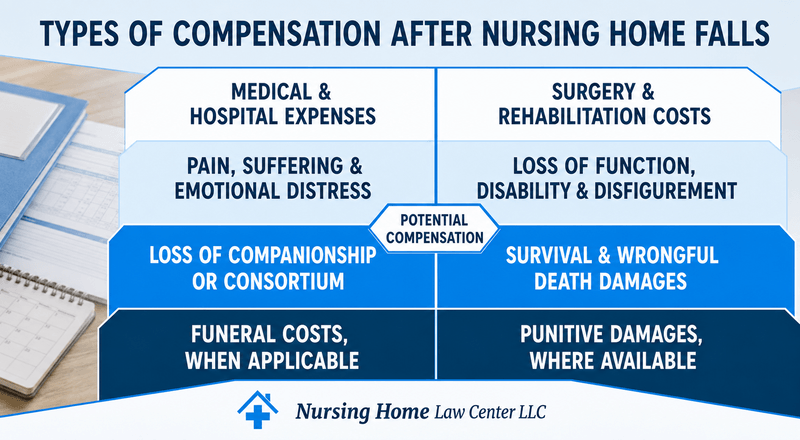
The financial relief available when a patient falls depends on the severity of the injuries, applicable state law, and the strength of the evidence against the facility. Families whose loved one suffered abuse or a preventable fall may be entitled to recover several categories of damages.
Depending on the facts of the case, financial compensation in a nursing home settlement following a fall may include:
A nursing home resident who survived a fall and retains legal capacity can file a lawsuit on their own behalf. When the resident cannot act due to cognitive decline or incapacity, a legal guardian, conservator, or someone holding power of attorney may be authorized to pursue a claim on the resident’s behalf, depending on state law.
If the resident died as a result of injuries sustained in a fall, the authorized representative of the resident’s estate typically must bring a wrongful death claim rather than a standard injury lawsuit.
Determining exactly who has standing to sue a nursing home can be complicated, particularly when multiple family members are involved or when the resident did not leave a will. A nursing home fall attorney can help identify who is legally authorized to file the claim and ensure the lawsuit is brought correctly from the start.
The deadline to file a nursing home fall lawsuit varies by state, typically between one and three years from the fall or its discovery. Some states apply a “discovery rule,” starting the clock when the family reasonably connects the injury to the facility’s conduct. Wrongful death claims typically carry similar deadlines measured from the date of death.
Families should consult a legal team as soon as possible after a fall, since missing a filing deadline can permanently bar a claim and delays can also mean lost evidence or faded witness memories.
Before accepting any settlement offer, families should take several steps to protect the resident’s rights and strengthen the value of their claim.
Most nursing home fall lawsuits settle before reaching trial. Still, a fair settlement typically requires a thorough investigation, careful record review, expert input, and negotiation with the facility’s insurer or defense counsel.
Here’s how our nursing home fall attorneys typically handle a case:

Our nursing home attorneys have secured fair compensation for elderly nursing home residents and families harmed by preventable falls in nursing facilities. Below are a few examples of nursing home abuse lawsuit settlements we’ve obtained for our clients.
An 82-year-old resident with a history of unsteady balance fell in his nursing home room after staff failed to respond to his call light. The fall caused a hip fracture and a subdural hematoma requiring emergency surgery.
The settlement value was higher than the average payout for a broken hip, reflecting the severity of his combined injuries, the medical bills tied to his emergency surgery and extended care, and evidence we uncovered showing a delayed staff response worsened his decline.
Dorothy, a 79-year-old resident, was left unattended in her wheelchair near a nurses’ station when it rolled and tipped, causing a broken leg and compression fractures to her spine.
We helped her family hold the facility accountable by building the case on why staff left her wheelchair unlocked despite her known need for close monitoring. The settlement value was formed by multiple broken bones and the staffing failure our team uncovered.
Frank, a 76-year-old wheelchair-bound resident, fell down his facility’s front stairs after staff forgot to engage his wheelchair’s wheel locks, suffering facial fractures and a subdural hematoma.
Our legal team pointed to the fall’s preventable nature and the facility’s failure to follow routine safety protocols.
Margaret, a 74-year-old assisted living resident using a walker, was told by a CNA to use the stairs instead of waiting for a nearby handicapped lift. She fell and sustained facial fractures and a torn rotator cuff requiring two surgeries.
We built her case around why staff bypassed the accessible option available to her. Settlement value was affected by the need for multiple surgeries and the clear failure to accommodate her mobility needs.
If your loved one suffered a fall in a nursing home or assisted living facility, your family deserves to know whether it can hold the facility accountable. An attorney from the Nursing Home Law Center can review your loved one’s fall, identify who’s liable, determine whether legal action may be available for nursing home abuse, neglect, or wrongful death, and guide you through the legal process.
Our nursing home fall attorneys handle personal injury cases on a contingency-fee basis, meaning you can sue a nursing home and pay no attorney fees unless we recover financial relief for you. To speak with an experienced lawyer about a possible legal action, call (800) 926-7565 or complete our online contact form.