
Experienced Attorneys Protecting the Rights of the Neglected and Abused
The Nursing Home Law Center is committed to providing the legal resources necessary to hold negligent facilities accountable.

Nursing home elopement settlements provide financial relief when a facility fails to prevent residents from wandering away unsupervised, exposing them to falls, dehydration, traffic accidents, or even death.
Elopement in nursing homes is often preventable because the facility carries the responsibility to identify elopement risks, maintain door alarms and security measures, and monitor residents with cognitive or physical impairments.
Settlement value depends on how the nursing home failed the resident and how the incident affected the resident and family members.
Our nursing home elopement lawyers review incident reports and staffing records to determine whether neglect caused serious harm. Contact us for a free case evaluation.
According to case data published by VerdictSearch, the average nursing home lawsuit settlement involving elopement is $801,908. The median settlement is $475,000, representing a more accurate picture of what most families recover once legal action concludes.
The gap between the average and median exists because a smaller number of high-value cases involving catastrophic injury or wrongful death pull the average upward, while most settlements cluster closer to the median. That spread becomes clearer when looking at the full range, as settlement amounts for nursing home elopement cases run from $110,000 to $4,900,000.

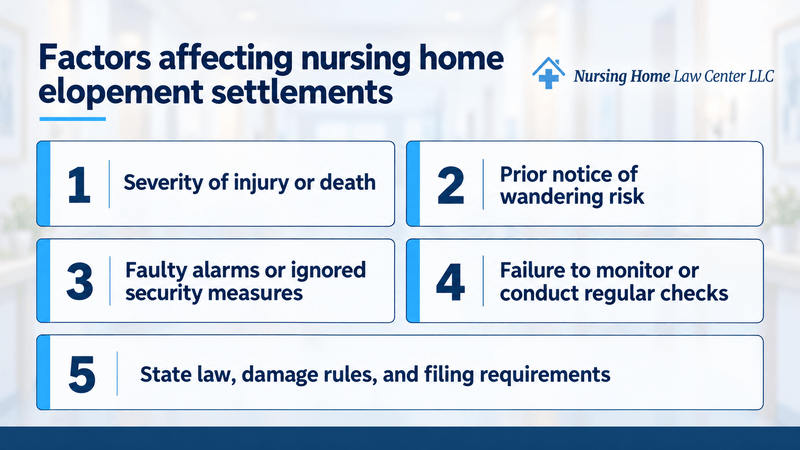
The value of a nursing home elopement lawsuit depends heavily on the severity of the outcome.
Lower-value cases may involve a resident who wandered off the nursing home facility but was located quickly and unharmed. Higher-value nursing home elopement cases typically involve serious injuries, prolonged exposure to weather, traffic accidents, drowning, or death after a resident wandered undetected for hours or days.
Settlement value also depends on whether the nursing home had prior notice that the resident was a high risk for wandering. Care plans noting a history of confusion, Alzheimer’s, or previous attempts to leave the facility can establish that nursing home staff members knew the resident needed closer supervision.
The condition of the facility’s safety protocols also plays a major role. Evidence that alarms were faulty, security measures were ignored, or staff members failed to conduct regular checks can significantly increase settlement value. Courts and insurers weigh these facts against how foreseeable the elopement was and how easily it could have been prevented.
Finally, state law affects settlement value. Damage rules, filing requirements, and negligence standards vary by jurisdiction. Assisted living facilities are generally regulated under state law, while federally certified nursing homes are also subject to federal requirements.
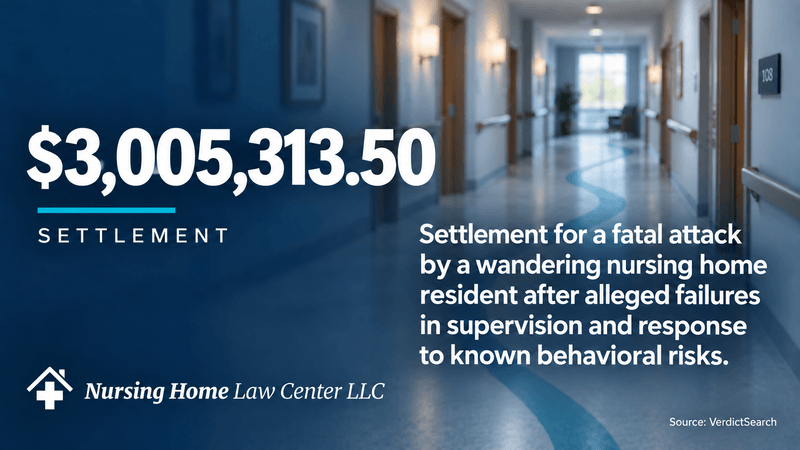
An elderly person residing in a nursing home was pulled from her bed by a fellow resident. The aggressive resident had a documented history of wandering and psychotic behavior, including mistaking his own male roommate for his wife and trying to pull him from bed. The victim lost a significant amount of skin from her arm due to her thin, fragile skin, and died several days later from related complications.
Her surviving adult children brought a nursing home wrongful death claim, alleging inadequate staffing and supervision. The Texas nursing home lawsuit lawyers working on this resident-to-resident nursing home abuse case argued the facility should have recognized the risk given the pattern of wandering and prior incidents.
A 78-year-old nursing home facility resident with Alzheimer’s was admitted to a nursing home with a documented history of wandering due to his cognitive impairment. He left the facility unnoticed one evening and was struck by a semi-truck on a nearby interstate the next morning. He survived, but the accident left him needing a wheelchair and a permanent feeding tube, and he died roughly two years later.
The Georgia nursing home neglect lawyers representing his estate alleged the facility didn’t prevent a known elopement risk, leading to a catastrophic decline in the resident’s health.
A 91-year-old nursing home resident wandered out of the facility on her second night there. Staff brought her back and restrained her without a doctor’s order, keeping her restrained for 55 days without proper authorization. Weakened by the prolonged restraint, she suffered repeated falls and a serious neck injury.
The Austin nursing home abuse lawyers who helped pursue accountability in this case alleged the facility failed to supervise a resident with a known elopement risk and delayed reporting the initial incident.
A 76-year-old nursing home resident with dementia and Alzheimer’s was frequently observed wandering throughout the facility and its grounds despite doctors’ orders requiring close monitoring. He fell while trying to move a chair, striking his head, and was later found on the floor near his bed with a large subdural hematoma. He died soon after.
The nursing home wrongful death lawyer representing his widow and daughter alleged that the staff was negligent for not following doctors’ orders requiring close monitoring and restraints, and the facility failed to provide a safe environment for a resident with known wandering risks.
An 80-year-old nursing home resident with dementia wandered out the front door of the facility unnoticed and onto a nearby highway, where he was struck by a vehicle. He suffered broken bones and a head injury, and died months later.
The Missouri nursing home abuse attorneys who pursued the claim on the family’s behalf sought damages covering his medical bills along with wrongful death damages, alleging the facility’s manager failed to activate the alarm on his door and lacked training to assess residents with a known wandering history.
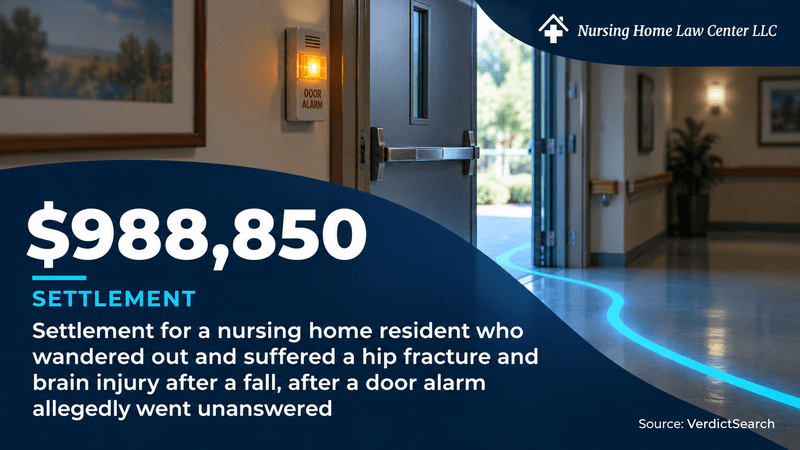
An 81-year-old nursing home resident with dementia wandered out the front door of her facility, setting off a door alarm that went unaddressed by nurses. She was found twenty minutes later, several houses away, after falling on the sidewalk. The resident sustained a hip fracture and a brain injury requiring surgery.
The Anaheim nursing home neglect lawyers claimed a caregiver ignored the alarm because they were on the phone.
An 88-year-old nursing home patient with dementia and a history of stroke was repeatedly observed wandering by staff, who created no care plan to address the risk. She went missing from her room and was found roughly fifteen hours later on the facility’s roof, dead from hypothermia.
Her son alleged nursing home staff members ignored a broken lock on a restricted door and a pattern of prior elopement incidents. The Pittsburgh nursing home abuse attorneys working on this case also pointed to a history of ignored safety violations.
A 41-year-old quadriplegic nursing facility resident who used a motorized scooter left the premises unnoticed and was later found unconscious in the facility’s courtyard after ingesting an illicit substance. He was hospitalized and suffered a fatal cardiac arrest.
His daughter, represented by a New York nursing home abuse lawyer, argued the facility was liable for failing to notice his departure.
A 73-year-old Texas retirement home resident with Alzheimer’s disease and a known pattern of wandering fell down a flight of stairs and was found the next morning with a broken wrist and pelvis. She never fully recovered and died about six months later.
Her son’s Fort Worth nursing home abuse lawyers alleged the facility disarmed a stairwell alarm and failed to place her in a locked unit despite assurances one would be provided.
An 84-year-old Georgia nursing home resident with late-stage Alzheimer’s got through an unlocked exit door at night and fell in the dark about fifty feet from the facility, suffering a serious injury to her head. She died less than three months after the incident.
The Atlanta nursing home abuse lawyers representing her children alleged the facility failed to maintain adequate security and that a contractor had improperly repaired the door’s locking system.
A 75-year-old nursing home resident with dementia wandered through an unlocked door with a non-functioning alarm and fell down a flight of concrete steps, suffering brain contusions and fractured ribs. He never fully recovered and died several months later.
His family had specifically requested placement in the facility’s secure dementia unit before the incident. The lawyers appointed to this case alleged the nursing home failed to adequately train staff and maintain a working alarm system.
A 90-year-old nursing home resident with end-stage Alzheimer’s disease was found in the facility’s parking lot with an injury on her head and died five days later. Her family had been assured that alarms covered every exit door, but the front entrance, staffed by a receptionist, had none installed. No one could determine exactly how she left the building unnoticed.
The Virginia nursing home neglect lawyers alleged the facility misrepresented its security measures and failed to prevent a known wandering risk.
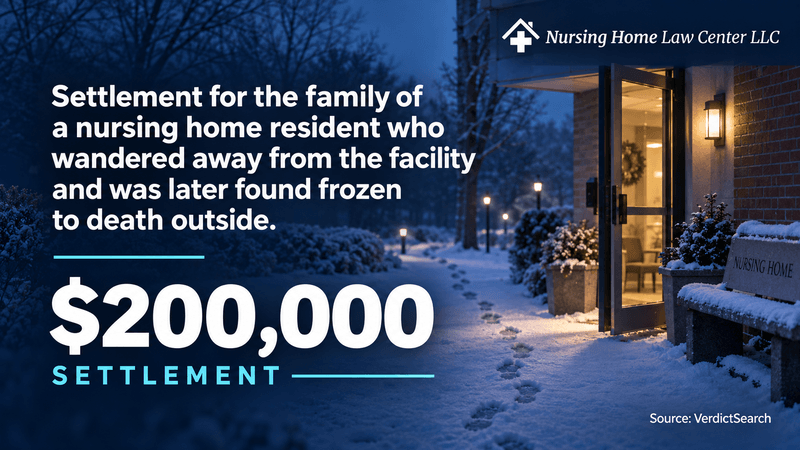
A 94-year-old nursing home resident wandered away from her facility and was found the next day frozen to death just outside the back door.
The Michigan nursing home abuse lawyers who took the case alleged the nursing home staff failed to provide the supervision needed to keep a resident with known wandering tendencies from leaving the building undetected in cold weather.
A 79-year-old nursing home resident with Alzheimer’s disease and cancer wandered away from her facility about a month after admission, despite her son’s earlier warning that she was a known elopement risk. She was found half a mile away with a facial injury and a shoulder fracture.
The Massachusetts nursing home neglect attorneys alleged the facility failed to use a promised wander-alarm device to keep the resident safe despite assurances of extra safety measures at admission.
Nursing home elopement occurs when a facility fails to match supervision and security measures to a resident’s actual risk level.
Vulnerable residents with dementia, Alzheimer’s disease, or other cognitive or physical impairments experience confusion, disorientation, or an instinct to search for a past home, job, or family member. Without proper safeguards, these residents can walk, wheel, or wander straight out of a building unnoticed.
Common causes of elopement in nursing homes include inadequate staffing, poor staff training, faulty or broken alarms, unlocked exits, malfunctioning security systems, and failure to update a resident’s care plan after a known wandering incident. A nursing home may fail to meet its duty of care when staff members do not conduct appropriate checks or fail to identify and address known elopement risks during resident assessments.
Family and staff members should watch closely for changes in behavior, especially in residents with dementia, Alzheimer’s, or other forms of mental impairment.
Signs that a resident may be a high risk for elopement include:
Failing to act on these warning signs is a common thread in nursing home wandering cases that lead to serious injury.
Below are some of the most common outcomes our nursing home injury lawyers have linked to nursing home elopement cases.
The types of damages available depend on state law and the severity of the resident’s injuries.
Depending on the circumstances, compensation may include:
An experienced nursing home abuse lawyer can help determine which damages apply to a specific case and pursue the full compensation the family deserves.
If the resident survived the elopement incident and has legal capacity, they may file a nursing home lawsuit on their own behalf. When the resident cannot act due to physical or mental impairments, a guardian, conservator, or agent under a power of attorney may be able to bring the claim depending on state law.
If the resident died as a result of the elopement, a personal representative of the estate typically must file the claim under the state’s wrongful death and survival statutes. Any recovery is generally distributed among the surviving spouse, children, or other statutory beneficiaries as determined by state law.
A nursing home neglect lawyer can help identify who has legal authority to file and ensure the claim is brought correctly and on time.
Deadlines for nursing home negligence claims vary by state, generally ranging from one to three years from the date of the injury or, in a fatal case, from the date of the resident’s death. Some states extend this deadline when the harm was not immediately discovered, particularly in cases where a facility’s safety failures only come to light later.
Wrongful death claims may follow separate rules from general personal injury deadlines, so the applicable timeframe can vary depending on the specific facts of the case and where the facility is located.
Because evidence such as door alarm logs, staffing records, and witness memories can fade or disappear over time, it’s important to act as soon as possible after a suspected nursing home elopement incident.
Our process typically includes:
If your family is dealing with the aftermath of a nursing home elopement incident, contact Nursing Home Law Center to speak with an experienced nursing home abuse lawyer who can evaluate your case and guide you through the next steps.
A nursing home resident wandered away from a supervised common area and fell in an unmonitored hallway, striking her head on the floor. She suffered a subdural hematoma along with a hip fracture, requiring emergency surgery and an extended hospital stay.
The case centered on whether the facility maintained proper staffing and individualized care plans designed to prevent a known wandering risk from reaching an unsupervised part of the building.
Settlement value was influenced by the severity of her injuries, the facility’s poor supervision policies, and evidence that closer monitoring could have prevented the fall entirely.
A nursing home resident with dementia and a documented history of wandering left her assigned area unnoticed and gained access to an unlocked storage closet containing cleaning chemicals. Staff did not notice the patient leaving the area before she ingested a toxic substance. She was rushed to the hospital but did not survive.
The case focused on whether the facility failed to secure hazardous materials in an area accessible to a known elopement risk.
The settlement reflected the facility’s failure to maintain adequate care and basic safety measures for a resident prone to wandering into unsupervised or restricted areas, along with the preventable nature of her death.
If your loved one suffered serious injuries or died after wandering away from a nursing home or assisted living facility, our legal team can review medical records and facility documentation to determine whether nursing home neglect contributed to the incident, identify the facility accountable, and explain your legal options.
Our nursing home elopement lawyers work on a contingency-fee basis, meaning you pay no attorney fees unless we recover compensation for you. To speak with an experienced attorney, call (800) 926-7565 or complete our online contact form to schedule your free consultation today.