
Experienced Attorneys Protecting the Rights of the Neglected and Abused
The Nursing Home Law Center is committed to providing the legal resources necessary to hold negligent facilities accountable.

42 C.F.R. § 483.25(g)(2) requires facilities to ensure that residents are offered sufficient fluid intake to maintain proper hydration and health. If your loved one became dehydrated because staff failed to offer fluids, monitor intake, recognize warning signs, or provide the assistance the resident needed to drink safely, a nursing home dehydration lawyer from Nursing Home Law Center can help you seek justice and hold the facility accountable.
Dehydration is a common issue among older adults, with studies estimating it affects 20% to 30% of this population.
A systematic review of 19 studies revealed that prevalence rates of dehydration varied between 0.8% and 38.5%, measured using different methods. Of the studies differentiating between acute and chronic dehydration, the first was estimated in ranges between 22.8% and 35.2%, while the latter was between 8.3% and 34.7%.
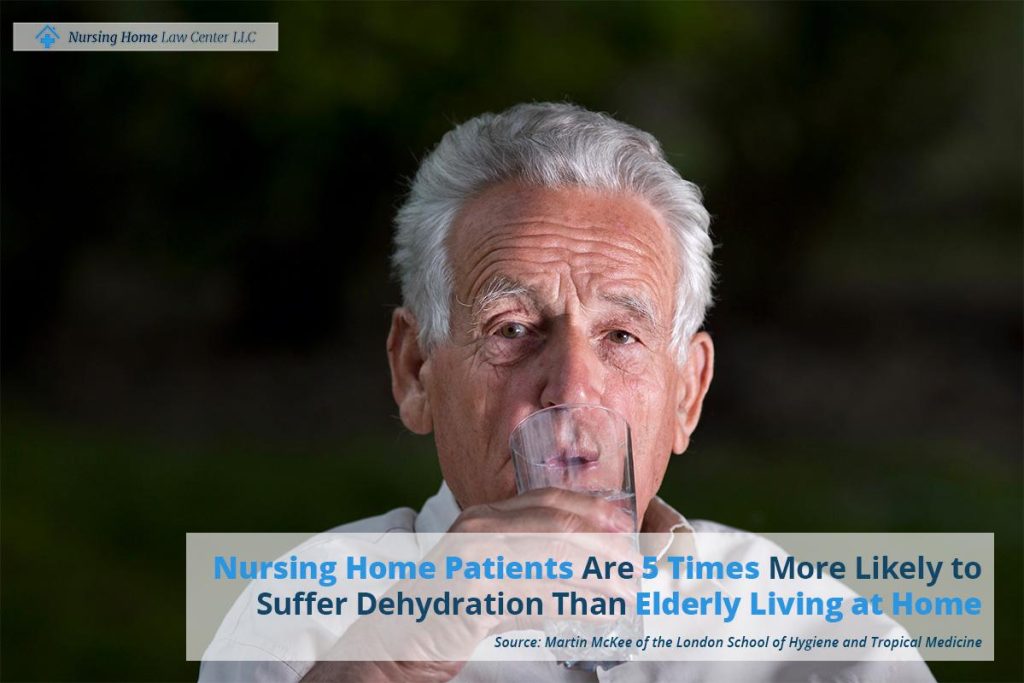
Inadequate fluid intake is prevalent in nursing homes, with research indicating that 39 out of 40 residents consumed less than 1,500 mL of fluids per day, which is below recommended levels. The study further found that 25 out of those 40 nursing home residents suffered from diseases that may have been caused or worsened by dehydration.
Common signs of dehydration among nursing home patients include:
Some nursing home residents face a much higher dehydration risk because they cannot reliably maintain fluid intake on their own. Those often include:
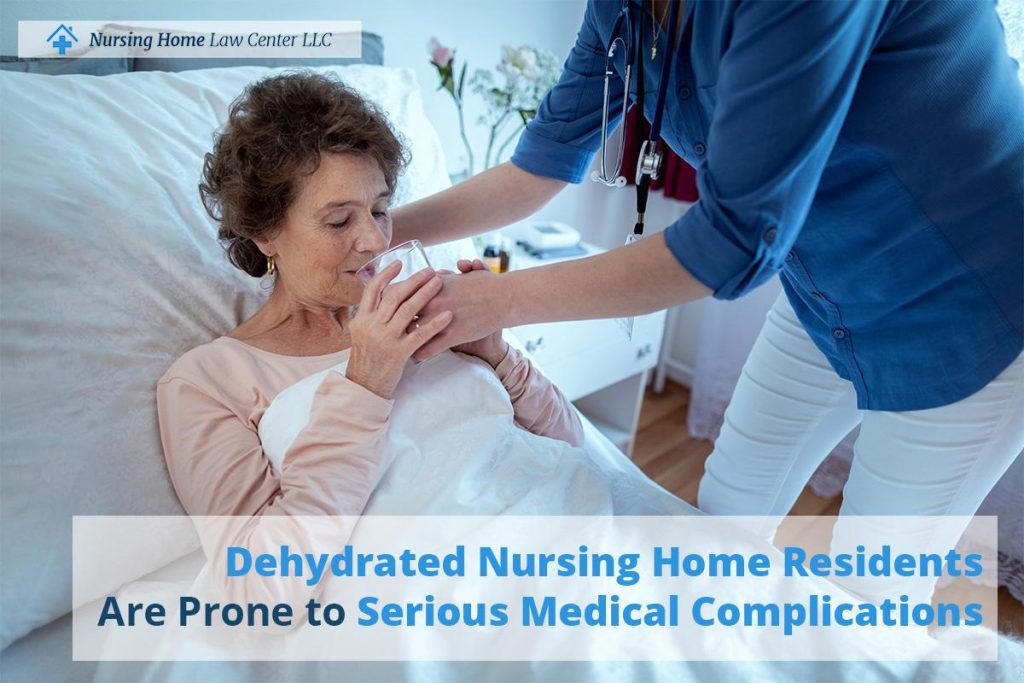
Dehydration poses serious health problems for residents of advanced age, often leading to severe medical conditions, life-threatening complications, and even death. When residents do not receive adequate hydration and proper nutrition, their bodies become more vulnerable to illness, organ failure, and other critical health issues, such as:
Dehydration might constitute nursing home neglect in cases involving:
Yes, a nursing home dehydration lawsuit can be filed if a nursing or assisted living facility fails to provide adequate hydration and nutrition. Negligent nursing homes can be held liable if staff neglect a resident’s dietary needs, fail to monitor fluid intake, or ignore clear signs of dehydration.
To establish negligence, the claim must prove that the nursing home failed to uphold its duty of care, directly causing harm or even wrongful death. Medical records, witness statements, and expert testimony can serve as critical evidence.
A nursing home abuse attorney can assist in proving liability, navigating dehydration and malnutrition lawsuits, and helping families recover compensation for medical costs, pain, and suffering.
Federal and state regulations require nursing homes to meet basic care standards, and failure to do so may constitute negligence or elder abuse.
Per 42 CFR § 483.25(g), which regulates nutrition and hydration standards:
According to 42 CFR § 483.60, which sets the standards for food and nutrition services:
The Omnibus Budget Reconciliation Act of 1987 (OBRA) – Nursing Home Reform Act mandates that:
The Centers for Medicare & Medicaid Services (CMS) inspects nursing homes for compliance with hydration and nutrition standards. Facilities cited for dehydration-related neglect may receive deficiency citations and be required to take corrective action.
Many state health departments impose additional hydration monitoring requirements. Some states require specific fluid intake protocols for residents at risk of dehydration, including those with dysphagia, dementia, or kidney disease. State health surveys inspect facilities for dehydration-related neglect and issue penalties for violations.
Dehydration is often classified as nursing home neglect or elder abuse if a facility fails to provide proper fluids or ignores warning signs. Families can file complaints with state agencies or pursue legal action for medical negligence.
If dehydration leads to severe harm or a resident’s death, families may sue the nursing home for gross negligence. Compensation may cover medical expenses, pain and suffering, and funeral costs.
A nursing home dehydration lawyer can assist in holding facilities accountable, ensuring victims and families receive the justice and compensation they deserve.
Federal agencies play a crucial role in nursing home negligence cases of dehydration.
The Centers for Medicare & Medicaid Services (CMS) oversees nursing homes and ensures compliance with hydration and nutrition standards. Families can file complaints through their state’s survey agency.
The U.S. Department of Health and Human Services (HHS) – Office for Civil Rights (OCR) also investigates neglect-related complaints, including inadequate hydration. Complaints can be filed online or by calling 1-800-368-1019.
Another important resource is the Long-Term Care Ombudsman Program, which advocates for residents’ rights and investigates inadequate care. Residents and families can find their state’s Ombudsman office online.
At the state level, State Health Departments & Survey Agencies regulate and inspect nursing homes under CMS guidelines, identifying hydration and nutrition violations. Reports can be filed through their website.
Adult Protective Services (APS) investigates elder neglect and abuse, including dehydration-related neglect cases. APS offices can be found online.
In severe cases of dehydration, leading to harm or death, the State Attorney General’s Office – Elder Abuse Unit may handle the case. Families can find their state’s Attorney General elder abuse divisiononline or report concerns through State Elder Abuse Hotlines
For cases involving criminal neglect or wrongful death, local law enforcement may be involved. Emergencies should be reported to 911, while non-emergency neglect reports can be filed with local police or sheriff’s offices.
Families may also consider private legal action by filing a nursing home dehydration lawsuit against the facility. An experienced hydration neglect lawyer from the Nursing Home Law Center can help assess the case, determine liability, and pursue compensation.
If dehydration in a nursing home leads to injury or death, a nursing home dehydration and neglect lawyer can help establish liability and pursue compensation. The first step is proving that the facility had a duty of care toward the resident. Nursing homes are responsible for ensuring the well-being of residents, and this duty is outlined in contracts, state regulations, and federal laws.
Once the duty of care is established, it must be shown that the nursing home breached this duty by failing to provide adequate hydration. This could involve neglecting to monitor fluid intake, ignoring signs of dehydration, or failing to follow dietary requirements.
After proving a breach, the next step is demonstrating that this failure caused harm or death. Evidence such as medical records, witness statements, nurse reports, and video footage may be used to link the nursing home’s negligence to the injury or wrongful death.
Our legal team will then negotiate a settlement to secure compensation for the victim or their family. Settlements may cover medical expenses, pain and suffering, loss of enjoyment of life, and wrongful death damages. If negotiations fail, our senior dehydration attorneys will continue seeking justice and financial recovery by filing a nursing home abuse lawsuit in court.
The evidence we use to prove negligence in a nursing home dehydration lawsuit includes:
The settlement in nursing home neglect cases involving dehydration is $2,378,925.
$900,000 Settlement
A nursing home resident receiving chemotherapy allegedly suffered toxic overdoses after staff mis-transcribed the prescribing doctor’s orders and failed to catch the effects in time. According to the elderly dehydration attorney handling the case, the reported complications included severe dehydration due to diarrhea and vomiting, loss of appetite, mental-status decline, and skin rashes causing severe pain, all of which pointed to a serious breakdown in medication management and monitoring. After hospital transfer and extensive treatment, the resident died.
$415,000 Settlement
An elderly nursing home resident was hospitalized with elderly malnutrition, severe dehydration, and a Stage IV pressure ulcer, then died later that month. The senior dehydration lawyer handling the case alleged the facility failed to provide adequate care, including proper assessment, repositioning, and monitoring, which allowed the ulcer to worsen, become infected, and contribute to her death. The claim tied the resident’s decline to neglect that likely involved insufficient fluid intake and failures in basic care needed to maintain health.
$350,000 SettlementAn elderly nursing home resident suffered a femur fracture during staff transport, and her condition declined rapidly afterward. She was later found to have a urinary tract infection, dehydration, and acute kidney failure, and then died days later in hospice. The senior dehydration law firm handling the case alleged the facility failed to provide adequate care through poor care planning, insufficient staff training and supervision, and unsafe transport practices. It also argued that the resident’s dehydration and infection contributed to her death, making the case part fall injury and part wrongful death lawsuit.
To prevent dehydration, nursing homes must implement strict protocols, such as:
If your elderly loved one has experienced dehydration due to nursing home abuse or neglect, you may be entitled to financial compensation for their medical bills, physical pain and suffering, and wrongful death damages.
At Nursing Home Law Center, we fight for victims harmed by inadequate care. Our elderly dehydration law firm has secured millions in settlements for families affected by nursing home negligence, including:
Legal action with the help of a nursing home neglect lawyer can hold nursing homes accountable and help families recover compensation for the harm caused.
At Nursing Home Law Center, we work on a contingency fee basis, meaning you pay nothing unless we win your case. Contact us today at (800) 926-7565 for a free consultation and discuss your options with a nursing home dehydration injury lawyer.
Not by itself. Dry skin can appear with dehydration, but in older adults, it is not a particularly reliable sign on its own because aging skin naturally changes and loses elasticity.
Yes. If dehydration or malnutrition becomes severe enough to cause serious complications or death, the case may support a wrongful death claim under the applicable state law.
According to Johns Hopkins University, recovery from severe dehydration depends on several factors, including the individual’s age, overall health, underlying medical conditions, and how quickly medical treatment is administered.
For mild to moderate dehydration, oral rehydration with fluids and electrolytes can lead to improvement within a few hours to a day.
However, in cases of prolonged or severe dehydration that has caused complications like low blood pressure, kidney failure, or confusion, intravenous (IV) fluids and hospitalization may be required, extending recovery to several days or weeks.
In elderly patients, full recovery may take longer, especially if dehydration has caused weight loss, muscle weakness, or cognitive decline.
Start by alerting nurses or administrators and requesting immediate hydration treatment. If symptoms are severe, demand a medical professional’s evaluation or hospitalization for IV fluids.
Make sure to record symptoms, staff responses, and medical interventions. If the facility fails to act, file a complaint with state health agencies, APS, or CMS.
If neglect caused harm or wrongful death, contact our law firm to help you seek compensation.
Yes, dehydration can lead to serious health complications, including kidney failure, urinary tract infections, low blood pressure, and cognitive impairment. Severe dehydration increases the risk of falls, pressure sores, organ damage, and even death.
Dehydration impacts multiple organs, including the kidneys, brain, heart, and skin.
Rehydration needs vary based on age, weight, and severity of dehydration. Mild dehydration can often be reversed by drinking 2–3 cups (500–750 mL) of water over a few hours. Severe dehydration may require oral rehydration solutions (ORS) or IV fluids under medical supervision.
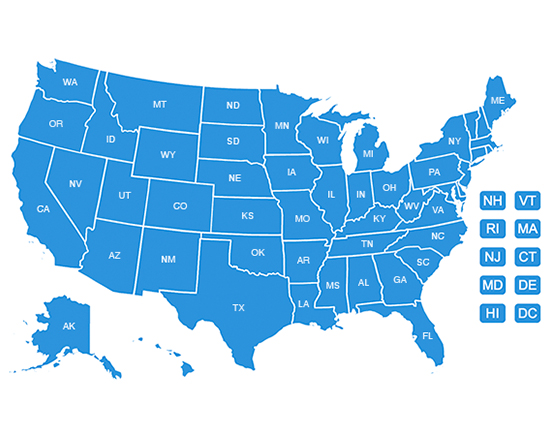
Nursing home abuse lawsuits must be pursued according to the laws set forth by the state where the facility is located. In this section, our attorneys have compiled the relevant laws, regulations and local organizations for each state so you can get an idea of how the law impacts your situation. Should you decide to move forward with a case, you will also find information about locating an experienced attorney who can assist your family.